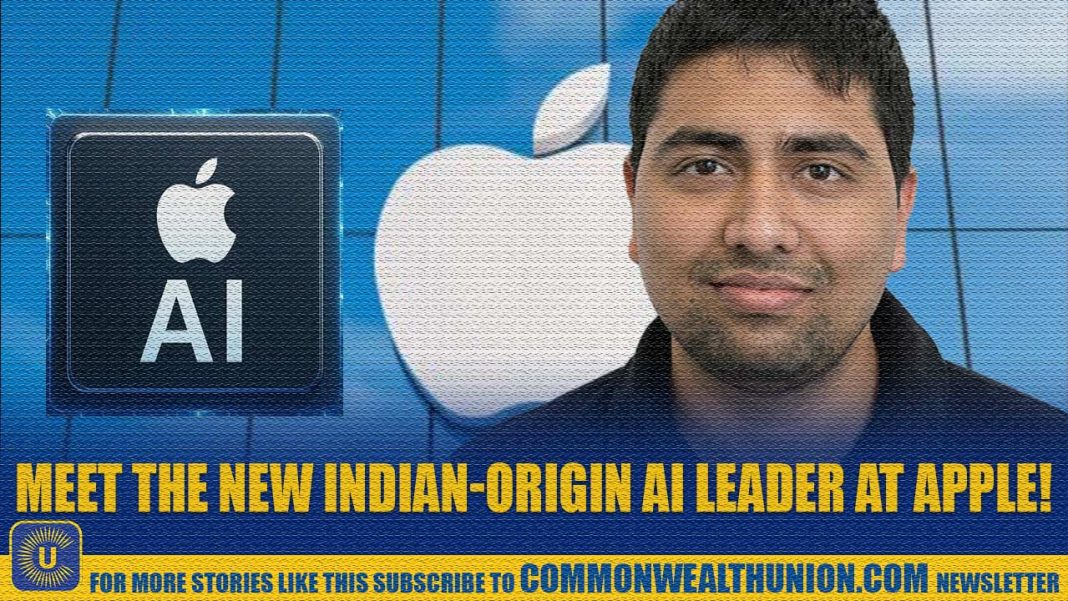

USA (Commonwealth Union)_ Amar Subramanya, an Indian-origin technologist with a long career in artificial intelligence, has taken on a pivotal new role at Apple, becoming the company’s vice president of AI. He steps into the position previously held by John Giannandrea, the veteran executive who helped guide Apple’s AI efforts for several years. Giannandrea will continue working with the company as an adviser until his planned retirement next spring. Subramanya now joins Apple as Corporate Vice President, reporting directly to Craig Federighi, Apple’s senior vice president of software engineering. Federighi oversees some of Apple’s most critical technology areas, including core AI models, search and knowledge systems, and the infrastructure that powers machine learning across Apple’s devices.
Also read: Mystery buyer revealed: Why is this Indian-origin entrepreneur buying Tata’s Seychelles villa?
Apple CEO Tim Cook described the appointment as an important moment for the company. “AI has long been central to Apple’s strategy, and we are pleased to welcome Amar to Craig’s leadership team and to bring his extraordinary AI expertise to Apple,” Cook said. In a company post announcing the move, Apple highlighted Subramanya’s track record in both developing new AI research and turning academic innovation into products used by millions, noting that his experience would play a key role in expanding Apple’s next generation of Apple Intelligence features.
Also read: Hindu heritage surges: Ram Mandir momentum spreads to Trinidad and Tobago!
Subramanya’s journey in technology began in Bengaluru, where he earned his BE in Electronics and Communication Engineering from Bangalore University between 1997 and 2001. He then moved to the United States, completing a PhD in Computer Science at the University of Washington in Seattle in 2009. His doctoral research focused on semi-supervised learning and graphical models, approaches that help AI systems learn effectively even when labeled data is scarce, a challenge the industry still grapples with today. His academic work earned him a Microsoft Research Graduate Fellowship in 2007. Alongside fellow researcher Partha Pratim Talukdar, he co-authored the book Graph-Based Semi-Supervised Learning, now widely referenced in machine-learning courses and research labs.
Also read: Indian steel magnate Lakshmi Mittal’s UK goodbye raises big questions: What’s behind the move?
Before entering academia full-time, Subramanya gained early industry experience at IBM in 2001 and spent a brief period at Microsoft around 2005, where he worked on machine-learning applications that were still in their infancy. Over the years, his research covered a wide range of areas, from speech recognition and natural language processing to entity resolution and human activity understanding, laying the foundation for the large-scale AI systems he would later help build. His most significant professional chapter unfolded at Google, where he worked for 16 years across research, engineering, and leadership roles. He joined the company in Mountain View as a staff research scientist in 2009 and steadily rose through the ranks.
After eight years, he was promoted to principal engineer, and in 2019, he became a vice president of engineering. In that role, he led engineering efforts for Google’s Gemini Assistant. Earlier this year, in July, he briefly moved to Microsoft as a Corporate Vice President of AI, marking a short but notable return to the company. His arrival comes at a pivotal moment for Apple. Under Giannandrea’s leadership, the company faced growing criticism for moving more slowly than competitors in the expanding world of generative AI. Samsung, for example, has pushed aggressive AI features into its smartphones, while Google and Microsoft have rapidly deployed large-scale AI products across search, productivity tools, and hardware. Apple’s own AI upgrades to Siri, originally expected earlier, were recently delayed until 2026. Reports also suggested that CEO Tim Cook had grown concerned about the pace of progress.
By hiring a leader with extensive expertise in both academic AI research and large-scale, real-world AI systems, Apple looks to be indicating a reinvigorated effort. Subramanya’s experience, which includes semi-supervised learning, multimodal models, and systems designed to function effectively at scale, is in line with the industry’s current trend. Major technology firms are increasingly focusing on developing powerful foundation models that can run safely on low-power devices while integrating smoothly with cloud-based applications. Apple, a firm recognized for tight hardware-software integration and a strong commitment to user privacy, may find Subramanya’s experience especially beneficial as it strives to enhance AI capabilities in Siri, on-device intelligence, and future Apple Intelligence services.