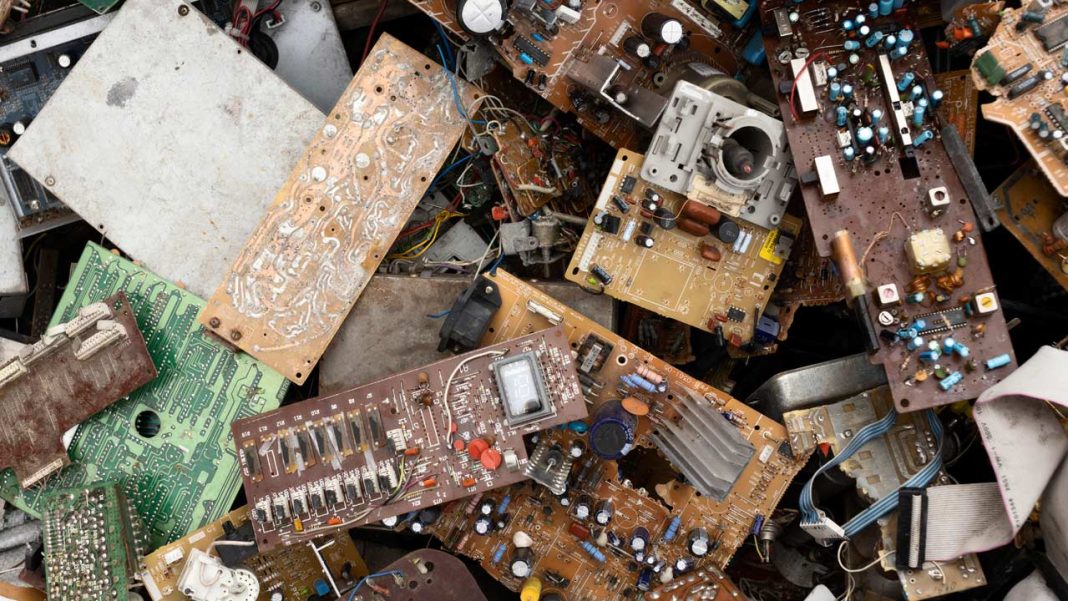

(Commonwealth_India) In a small, dimly lit room tucked away in one of northeast Delhi’s busiest alleys, 32-year-old Shahjahan sits on the floor carefully peeling insulation from old wires with a knife. Her two young children work quietly beside her, sorting bits of copper and trying not to trip over the piles of scrap that fill nearly every corner of the room.
For a day’s work, Shahjahan earns only a few hundred rupees, barely US$2. But even that income is slipping away. The supply of discarded electronics she depends on is shrinking as more and more e-waste is redirected to large, licensed recycling facilities on the outskirts of the city. “If the work disappears, what will we do?” she asks softly, giving only her first name.
Thousands in Delhi’s Seelampur district, renowned as one of India’s largest informal e-waste hubs, share her concern. For decades, families here have survived by dismantling old phones, wires, computers, and appliances, recovering whatever metal they can sell. The environmental group Toxic Links reported in 2019 that Seelampur is home to more than half of Delhi’s 5,000 informal recycling sites. Tens of thousands rely on this work.
India is now the world’s third-biggest producer of electronic waste, 1.75 million tonnes last year, government data shows, and the country wants to extract far more value from it. Copper, lithium, and rare earth metals are crucial for electric vehicles, batteries, and solar panels, and recovering them domestically has become a national priority.
Earlier this year, the government launched a US$4 billion National Critical Minerals Mission, which aims to secure mineral supplies from both domestic and overseas sources. A major part of that plan is formalizing e-waste recycling. The government is offering financial incentives to build new recycling plants, increase processing capacity by 270,000 tonnes, and produce around 40,000 tonnes of critical minerals annually. Officials also hope to create nearly 70,000 jobs in the sector.
India already recycles over 40% of its e-waste, close to rates seen in Europe and the U.S., but much of the early dismantling still happens in cramped rooms like Shahjahan’s, without safety gear, training, or secure incomes.
Swati Singh Sambyal, a circular economy expert with GRID-Arendal, warns that the informal sector cannot simply be erased in the move towards a cleaner, more regulated system. “Informal workers remain the first and most important tier of India’s e-waste chain,” she said. “Formalization must protect their rights and create pathways to better work; otherwise, the shift will deepen marginalization.” And for many in Seelampur, that marginalization has already begun.
For years, the local e-waste chain was straightforward: scrap dealers collected old electronics, households dismantled them, and neighborhood buyers purchased the extracted metals for factories. That system is now fading. Authorities have been cracking down on home-based dismantling, disconnecting electricity, issuing fines, and encouraging traders to move to industrial zones.
Workers like Mohammad Saleem are feeling the impact. Eight years of peeling wires have left his palms darkened and cut, the skin rough and hardened. Once he made around 700 rupees a day; now he barely earns 300. “The work is disappearing from these alleys,” he said outside the small home he shares with his family. Women, in particular, are losing their livelihoods. Many are unable to travel to distant industrial areas where formal plants are located, nor do they possess the necessary resources to establish their own licensed facilities.
For 28-year-old Mohammed Shadab, the shift feels especially painful. He once worked in a factory for 10,000 rupees a month but managed to build a small dismantling business that earned him up to 25,000. Now, with traders moving out and regulations tightening, he fears he will be pushed back into low-paid factory work. “I don’t have the money or information to set up a licensed plant,” he said. “It feels like my progress is being undone.”
Formal recyclers acknowledge the dependence on informal workers but say they simply can’t absorb everyone. Rajesh Gupta, from Mumbai-based Recyclekaro, said companies try to involve informal collectors through authorized buying networks and basic training, but expanding further requires more investment and clearer long-term policies.
Stable pricing also plays a crucial role in the industry’s growth. Indian regulations mandate electronics manufacturers to recycle their e-waste at registered facilities, paying a minimum of 22 rupees per kilogram. The idea is to make legal recycling financially viable and discourage unsafe dismantling. “A steady 22 rupees a kilo gives us confidence to grow,” explained Yashraj Bhardwaj of Plannex, a new recycling company.
But this system is now the subject of a major legal battle. Global electronics giants, including Samsung, LG, Daikin, and Carrier, have sued the Indian government, arguing that fixed recycling prices distort the market. The court’s decision will have far-reaching consequences: it could determine whether India builds its recycling future around large, centralized plants alone, or whether small collectors and informal workers retain a place in the system.