
Science & Technology (Commonwealth Union) – When the body encounters a new pathogen, it activates a crucial defence mechanism called adaptive immunity. T cells, which are essential to this system, patrol infected cells and work to eliminate the invading organisms. These T cells are very adaptable, able to change their structure and composition when interacting with other cells.
Sudha Kumari, an Assistant Professor in the Department of Microbiology and Cell Biology (MCB) at the Indian Institute of Science (IISc), explained that when naive T cells interact with an Antigen Presenting Cell (APC)—a host cell that displays pathogen-derived proteins, known as antigens—a specialised contact zone, called the immunological synapse, forms between the APC and the T cell receptors (TCRs). She further indicated that the first few minutes of this interaction are critical and they permanently alter the T cell.
Kumari’s group, collaborating with Sumantra Sarkar’s team from the Department of Physics, has uncovered new insights into this process. Their research, published in EMBO Reports, highlights previously unrecognized cytoskeletal behaviors that govern the formation of this interface.
Earlier microscopy studies revealed that TCRs engaged by antigens quickly cluster into microdomains at the immunological synapse. Using conventional imaging, scientists had largely believed that these microclusters are drawn toward the synapse center, where they are internalized by the cell—a process called endocytosis—effectively ending contact with the APC. This movement was thought to be driven by retrograde actin flow, in which actin filaments—key components of the cell’s cytoskeleton—move from the cell’s edge toward the center.
However, T cells are able to engage with multiple antigen-presenting cells (APCs) one after another—something that wouldn’t be possible if all T cell receptors (TCRs) were internalized and had to be freshly made each time. To explore this, the IISc team employed high-resolution imaging, both in space and time, to observe how TCR microclusters form and move when a T cell interacts with an APC-like lipid bilayer. They then created a tracking algorithm to map the motion of these microclusters. Surprisingly, nearly 40% of TCR microclusters moved away from the centre of the synapse toward the cell’s periphery—a behavior that could not be explained by actin retrograde flow alone.
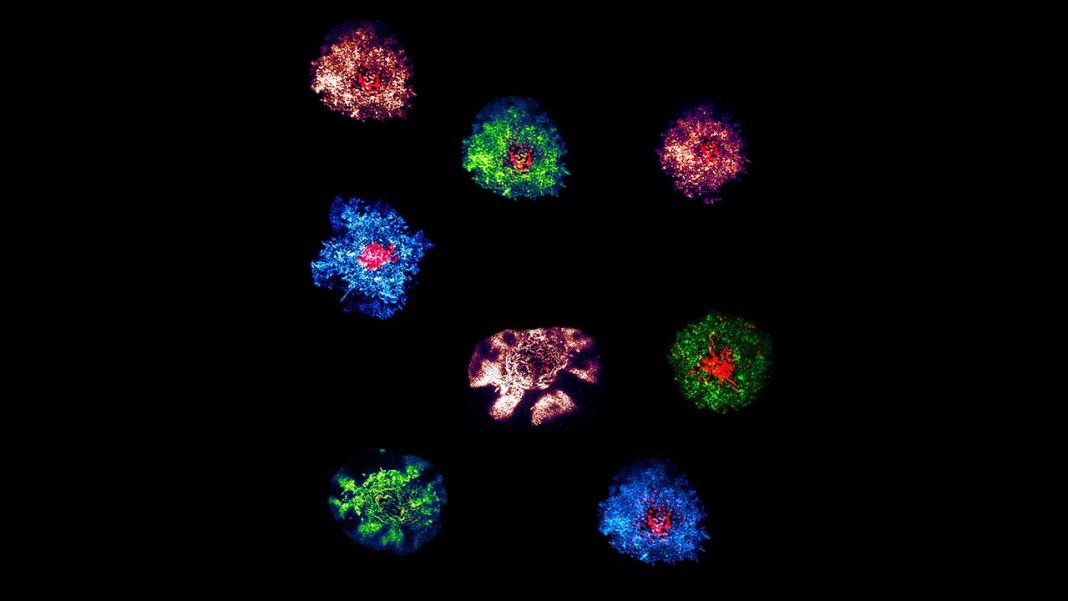
The researchers realized another process was at play. Actin was generating wave-like fronts around the synapse centre that propagated outward toward the cell edge. The movement of these waves was closely associated with the outward drift of TCR microclusters. Additionally, naive T cells that lacked a critical protein called WASP—mutations of which are linked to immunodeficiency disorders—showed a clear uncoupling between the actin waves and TCR movement.
The findings reveal that actin wavefronts actively carry nearly half of the TCRs away from the synapse centre, protecting them from being internalized. This is counterintuitive because actin usually moves in the opposite direction inside cells. Kumari indicated that it is like a river flowing both ways and is almost impossible imagine.
Samuel Khiangtze, a PhD student in the Department of Physics and one of the lead authors, notes that the results also highlight a wider theoretical gap in biophysics. He indicated that the striking patterns revealed by the experiment spark many intriguing questions about the fundamental physics of the active cytoskeleton and inspire them to explore how cellular activity contributes to dynamic pattern formation.
For Aheria Dey, a PhD student in MCB and another lead author, the findings carry significant immunological weight. She describes the immune synapse as the “decision-making hub” that governs whether a T cell mounts an appropriate response, with subtle cytoskeletal behaviors—often overlooked—potentially influencing this critical balance. A deeper understanding of these dynamics could greatly advance research into cancer therapies and autoimmune disorders.
Credit:Actin cytoskeleton and the T cell receptor, pseudocoloured to highlight different cells. Credit: Aheria Dey