
Healthcare (Commonwealth Union) – Researchers have come up with a system based on “negative luminescence” that enables a new way to transmit concealed information.
Engineers from the University of New South Wales (UNSW Sydney) and Monash University designed the technique to send data in a manner that is extremely difficult for others to detect or intercept.
The approach uses the phenomenon of negative luminescence, allowing signals to merge seamlessly with the natural background of heat radiation—the same type of radiation visible through thermal imaging.
To anyone observing from the outside, it appears as though no communication is taking place. However, a receiver equipped with the proper technology can still detect and decode the hidden transmission.
Since the communication itself remains effectively invisible, intercepting or hacking the signal becomes extremely difficult. This could eventually provide a powerful new layer of security for sensitive communications, particularly in areas such as defence and finance.
The research team—led by UNSW Professor Ned Ekins-Daukes and Dr Michael Nielsen, along with Professors Michael Fuhrer and Stefan Maier from Monash University and Imperial College London—has so far demonstrated data transmission speeds of roughly 100 kilobytes per second during laboratory tests.
Researchers say transmission speeds could reach gigabytes per second—or even higher—as the emitter technology continues to improve.
Dr Michael Nielsen, the lead author from UNSW’s School of Photovoltaic and Renewable Energy Engineering pointed out that data is everywhere in modern life, yet we are not always developing new methods to safeguard it.
He indicated that they have encryption methods, however at the same time they are always need to produce new encryption methodologies when bad players come up with new decryption strategies.
Dr Nielsen pointed out however that if someone does not even have the knowledge that data is being transferred, then it is really difficult for them to hack into it. He indicated that if we can send information in a discrete manner then it definitely assists in preventing it being acquired by individuals, we do not want to access it.
The new technique, detailed in a paper published in Nature Publishing Group’s journal Light: Science & Applications, makes use of the unusual phenomenon known as negative luminescence produced by LEDs that operate in the mid-infrared region of the light spectrum.
All objects naturally emit a subtle amount of heat radiation in the infrared range, something that is usually invisible to the human eye unless detected with specialised thermal cameras.
Dr Nielsen explained indicated that what makes negative luminescence particularly fascinating is that it causes this glow to appear darker rather than brighter and in simple terms, it is a bit like having a flashlight that can somehow become darker than being switched off.
He indicated that while that’s not possible to achieve with visible light, certain materials can create this ‘negative light’ effect in infrared, which is what the research team are now exploiting.
Dr Nielsen indicated that in traditional data communication, information is sent by something being either on or off and that can be as simple as a flashing light, or radio waves, or signals transmitted in optical fibres.
“Observers are able to see that data is being transmitted, even if they cannot read the message because of it being encrypted in some way.
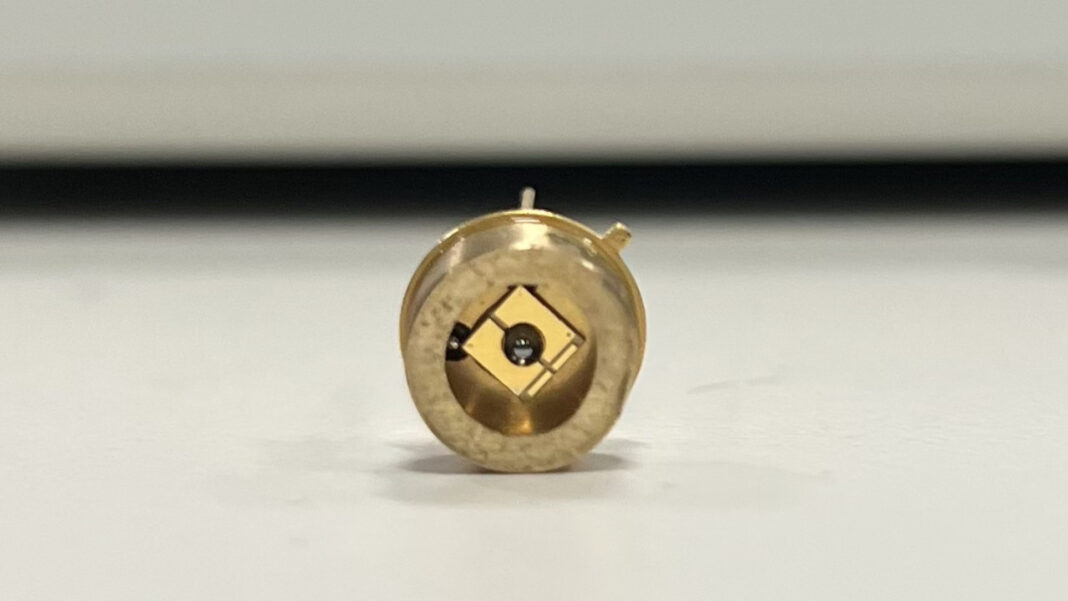
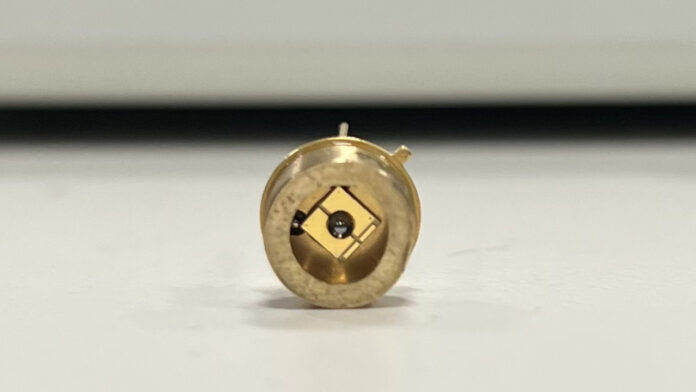
“But with negative luminescence it is possible to create a hidden signal using a special device called a thermoradiative diode.”
The diode is able to rapidly alternate its output between brighter and darker-than-normal levels, producing a pattern that merges with the surrounding background “noise.” As a result, anyone unaware that a transmission is occurring cannot detect that data is being sent.
The concealed information carried by these thermoradiative diodes can also be protected using conventional encryption methods, providing an additional layer of security.