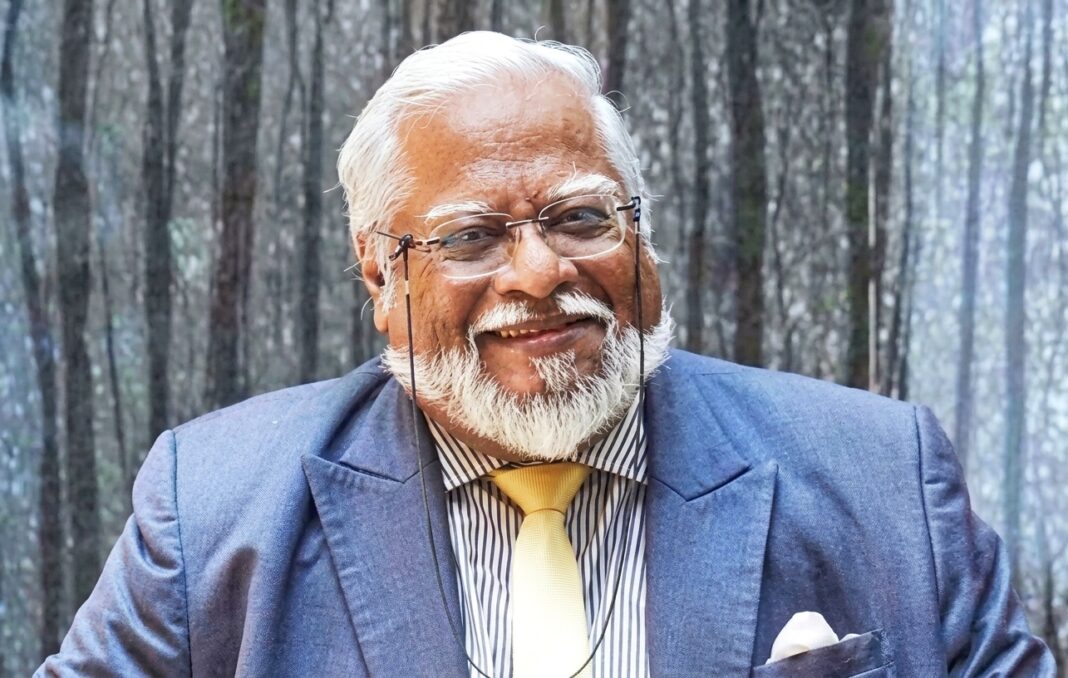

Nirj Deva DL FRSA is unique. The only person born in one country (Sri Lanka) to be elected as the first post-war, post-colonial non-white Conservative MP in the UK, later representing South East England in the European Parliament for 20 years, and subsequently serving as a Presidential Envoy of Sri Lanka repesenting its people while retaining his appointment under the Lord Lieutenancy of Greater London.
He was nominated as a candidate for UN Secretary-General; and by the ECR Group for President of the European Parliament. He founded the Commonwealth Union, creating the first global digital cyber community NGO connecting 2.5 billion people with a shared legal heritage, parliamentary democracy, the rule of law, the English language, and a common defence in two world wars.
Full CV: https://drive.google.com/file/d/1moAOhjb1LltOzTKHuvDjqpuwQIbLBNmd/view?usp=drive_link
Email: nirjdeva@yahoo.co.uk
WhatsApp: +44 7976 734722
CV Download
The Emergence of Digital Civilisation:
While traditional alliances weaken, a new form of human organisation has emerged—one that operates largely outside the framework of nation-states.
Digital platforms—Facebook, X, Instagram, TikTok—have created transnational communities of identity and interest.
These are not peripheral phenomena; they are now central to how billions of people experience the world.
A young entrepreneur in Lagos collaborates with a developer in Bangalore. A legal activist in London debates constitutional reform with peers in Nairobi. Climate movements, financial networks, and cultural communities operate across borders with unprecedented speed and intensity.
This is not globalisation in its traditional economic sense. It is something deeper: the formation of a digital civilisation.
In this civilization; identity is shaped by networks, not nations. Influence flows through algorithms, not institutions.
Solidarity is built on shared values, not shared territory.
The implications are profound. States that fail to understand this shift risk becoming increasingly irrelevant to the lived experience of their citizens.
The Only Viable Alternative: Alliances of Democracies.
In this transformed landscape, only one type of alliance remains viable: alliances of democracies, grounded in shared values rather than geography or dominance.
These values are not abstract ideals; they are institutional principles developed over centuries:
Rule of law. Parliamentary governance. Individual liberty. Transparency and accountability.
They trace their lineage to foundational developments such as the Magna Carta and have evolved through constitutional practice across multiple continents.
Crucially, these values are portable. They are not confined by borders. They can be adopted, adapted, and defended across diverse societies.
That is why in two World Wars as attested by countless war graves in Commonwealth cemeteries, 4.3 million colonial soldiers, particularly from the Indian Subcontinent volunteered to fight in ditches in France Belgium Burma and the Western dessert earning Victoria Crosses. They fought not to save Britain which they had never seen but to protect an ideal -a set of values – from Facism and German and Japanese absolutism.
An aspect of these Wars much overlooked by those who saw the relationship only as exploitative. In fact it was to protect the transfer of modern ideas of rule of law, justice, equality and jury systems to ancient civilisation by these volunteering soldiers.
In the digital age, this portability becomes strategic. Values travel through networks, shaping global opinion and creating communities that transcend national boundaries. Democracies that align around these principles can form alliances that are more resilient than those based on proximity or power.
The Commonwealth as the Natural Platform
Within this context, the Commonwealth emerges as a uniquely positioned foundation for a new kind of alliance.
The Commonwealth is not a traditional power bloc. It is a voluntary association of 56 plus MENA7 nations, representing approximately 2.7 billion people—around one-third of humanity—and encompassing both advanced and developing economies. �
What distinguishes the Commonwealth is not geography, but shared institutional DNA:
Common law traditions.
Human rights.
Parliamentary systems.
English as a working language.
Historical experience of equality embedded in governance structures.
The rule of law as opposed to rule by law.
These commonalities provide a basis for cooperation that is deeper than geography and more stable than influence.
The emergence of CommonwealthUnion.com marks a significant development in translating this latent potential into operational reality.
It is not merely a media website. It is a digital infrastructure platform designed to connect the economic, political, and social ecosystems of the Commonwealth and its people to its millions of busineses.
It is now engaging with a substantial part of its diaspora which consists of over 100 million strong professionals and business actors across the world and aims to interface with over 150 million SMEs across Commonwealth economies.
It functions as a nascent gateway for trade, investment, and sectoral collaboration and already operates across multiple verticals. These include—business, blockchain, digital banks, technology, education, healthcare, travel, media—creating a multi-sector digital marketplace of ideas and opportunities.
This is the critical point:www.commonwealthunion.com is not an end in itself. It is a prototype of a new type of alliance infrastructure—one built not through treaties, but through networks, platforms, and economic integration.
From Platform to Union: The Multi-Vertical Model
The most important and under reported aspect of this model is its emphasis on building multiple business verticals.
Traditional alliances focus on high politics—defence, diplomacy, and treaties.
The Commonwealth Union model inverts this logic.
It begins with economic and functional integration across hundreds of sectors, including:
trade and logistics, digital finance and fintech, education and skills mobility, healthcare systems, energy and infrastructure, tourism and cultural exchange, legal and professional services., ai[potrts and ports, airlines and hotels agriculture and horticulture…building stand alone verticals or more.
Each vertical functions as a self-reinforcing network, linking businesses, professionals, and institutions across Commonwealth countries.
The cumulative effect is transformative.
Instead of a single monolithic structure, the Union becomes a distributed ecosystem of interlocking networks. Each vertical generates its own momentum, cash flow and profitability, but all are connected through shared standards, values, and digital infrastructure.
This model has three decisive advantages:
Scalability. A system built on multiple verticals can expand organically. New sectors can be added without restructuring the entire system. Resilience. Failure in one area does not collapse the whole. The network adapts and reconfigures.
Inclusivity; Small states and developing economies can participate meaningfully within specific verticals, rather than being marginalised in a centralised structure.
At the centre of this emerging architecture stands India as the Strategic Anchor.
India’s significance is not merely demographic, though its scale—over 1.4 billion people—is unmatched within the democratic world. It is also institutional and civilisational.
India represents the largest functioning democracy, a long standing parliamentary tradition, a rapidly growing digital economy, strategic autonomy in global affairs. No other country combines these attributes at comparable scale.
The Commonwealth Union model is not hierarchical. It is networked leadership, where influence derives from participation and contribution rather than dominance.
A fully developed Commonwealth Union would provide a systemic counterweight to authoritarian models of global organisation. The key difference is structural. Authoritarian systems centralise power. The Commonwealth Union would distribute it across networks, making it inherently more adaptive. The most common objection is that the Commonwealth is too diverse to function as a coherent alliance. This misunderstands the nature of the model.
Diversity is a weakness only in centralised systems. In networked systems, it becomes a source of strength.
Different countries contribute different capabilities across different verticals.
Another criticism concerns democratic imperfections within member states, including India.
Yet this criticism inadvertently reinforces the argument. Democracies are not defined by perfection, but by capacity for self-correction. Their legitimacy derives from openness, accountability, and the possibility of change.
Authoritarian systems offer no such mechanisms.
The Commonwealth Union—understood not as a bureaucratic institution, but as a networked, multi-vertical, value-based system—offers a coherent path forward.
It aligns with the realities of the digital age.
It leverages existing institutional commonalities.
It scales across continents and sectors.
Most importantly, it provides a framework for sustaining the principles—rule of law, liberty, democratic governance—that underpin human development.
The question is no longer whether such a system is desirable.
We are building it. Join us.
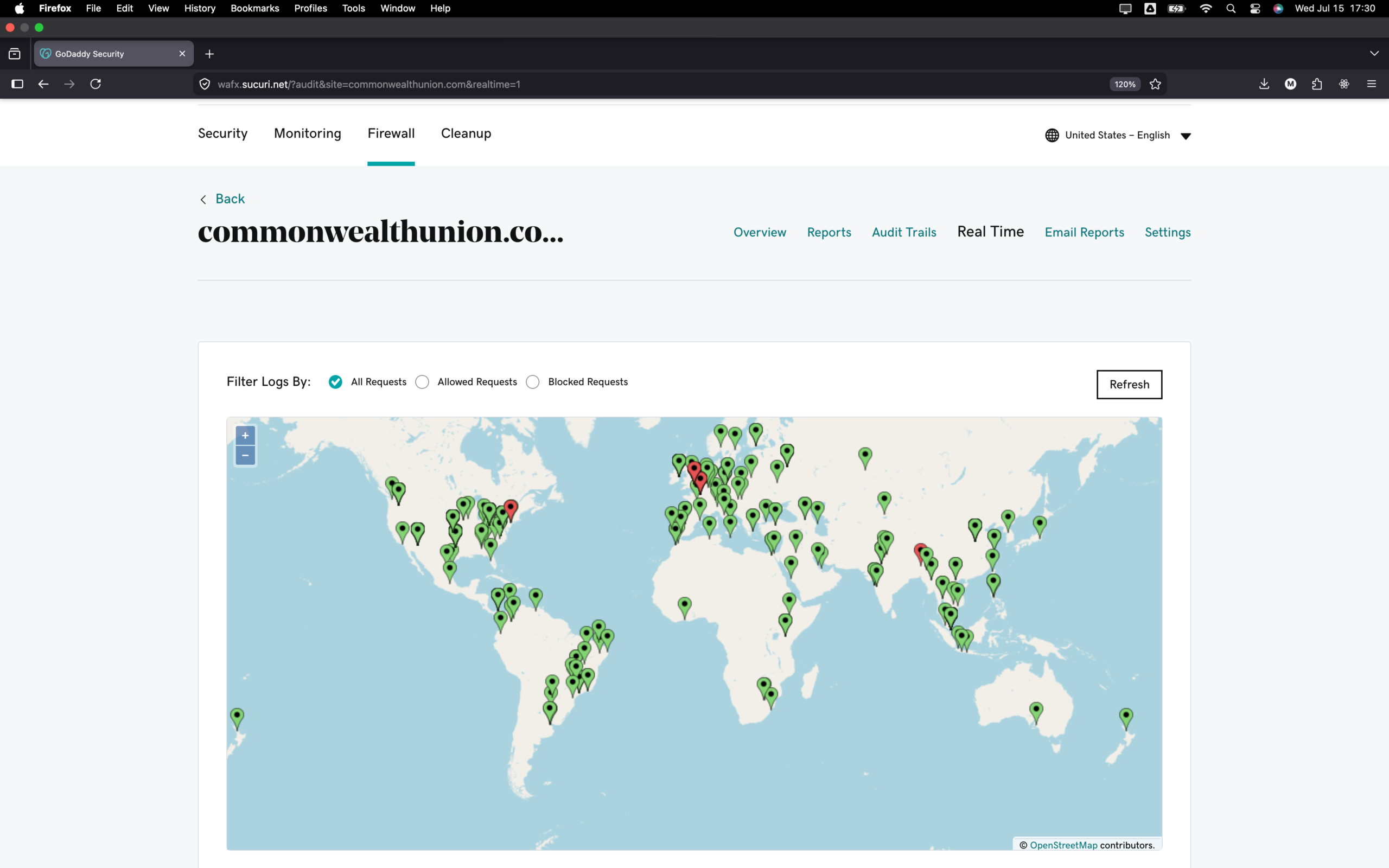
The integrated world map visually displays active incoming web requests from around the globe. Traffic is originating from a diverse range of countries across multiple continents, including the United States, Canada, and Brazil in the Americas. In Europe and Africa, requests are coming from nations like the United Kingdom, France, Germany, and South Africa. The map also shows significant activity spanning Asian and Oceania regions, including India, China, Australia, and New Zealand.
Go daddy report
Social media report