
Singapore (Commonwealth Union)_ Singapore is preparing to give its political leaders a substantial pay increase, pushing Prime Minister Lawrence Wong’s annual benchmark salary to about S$3.6 million, or roughly US$2.8 million. Accordingly, the hefty S$1.4 million raise puts Wong, who is already the world’s highest-paid prime minister, even further ahead of other world leaders in terms of pay. Wong currently earns about S$2.2 million a year. Under the revised framework, his benchmark pay will rise by more than 60 percent. As such, he has said he will donate the entire increase to suitable charitable causes during his five-year term.
Also read: One chair, three titans, a big race: The final battle for Tata’s top chair heats up! Who will win?
The increase also extends to other senior political figures. The benchmark salary for a deputy prime minister will rise from S$1.87 million to S$3.06 million, while cabinet ministers will receive between S$1.8 million and S$2.88 million, depending on their seniority and responsibilities. The benchmark for an entry-level minister will increase from S$1.1 million to S$1.8 million. The decision follows a review by an independent committee and represents Singapore’s first major overhaul of political salaries in 15 years. The government says the aim is not simply to reward politicians but to ensure that Singapore can continue attracting capable people into public service.
Wong defended the policy in parliament, acknowledging that political salaries are a sensitive issue because the amounts are far beyond what most Singaporeans earn. But he argued that the country’s future depends on having strong leadership and that competitive compensation can help maintain high standards in government. Singapore has long used this argument to justify its unusually high political salaries. Officials have also said that paying ministers competitively can reduce the temptation for corruption and help the government attract skilled and experienced professionals from the private sector.
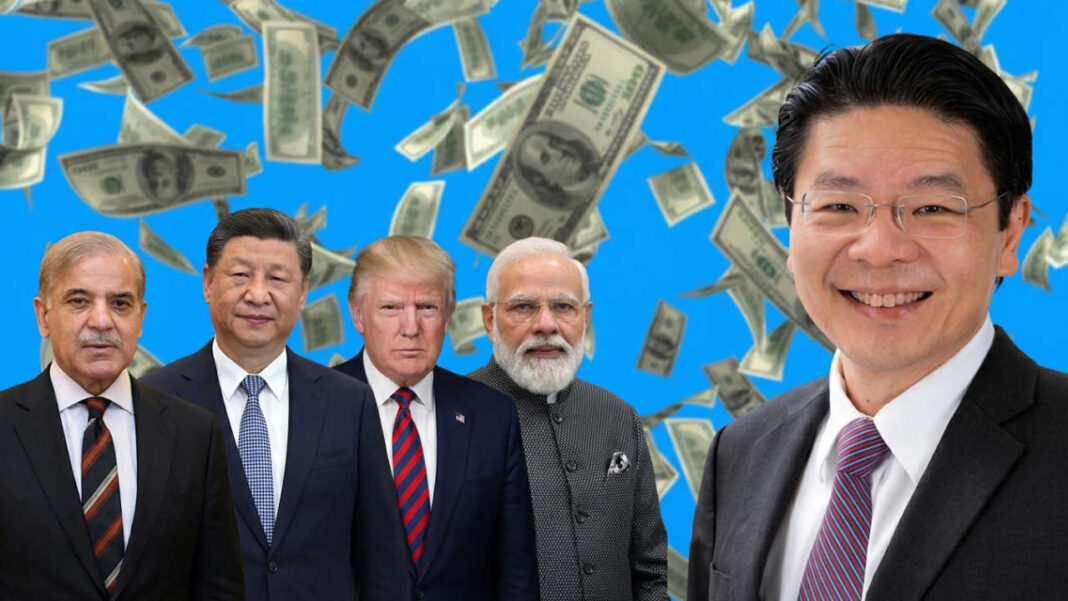
Wong’s new salary stands out sharply when compared with other major global political leaders. Accordingly, Hong Kong Chief Executive John Lee earns about US$719,000 a year, while Swiss President Guy Parmelin receives around US$606,000. US President Donald Trump’s official salary is US$400,000 annually. British Prime Minister Andy Burnham earns roughly US$230,000. The gap is even wider when Singapore’s salary is compared with leaders in Asia. Indian Prime Minister Narendra Modi earns around Rs 20 lakh a year, while Pakistan Prime Minister Shehbaz Sharif’s annual pay is above Rs 6 million. China’s President Xi Jinping received a 62 percent increase in his basic salary in 2015, but his annual basic pay was still only around US$22,000 at the time.
The latest Singapore decision, however, comes at a politically sensitive moment. Critics have questioned whether such a large increase is appropriate when households are facing higher living costs and concerns about employment. Government data also shows layoffs have reached a five-year high, while younger workers are facing uncertainty over job prospects. However, existing officeholders will not immediately receive the full new benchmarks. They are due to receive a one-off adjustment of up to 9 percent from October 15, depending on factors including performance and individual responsibilities.
Also read: Vijay joins Modi and Rahul in the 2029 PM race: How did Vijay become a serious contender for India’s PM post in just two years?
The government insists that the wider objective is long-term: to keep Singapore’s public sector competitive, capable and relatively clean. For Wong, the decision also carries a personal element. By donating his entire pay increase, he is seeking to separate the policy debate from his own financial gain. Still, the scale of Singapore’s political salaries ensures that the debate is unlikely to disappear. The government’s central argument is straightforward: paying more is justified if it helps secure better leadership. Critics, meanwhile, will continue to ask whether that premium is necessary and whether it is fair at a time when many Singaporeans are struggling with the cost of living.