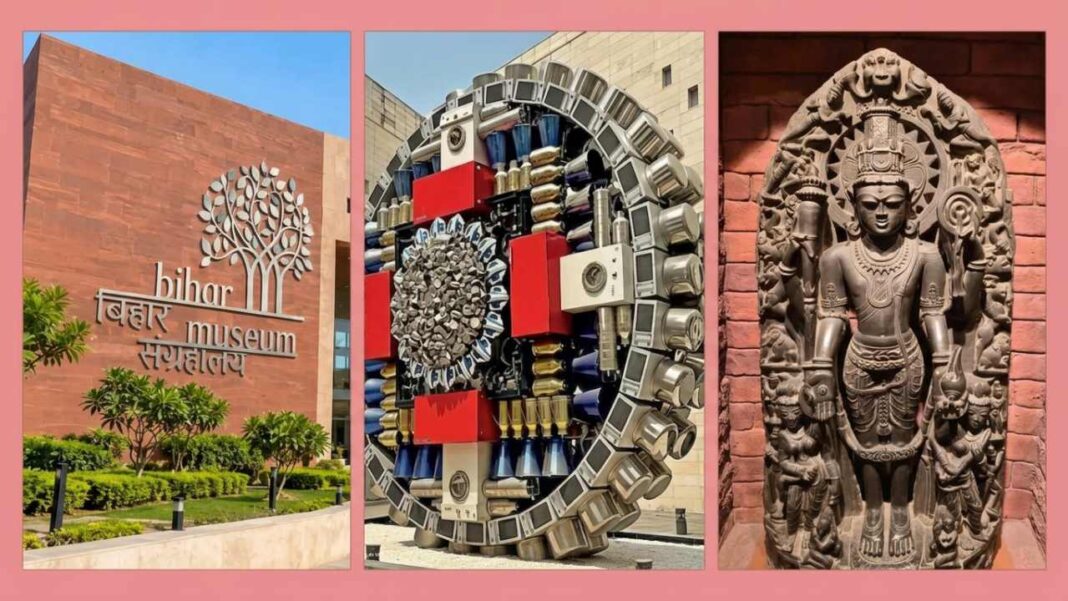

India (Commonwealth Union)_ India’s Bihar Museum has earned international recognition by securing the ninth position in the list of the world’s 100 best museums for 2026. Located in Patna, the museum has ranked first in Asia, placing ahead of some of the world’s most famous cultural institutions, including the Louvre Museum in Paris and the Metropolitan Museum of Art in New York. The achievement has brought attention to India’s rich cultural heritage and highlighted how a relatively young museum can compete with internationally established institutions.
The ranking was published by Worth a Journey, a Munich-based travel magazine and digital publication. Its 2026 list placed museums from different countries based on an evaluation of millions of data points collected from thousands of cultural institutions. The ranking covers museums across 142 countries and considers several categories, including art, history, archaeology, science and technology. Bihar Museum’s ninth-place finish is particularly significant because it is the only Indian institution featured among the top 100. Established with the aim of presenting Bihar’s history and cultural identity to a global audience, the museum has an interesting history of its own.
Also read: China and Pakistan deepen ties with the launch of a new information corridor – CPIC!
The construction began in Patna in 2013, and part of the museum opened to visitors in 2015. It was fully opened in 2017. The building was designed by Japanese architect Fumihiko Maki, winner of the prestigious Pritzker Architecture Prize, in collaboration with Mumbai-based Opolis Architects. Its modern design, open courtyards and landscaped surroundings create a welcoming space for visitors. What makes Bihar Museum special is its extensive collection, which tells the story of the region from ancient times to 1764. Its galleries display sculptures, coins, manuscripts, historical objects and traditional folk art. Visitors can explore different periods of Indian history, including the Mauryan, Gupta, Pala, Sur and Mughal dynasties.
The museum also highlights Bihar’s important contributions to Buddhist and Jain traditions. One of its most remarkable attractions is the Didarganj Yakshi, a celebrated Mauryan-era sculpture admired for its polished surface and exceptional craftsmanship. The sculpture represents the artistic excellence of ancient India and remains one of the museum’s most important treasures. There is more to the museum than the traditional historical exhibits. Its Children’s Gallery introduces young visitors to animals, science, culture and folk traditions via engaging exhibits. The Diaspora Gallery is about Bihar’s connections with communities beyond its geographical boundaries, demonstrating how the people and traditions of the region have influenced other parts of the world.
According to the published 2026 ranking, Mexico’s Museo Nacional de Antropología secured first place, followed by Spain’s Museo del Prado in second. Denmark’s Louisiana Museum of Modern Art ranked third, while Russia’s State Hermitage Museum came fourth. Austria’s Kunsthistorisches Museum occupied fifth place, followed by Türkiye’s Şanlıurfa Archaeology Museum in sixth. Poland’s Museum of the Second World War ranked seventh, and the National WWII Museum in the United States came eighth. Bihar Museum secured ninth place, while the Metropolitan Museum of Art in New York completed the top ten.
The Louver, for all its worldwide fame, was outperformed by the Bihar Museum. The recognition is a sign of the increasing importance of regional museums on the international cultural tourism scene. The Bihar Museum has proved that historical value, thoughtful architecture and accessible educational experiences can draw the attention of the world. Its success is not just a game of outperforming famous museums. It is about bringing India’s history to the international stage and showing that Bihar’s cultural legacy deserves worldwide recognition.