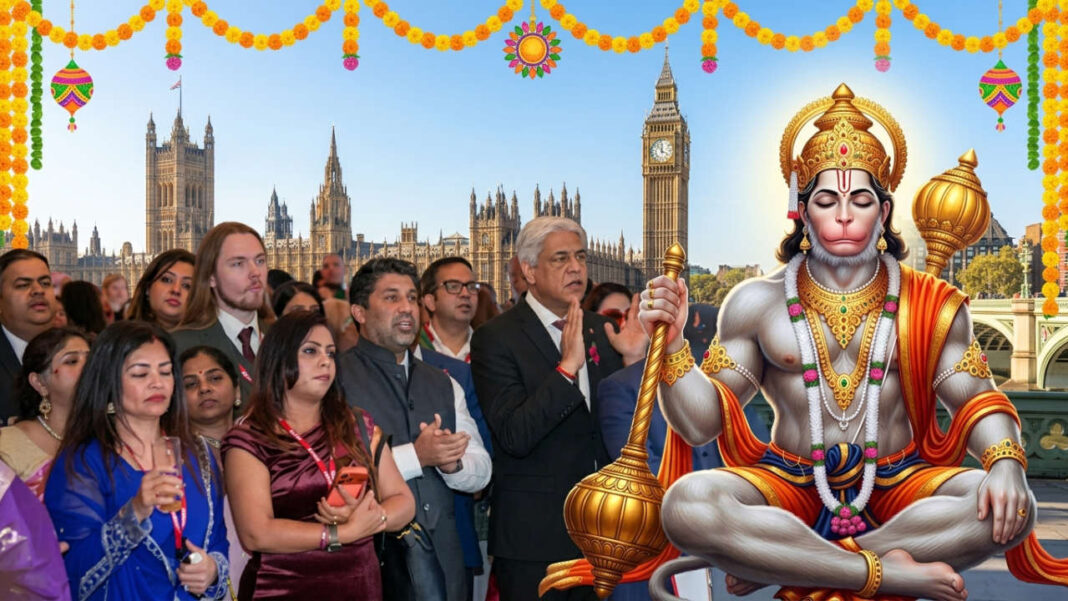

UK (Commonwealth Union)_ This year marked a historic moment for the Indian diaspora in the United Kingdom as Hanuman Chalisa was recited for the first time at the House of Lords during the Diwali celebration. The festival event is a sign of growing acceptance of Hindu traditions and Indian cultural heritage in British public life. Organised by the Labour Asians Society (LAS), the celebration took place at the Cholmondeley Room and Terrace inside the Palace of Westminster. It brought together British parliamentarians, community leaders and members of the Indian diaspora to mark the festival of lights. The programme was led by Manish Tiwari, founder of Here&Now365, and hosted by Lord Uday Nagaraju of Bloomsbury, patron of the Labour Asians Society.
Also read: Ramayana makes its Oscar move: Can India’s epic make history at the Academy Awards?
One of the most memorable moments came when the Hanuman Chalisa was recited along with the tabla and harmonium. The devotional prayer, dedicated to Lord Hanuman, has a special place in Hindu religious tradition. Its recitation inside the British Parliament was widely seen as a significant moment for the Hindu community and Indians living in the UK. Speaking at the gathering, Tiwari highlighted the importance of Diwali as a festival that connects people across religious and cultural boundaries. “Diwali is the light that shines across the divide of communities and is an essential part of our shared ancient heritage,” he said. He added that the festival is celebrated by Hindus, Sikhs, Jains and Buddhists and has increasingly become part of Britain’s wider cultural celebrations. He also highlighted the historic first-ever recitation of the Hanuman Chalisa at the House of Lords, describing it as a landmark occasion that would remain memorable for the Indian community for years to come.
Lord Uday Nagaraju welcomed the guests and acknowledged the Labour Asians Society’s significant contribution to British public life and the promotion of community relations. He said hosting the Diwali celebration at the House of Lords was a privilege and described the festival as a symbol of light overcoming darkness and good triumphing over evil. Several prominent personalities attended the event, including Gurinder Singh Josan, MP for Smethwick; former MP Virendra Sharma; humanitarian charity Go Dharmic founder Hanuman Dass; and Chandru Iyer of Grant Thornton, a former British High Commissioner to Karnataka. The programme also included a minute’s silence in memory of those who lost their lives in wars and conflicts, reflecting the occasion’s connection with Remembrance Sunday.
The event highlights how Indian culture and Hindu traditions are gaining greater visibility in the UK’s political and social institutions. Diwali celebrations are no longer limited to Indian communities or religious organisations. They are increasingly being held in Parliament, financial centres and major British businesses. For Britain’s Indian-origin population, such occasions represent more than cultural celebrations. They are celebrated for their identity, their traditions and their contribution to society in Britain. So the recitation of the Hanuman Chalisa in the House of Lords is a great symbolic moment. It shows how Indian religious and cultural practices are claiming their place in Britain’s multicultural public life, uniting communities and enhancing the cultural ties between India and the UK.