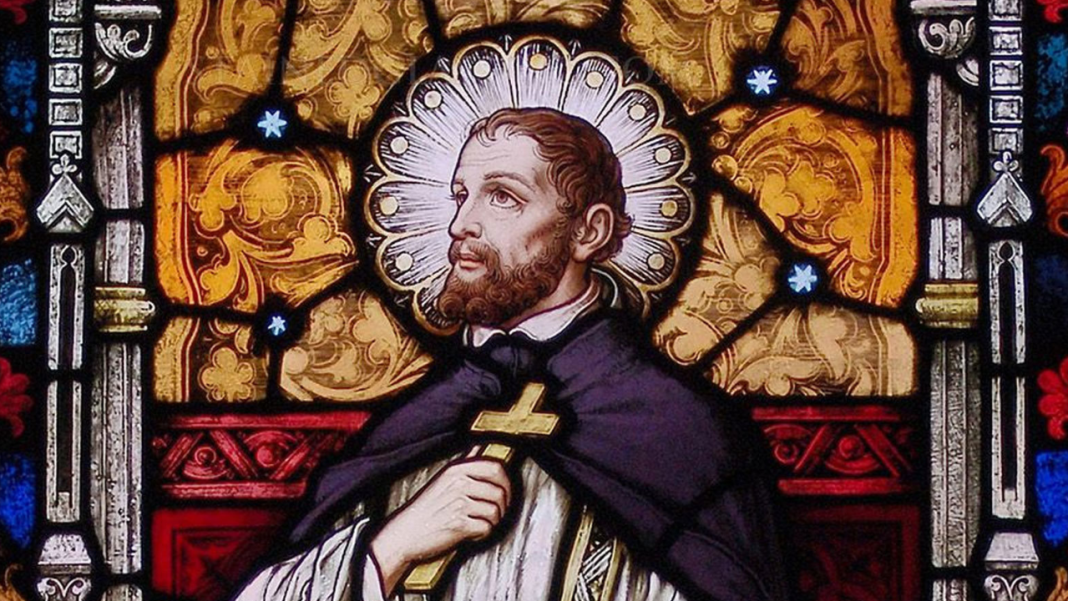

St. Francis Xavier was born in the Kingdom of Navarre on April 7, 1506. Francis was sent to study at the University of Paris. While there he roomed with his friend, Peter Favre. The young men were profoundly influenced by Ignatius of Loyola, who urged Francis to become a priest. In 1530, Francis Xavier got his master’s degree, and went on to teach philosophy at the University of Paris.
Francis Xavier, Peter Favre, and a number of other friends pledged poverty, chastity and obedience on August 15, 1534. The men planned to travel to the Holy Land to convert non-believers. In the same year, Francis Xavier began studying theology, and on June 24, 1537, he was ordained.
Pope Paul III approved the foundation of their order in 1540, which became The Society of Jesus. The order is now well recognised as the Jesuits. While Francis Xavier was studying to become a priest, Portugal was colonising India. Portuguese settlers were losing their Christian values and faith in India and other places. To restore these ideals, the King of Portugal urged the Pope to send missionaries to the region.
Pope Paul III wanted the new order to take up the mission and Ignatius decided to send Francis. Francis Xavier left for India in 1541, on his thirty-fifth birthday. As he departed he was notified that the pope appointed him to be the Papal Nuncio in the East. He came at the territory and colony of Goa, India on May 6, 1542.
Goa was a Portuguese colony with churches and even a bishop, but there weren’t many preachers or ministers to the Portuguese, particularly beyond the city gates. Xavier ministered first to the ill and the children. He then discovered that the indigenous people of the Pearl Fishery Coast had been baptised ten years prior but had never received religious instruction. Xavier began ministering to them. Xavier built 40 churches for the inhabitants of the Pearl Fishery Coast.
Xavier also visited Malacca and the Maluku Islands to spread Christianity. Anjiro, a Japanese man, became the first Japanese person to become a Christian after Xavier converted him. Xavier was highly interested in seeing Japan. In 1549, he eventually embarked for the land, arriving in July of that year. The Japanese were difficult to convert, despite his best efforts. Xavier formed a few churches, but the religion was banned from growing and Christianity became the target of immense persecution, leading many to go underground with their convictions.
In August, Xavier’s ship arrived in China and made a halt at an island off the shore. He managed to locate a man to agree to transport him to China for a huge cost, but while he was waiting for his boat to come became ill with a fever. On December 3, 1552, Xavier took his last breath. His body was brought to Goa and is still interred in a glass casket with a silver coffin.
On October 25, 1619, Pope Paul V beatified Xavier and on March 12, 1622, Gregory XV canonised him in the same ceremony as Ignatius of Loyola. December 3 is his feast day, and he is the saint of Catholic missions.