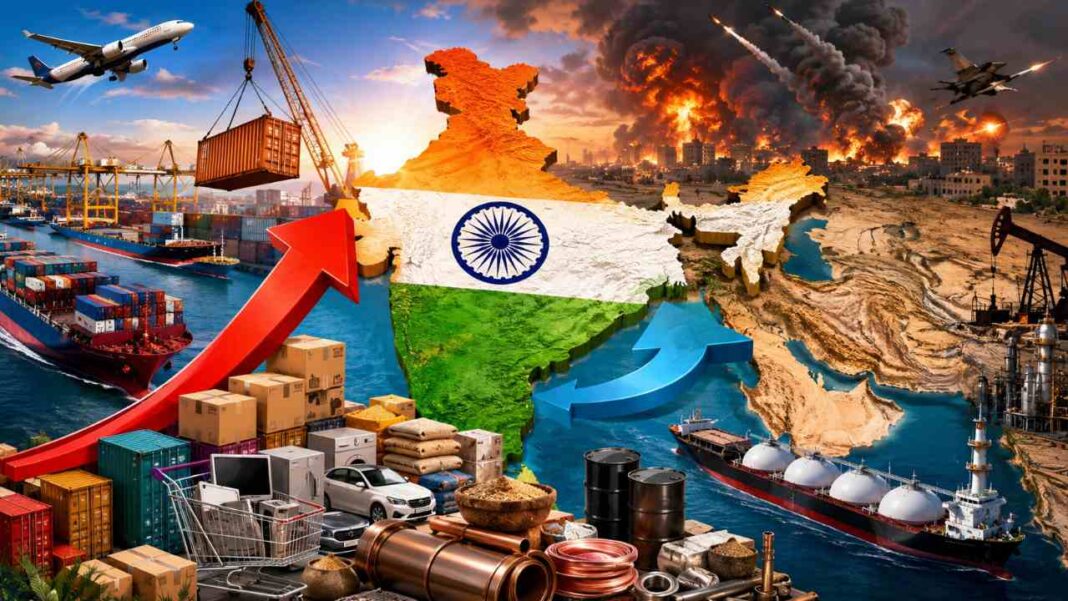

India’s merchandise trade deficit (INTRD=ECI) widened more than expected to a 6-month high of USD 31.98 billion in July ’26. This was due to the Middle East war driving the country’s oil import bill, besides global freight rates.
This data underscores the growing pressure on India’s external balance. This is occurring while a wider trade gap exerts pressure on the rupee, in addition to affecting capital inflows.
A Reuters poll of economists expected the merchandise trade deficit in July ’26 at USD 30.20 billion. The deficit was as it stood at USD 30.43 billion in June.
Data released by the trade ministry reflected that imports rose to USD 76.22 billion against USD 70.84 billion in June. The increase was driven by a surge in crude oil prices besides surging imports of electronic goods and gold.
Imports of electronic goods, including chips, increased by more than 44% year-on-year during July ’26, reaching USD 14.37 billion. Gold imports rose nearly 5% to USD 4.16 billion.
Oil imports stood at USD 18.31 billion in July. This was USD 19.33 billion a month earlier in June. Data reflected higher global crude oil prices.
Good exports hit a record high of USD 44.24 billion in July. It surpassed the previous July peak of USD 38.34 billion, which occurred four years ago in 2022. This was while they were at USD 40.41 billion in June.
Trade Secretary Rajesh Agrawal told reporters that exports of petroleum products, electronics & engineering goods have been strong so far this fiscal year. This is while shipments to the Middle East increased by 8.6% year-on-year to USD 5.7 billion in July.
The U.S. remained a top destination for Indian exports. This was with goods shipments at USD 33.49 billion in the April–July period. Data reflected that this nearly matched last year’s level.
About 45% of India’s exports to the U.S. remain exempt from the new 10% duty introduced by Washington in July. India was actively engaging with U.S. authorities in resolving outstanding trade issues. A trade official said that India was aiming for an early conclusion of a bilateral trade agreement.
Service exports remained robust at USD 35.89 billion in July. This is while services imports total USD 18.94 billion. Trade ministry estimates reflected that it resulted in a surplus of USD 16.95 billion.

Exporters squeezed by shipping disruptions
Freight rates on routes from South Asia to the U.S. & Europe have risen sharply recently. During this time, rates to the Middle East remained elevated due to regional disruptions. Exporters and shipping-industry data indicated that high fuel costs and tight vessel capacities also contributed to the increase in rates.
The U.S. & Iran remain at loggerheads over efforts to agree to an end to the war. This information came from a senior Iranian source who stated that there had been no progress in talks to revive the interim deal agreed upon in June, except for defining a timeframe for its implementation.
The increase in freight rates is squeezing margins for exporters of rice, textiles, and pharmaceuticals, besides engineering goods. They were also grappling with delayed shipments. Additionally, they are facing issues with stranded cargo and uncertainty regarding vessel schedules.
Vice president at Gokaldas Exports, Shivanramatiswan Ganapathy, told investors after the company’s quarterly results were announced on Wednesday, 19 August, that container shortages & shipping delays continued to disrupt the flow of materials. It affected production planning & throughput.
India’s top exporters’ body has urged the government to engage in negotiation with global shipping lines. They added that higher freight costs besides a shortage of containers were undermining exporters’ competitiveness.
India’s widening merchandise trade gap highlights the external pressures created by the Middle East conflict, particularly higher energy besides freight costs. Yet record exports offer resilience. Sustaining export momentum and diversifying energy supplies besides strengthening logistics will be crucial to containing the deficit and protecting India’s broader economic stability.