
Nanotechnology (Commonwealth Union) – Scientists at the Northwestern University have produced printed artificial neurons that take us beyond simply copying the brain — they can directly interact with it.
In the new study, the researchers designed flexible, affordable devices capable of producing electrical signals realistic enough to stimulate living brain cells. When tested on slices of mouse brain tissue, these artificial neurons successfully activated real neurons, highlighting a significant advance in compatibility with biological systems.
This breakthrough points toward a future where electronics can communicate seamlessly with the nervous system, opening the door to applications such as brain–machine interfaces and neuroprosthetics, including devices to restore hearing, vision, and movement.
It also paves the way for more efficient, brain-inspired computing. By replicating the way neurons transmit signals — one of the reasons the brain remains the most energy-efficient computer — next-generation systems could carry out complex tasks while using far less power than current technologies.
The findings appeared recently in the journal Nature Nanotechnology.
Mark C. Hersam, of Northwestern University who was the lead of the research indicated that the world we live in at present has seen a domination of artificial intelligence (AI) and the way we go about to make AI smarter is by training with an increased amount of data. He further pointed out that this data-intensive training brings about a large power-consumption issue hence, we have to come up with more efficient hardware to process big data and AI. As the brain has a much larger energy efficiency than a digital computer, so it is only logical to seek the brain for inspiration for next-generation computing.
A specialist in brain-inspired computing, Hersam serves as the Walter P. Murphy Professor of Materials Science and Engineering at Northwestern’s McCormick School of Engineering. He also holds appointments as a professor of medicine at the Feinberg School of Medicine and as a professor of chemistry at the Weinberg College of Arts and Sciences. In addition, he chairs the Department of Materials Science and Engineering, leads the Materials Research Science and Engineering Center, and is a member of the International Institute for Nanotechnology. He co-led the study alongside Vinod K. Sangwan, a research associate professor at McCormick.
The researchers of the study went from rigid silicon to adaptive brains. As computational challenges grow more demanding and data-heavy, conventional computers respond by scaling up — packing billions of identical transistors onto flat, rigid silicon chips. Each transistor functions in the same way, and once manufactured, the system’s structure is largely unchangeable.
The brain, however, works very differently. Instead of uniform components, it depends on a wide variety of neurons, each with distinct functions, arranged across different regions. These soft, three-dimensional networks are highly dynamic, continually adjusting their connections as learning and adaptation occur.
“Silicon achieves complexity by having billions of identical devices,” explained Hersam. “Everything is the same, rigid and fixed once it’s fabricated. The brain is the opposite. It’s heterogeneous, dynamic and three-dimensional. To move in that direction, we need new materials and new ways to build electronics.”
Existing artificial neurons still lack true biological fidelity. Most generate overly basic signals, which means engineers must depend on large, power-hungry networks of devices to produce more sophisticated behavior.
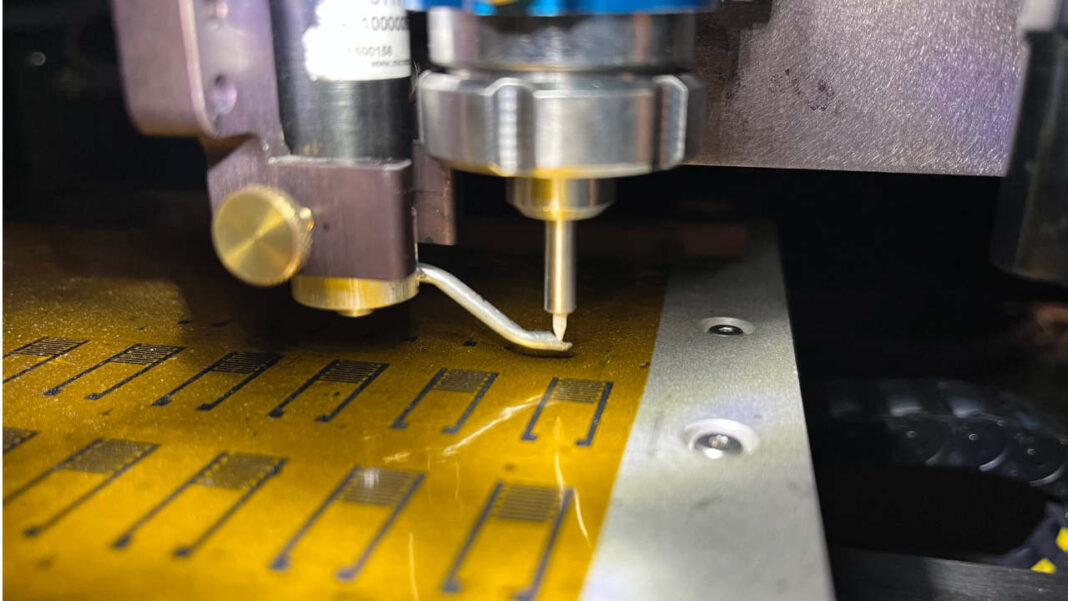
To better replicate the workings of the brain, Hersam’s team created artificial neurons from soft, printable materials that more closely resemble neural structure and function. This breakthrough relies on specially formulated electronic inks made from nanoscale flakes of molybdenum disulfide (MoS₂), a semiconductor, and graphene, which acts as a conductor. Using an advanced technique known as aerosol jet printing, the team deposited these inks onto flexible polymer surfaces.
Previously, researchers saw the stabilizing polymer within these inks as a drawback because it disrupted electrical conductivity, often removing it after printing. Hersam, however, turned this perceived flaw into a strength, using the polymer to introduce brain-like properties into the device.