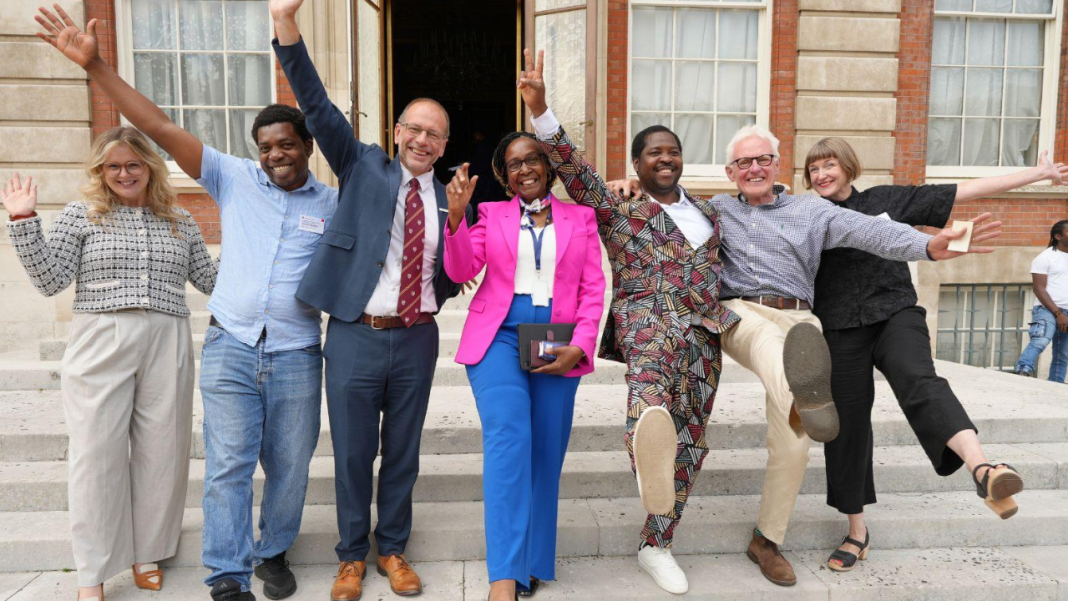

(Commonwealth)__To celebrate International Youth Day, more than 120 young performers, artists, community activists, social workers, and visionaries met at the Commonwealth Secretariat headquarters in London for the Young Leaders for Arts and Health Summit. Organised by the Global Arts for Medicine Fellowship and in partnership with the Commonwealth Secretariat, the summit encouraged people to be aware of the importance of arts leadership to health and well-being. A common aspect of the conference was the universal feeling that the arts, whatever their form, are at the centre of healing, bonding, and enabling young people.
The programme was launched by a story of resilience told by Young Leaders for Arts and Health Executive Director and Founder Dr Kunle Adewale, who himself has long been an advocate for artistic forms as powerful forms of communication, connection, and community. He noted that youth are beset with every type of problem, from identity to mental illness, and argued that initiatives like this provide pathways of education, empowerment, and participation that can lead them to a better future. As the winner of the 2016 Commonwealth Youth Worker Award, Dr Adewale delineated the work with the Commonwealth as a vow to being capable of seeing no young person being left behind in being able to access arts-based health interventions.
The arts as a gateway to health was an ongoing theme during the day. Reading work fromemerging writers gave a glimpse into their world, their fears, joys and ambitions. At the same time, an installation of the Virtual Museum of the Commonwealth by Oluwatosin Ogunyebi, virtual reality developer at Imperial College London, illustrated how new technology can be used to widen access for arts and health.
The summit not only featured artistic performances but also provided a platform for serious deliberation on mental illness. Doctors, activists, and youth leaders discussed in a panel session how art forms like music, drama, and painting can be employed as therapy, unite people in communities, and shatter stigmas. Former UK Government Community and Social Care Minister Sir Norman Lamb highlighted that arts-based interventions both enhance wellbeing and reduce reliance on certain drug interventions, especially for mental health. Such ideas were underpinned by World Health Organisation evidence by Janneth Mghamba, Commonwealth Secretariat Health Adviser, using Finnish case study evidence to show the effect of arts and health integration into national policy and how that can achieve long-term results. She emphasised young people’s arts programmes as being at the forefront of driving innovation in health and in delivering responsive and accessible solutions.
The day consisted of four interactive breakout sessions where the delegates developed means to empower youth to develop arts-based solutions to health within their communities. Throughout, speeches were always making reference to the fact that youth participation is not visibility but building safe spaces where all voices are heard and heeded.
Arts were infused throughout the summit. One of the sessions on neurodiversity was 15-year-old blind pianist Chapman Shum, who read his poem My Calling. His reading showed how music is a bridge-building language which cuts across ethnicity, ability, and disability. Chapman was born with an extremely rare genetic disorder that blinded him and gave him other learning disabilities. Chapman has had an inspirational career as a pianist, travelling worldwide and demonstrating the power of music to overcome boundaries.
The summit also recognised Kanyeyachukwu Tagbo-Okeke, a 15-year-old Nigerian painter from Abuja, Nigeria, for creating the world’s largest art canvas to raise awareness about autism. Being a non-verbal person himself, his 12,304-square-meter painting of a ribbon of varied colours, the official emblem of autism, was a robust piece of art and advocacy gesture.
Between the breakout and panel session, the stage was occupied by Global Arts in Medicine Fellows like Chidinma Chukwuka, Toluwani John Ajayi, Gabriel Adedeji, Israel Ola Akindipe, and Adeshina Oluwaseun Emmanuel. They stepped onto the stage to render a union of artistic excellence and call to conversation, convening the audience to reflection and action.
At the end of the summit, everyone carried away more consolidated partnerships and a clear commitment to integrating arts with youth health and wellbeing policy. Not only did creativity celebration occur at the festival, but it reiterated more than ever before the place of the arts as an essential component in building healthier, more just communities across the Commonwealth.