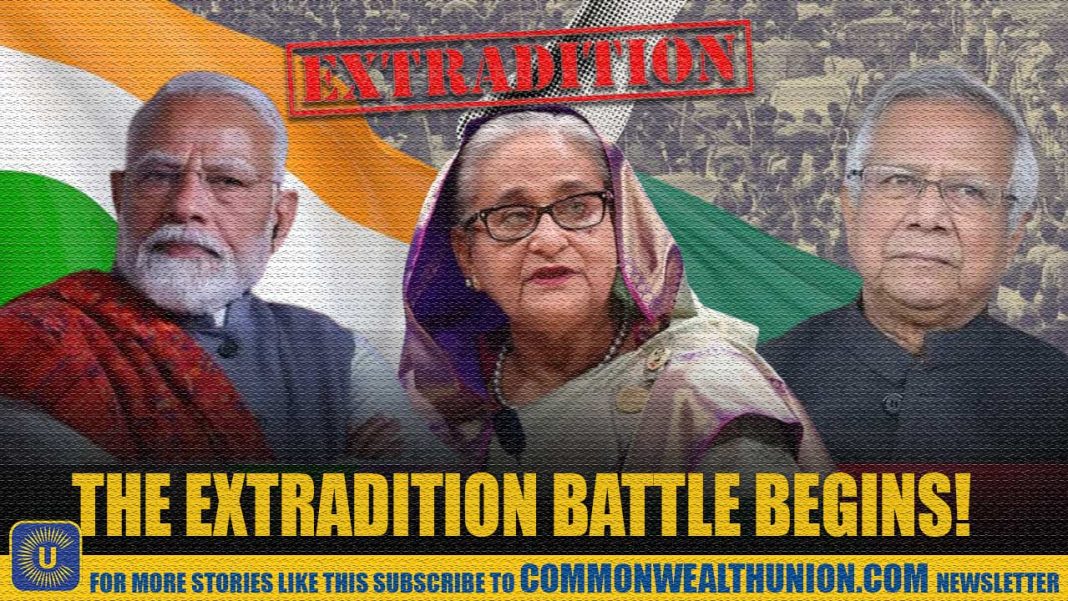


India (Commonwealth Union)_ The case involving former Bangladesh Prime Minister Sheikh Hasina has become one of the most contentious political issues India has faced in recent years. Her conviction and death sentence by Bangladesh’s International Crimes Tribunal have resulted in a serious diplomatic standoff between New Delhi and Bangladesh. However, at the heart of the turbulence is a simple question: how can India justify resisting Bangladesh’s request to extradite a former friend who is now facing the death penalty?
For India, the answer may be found not just in legal rules or treaty duties, but also in the broader political environment that shapes Hasina’s prosecution. As analysts increasingly point out, the case appears to be linked to political vengeance and transitional power conflicts in Bangladesh. That gives India considerable room to argue that the request is not a neutral legal matter but a politically driven pursuit, precisely the kind of case extradition treaties allow countries to decline.
Hasina’s death sentence and India’s cautious moves
Sheikh Hasina was sentenced to death by Bangladesh’s International Crimes Tribunal, which accused her of ordering a deadly crackdown on student-led protests that resulted in more than a thousand deaths. Following the ruling, the interim government in Dhaka quickly sought her extradition from India, where she has been staying since her removal from office. New Delhi’s initial responses have been cautious. Officials understand that Hasina is not simply a political figure in exile but someone who governed Bangladesh as India’s closest partner for nearly 15 years. At the same time, the present interim administration, led by Nobel laureate Muhammad Yunus, expects India to fulfill its extradition treaty obligations. This places India in a delicate position to protect its strategic interests in Bangladesh while avoiding acts that may be seen as supporting politically motivated prosecutions.
Bangladesh’s push for Interpol’s involvement
Amid India’s careful silence, the interim government in Bangladesh has taken steps to internationalize its pursuit. Dhaka is preparing to seek Interpol assistance by requesting Red Notices for Hasina and her former home minister. The strategy seeks to pressure India diplomatically by treating India’s internal issues as an international law enforcement matter, but Interpol Red Notices have no jurisdiction over a country’s sovereignty. India has complete freedom on whether to proceed, and New Delhi may claim that the allegations are politically motivated, which is a legal reason to refuse any cooperation related to politically motivated notifications.
Bangladesh’s formal extradition request
Dhaka’s official extradition request arrived shortly after the verdict. Bangladesh has emphasized that the request is consistent with the terms of the 2013 extradition treaty between the two countries, which was originally designed to address cross-border terrorism, illegal migration, and fugitives escaping justice. But Hasina’s case is vastly different from past precedents. Previous extraditions involved individuals linked to extremist groups or separatist militancy. The attempt to extradite a former prime minister convicted in absentia by an interim government thus presents a profound legal and political challenge.
How the extradition treaty favors India
The 2013 Agreement, later amended in 2016, allows for extradition in principle but provides considerable room for India to deny extradition requests. This means that India can leverage those treaty provisions along with more expansive international legal concepts when denying extradition requests based on their assessment that such requests were made for political purposes.
Also read: G20 Leaders’ Summit: Inside PM Modi’s high-stakes South Africa mission!
How Article 6 strengthens India’s case
Article 6(1) of the treaty is fundamental to India’s legal contentions. However, India may use this as a reason to deny extradition based on the fact that the offenses charged against Hasina are political in nature. It is reasonable to assume that Indian officials may use the political turmoil surrounding Hasina’s arrest warrant and subsequent prosecution as a basis for applying the political exception.
While Article 6(2) prohibits major crimes such as murder or terrorism from being classified as political, India may argue that the allegations against Hasina, which are framed as crimes against humanity, are the result of decisions made by her as head of government rather than her personal involvement. Such decisions, India may argue, fall within the realm of state accountability rather than individual criminal behavior.
How Article 8 allows India to question good faith
Another important option for India is Article 8(3), which allows for the refusal of extradition if the request is not made in good faith or if carrying it out would be contrary to the interests of justice. In this case, India can fairly claim that the trial was hasty and irregular; the interim administration lacked democratic legitimacy; and the evidence standards did not match international standards. These points provide New Delhi with a firm basis to argue that the request is unfair and partial and therefore violates the spirit of the treaty.
Also read: Trump-linked world’s first tokenized hotel venture to rise in the Maldives!
Legitimacy concerns about the tribunal and trial
Several legal and procedural concerns surround Hasina’s trial. Critics have cited serious constitutional violations, questionable judicial appointments during a period without an elected parliament, restrictions on Hasina’s legal defense, the unusual speed with which the trial was completed, and the fact that the verdict was delivered in her absence. The trial supposedly lasted only 140 days from start to finish, which is an unusually quick timeframe for a case of this magnitude. For India, these flaws raise legitimate concerns about whether due process was followed, giving New Delhi a viable argument that the sentence is invalid. India may also argue that Hasina’s absence from Bangladesh during the trial undermines the fairness of the proceedings. International rules compel defendants in capital proceedings to be present and properly defended by counsel of their choosing.
Lack of strong evidence against Hasina
In addition, legal experts have expressed concern over the weakness of the evidence linking Hasina to the alleged orders that they issued. If there was not adequate documentation to support the alleged orders, no one can determine who commanded that action. The Indian government can use this as an opportunity to argue that the prosecution appears to be relying upon a political interpretation of the evidence rather than reliable evidence. In addition to these concerns, Hasina claimed that she was denied adequate legal representation and alleges the panel was prejudiced against her and convicted her based on their bias. All the above accusations, along with procedural defects in the proceedings, provide a basis for the Indian government to assert that the nature of the prosecution was politically motivated instead of based on factual criminal liability.
A rapid investigation driven by political pressures
Concerns have been raised in Bangladesh and abroad regarding the rapid production of evidence and the trial of the case. The way in which the Bangladesh authorities altered their standard procedure to comply with a time frame for completion that falls short of the time frame provided for legally obtaining authorization from Parliament is concerning. In addition, the interim government in Bangladesh currently does not have a Parliament to provide it with the ability to make these changes constitutionally. Additionally, there are claims that certain political organizations, including student groups, pressured for the expeditious completion of the trial prior to the election, raising further questions as to whether or not the outcome of this case was influenced more by political expediency than by independence in the judicial process. India may argue that this lack of independence and the pressure for a rapid resolution to this case may call into question the legitimacy of the ruling.
Political motivations behind Hasina’s prosecution
India’s strongest case may lie in demonstrating that the charges against Hasina stem from political motivations rather than genuine criminal wrongdoing. Her removal from office after mass protests in 2024 reshaped Bangladesh’s political landscape, leaving the Awami League sidelined and vulnerable. The interim administration led by Muhammad Yunus has taken a firmly critical stance toward Hasina’s previous rule. The speed and severity of the charges against her appear to reflect the political hostility between the two sides. Moreover, Hasina had been Bangladesh’s most influential political figure for over a decade, raising doubts about whether any investigation into her actions could remain free from political coloring. India may present this backdrop as evidence that the prosecution lacks impartiality.
Past Yunus–Hasina rivalry: Strong evidence of political vengeance
The political rivalry between Hasina and Muhammad Yunus dates back many years. Their relationship was marred by tensions over Yunus’s brief attempt to enter politics and later by his removal from Grameen Bank under Hasina’s government. Throughout her tenure, Yunus faced numerous legal challenges, many of which his supporters considered politically motivated. This history offers India a compelling narrative: that Hasina’s trial, now pursued under Yunus’s leadership, may be shaped by longstanding personal and political vengeance. India can argue that the interim administration may be using judicial mechanisms to settle political scores.
Motivations of opposition parties
The political landscape in Bangladesh has long been divided between the Awami League and the Bangladesh Nationalist Party, two rivals with deep-seated conflicts. The BNP and its allies suffered extensive crackdowns during Hasina’s rule, including the imprisonment of several leaders and the banning of groups like Jamaat-e-Islami. Now, with Hasina out of power, those same groups may see an opportunity to hit back. India can point to this history to reinforce the notion that the case has political roots. The involvement of these parties in the push for Hasina’s conviction strengthens India’s claim that the process is not simply a legal one but part of a broader political upheaval.
India’s opposition to the death penalty
India traditionally opposes the death penalty in political cases and rarely extradites individuals facing capital punishment. The United Nations and global human rights organizations have criticized the verdict as well, reinforcing India’s diplomatic argument that extraditing Hasina would violate widely recognized human rights standards. For India, returning a former ally to face execution would not only create an ethical dilemma but also risk undermining its reputation as a stable and principled regional power.
India’s role as a reliable ally in South Asia
Hasina was one of India’s closest partners for 15 years. Extraditing her into a politically turbulent situation could send an unsettling message to India’s other allies that New Delhi might abandon its partners under pressure. This could weaken India’s standing in South Asian politics. Granting her asylum or delaying extradition until a democratically elected government is in place would allow India to protect its diplomatic credibility while also demonstrating consistency in its regional policy.
An extradition battle with uncertain outcomes
Despite political pressures from Dhaka, most political parties in India appear reluctant to support Hasina’s extradition. The decision involves layers of legal, humanitarian, and strategic considerations that make a quick resolution unlikely. India can continue to rely on the treaty’s provisions, the questionable legitimacy of the trial, political motivations behind the charges, personal vengeance, and its own stance on capital punishment to justify refusing extradition. As long as Bangladesh operates under an interim government without parliamentary oversight, India has strong grounds to delay any decision. Ultimately, India’s argument may rest on a simple but powerful principle that no country should extradite a foreign leader when there is credible evidence that the charges are politically motivated and the judicial process compromised. In Hasina’s case, India can assert that both concerns stand at the forefront.