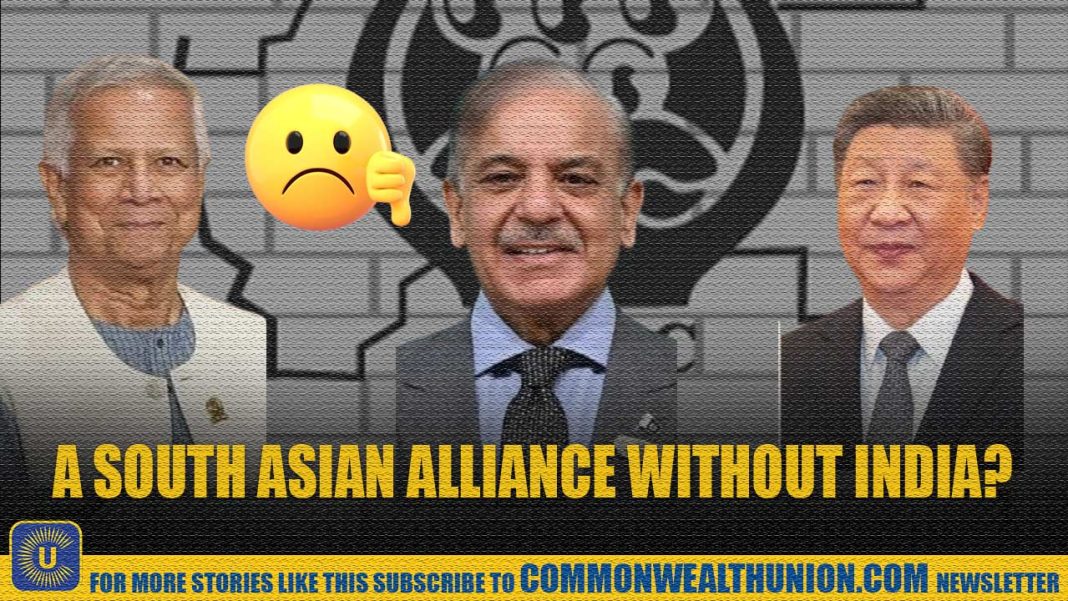
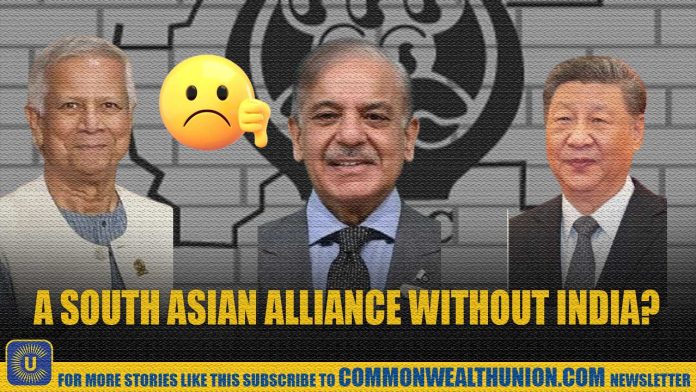

Pakistan (Commonwealth Union)_ Pakistan is trying to redraw South Asia’s political map by promoting a new regional grouping that pointedly leaves India out. The idea, floated recently by Deputy Prime Minister Ishaq Dar, is framed as an attempt to break what Islamabad sees as decades of Indian dominance in regional affairs. Dar says Pakistan wants to expand its emerging trilateral cooperation with Bangladesh and China into a wider framework that could eventually bring in other countries as well. But despite the confidence in Islamabad’s rhetoric, analysts across the region say the plan is unlikely to gain traction. India’s economy, its role as a key regional connector, and its record as a crisis responder, they argue, make it nearly impossible for any meaningful bloc to function without New Delhi.
Dar announced Pakistan’s intentions during a recent address, where he spoke of the need for South Asia to move past “zero-sum thinking” and what he described as a “dysfunctional” regional order. He pointed to Pakistan’s first trilateral meeting with China and Bangladesh, held earlier this year in Kunming, as evidence that new forms of cooperation are already taking shape. According to him, Islamabad is exploring whether this format can be expanded or replicated with other nations willing to chart a different course from the long-stagnant South Asian Association for Regional Cooperation (SAARC). The subtext of his remarks was clear: Pakistan sees an opportunity to build platforms that dilute India’s influence. Dar even warned against the “rigidity” he believes has kept the region from real progress, a remark widely interpreted as a swipe at New Delhi.
Also read: Cyclone Ditwha’s aftermath: How the world stands with Sri Lanka in its darkest hour!
Yet few in the policy community are convinced that Pakistan can rally support for a bloc that excludes the region’s largest economy. SAARC itself is a reminder of the challenges. Formed in 1985 by India, Pakistan, Bangladesh, Sri Lanka, Nepal, Bhutan, and the Maldives, and later expanded to include Afghanistan, the organization was meant to foster economic and political cooperation. Instead, India–Pakistan tensions repeatedly stalled its progress. Since the 2016 Uri terror attack and India’s decision to boycott the scheduled Islamabad summit, SAARC has remained effectively frozen. New Delhi has shifted its focus to BIMSTEC, which brings together the Bay of Bengal countries but leaves Pakistan out.
Also read: Modi & Putin go big: From new corridors to energy deals: Inside Putin’s high-profile India visit!
The cost of this fragmentation has been stark. South Asia is home to more than two billion people, yet regional trade remains extremely low, about $23 billion, or roughly five percent of total commerce. According to the World Bank, the figure could triple if countries reduced barriers and improved transport and energy links. Weak connectivity, mistrust, and political disputes continue to hold back the enormous economic potential in the region. Against this backdrop, many analysts view Pakistan’s latest initiative as more aspirational than practical. Rabia Akhtar of the Centre for Security, Strategy and Policy Research in Lahore says the proposal reflects Pakistan’s desire to “reimagine cooperation” at a time when SAARC is stalled. But she adds that two obstacles stand out: whether smaller countries see real value in mini-lateral groupings and whether they would risk upsetting their ties with India, which remains central to their economies.
That centrality is difficult to overstate. India’s population is several times larger than Pakistan’s, its military spending far exceeds Islamabad’s, and its economy is more than ten times bigger. Its foreign exchange reserves are dramatically higher as well, giving New Delhi far greater financial and strategic space. In practical terms, India’s size makes it the region’s natural hub: its roads, ports, markets, and supply chains support the day-to-day functioning of neighboring economies. During major disasters and public-health emergencies, India has also been the first provider of relief.
Regional analysts argue that any bloc that attempts to work around India would face both financial constraints and political limitations. Some warn that excluding New Delhi could even increase the region’s exposure to great-power rivalry, particularly as China expands its footprint. For now, Pakistan’s proposal appears to be more about sending a political message than laying out a viable blueprint. While Islamabad may want to signal dissatisfaction with the regional status quo, most observers believe no alternative framework can realistically move ahead without India. Until that changes, the idea of a South Asian bloc built without its largest and most influential country is likely to remain just an idea, not a plan with a future.