
The trade momentum that developed across India, the Middle East, and Africa (IMEA) continued to build during December 2025. Many factors, including major infrastructure milestones, stronger customs digitalisation, and a rapidly expanding inland cold-chain network, have supported this feat.
Bangladesh’s landmark Laldia Container Terminal, besides Ghana’s major vessel call signal structural upgrades, is jointly shaping future growth across South Asia and West Africa. The regulatory shift from Saudi Arabia’s SABER enforcement to trendy India’s advancing Free Trade Agreements (FTAs) is creating favourable and new opportunities for exporters’ navigation. The result is evolving global compliance frameworks.
Meanwhile, India is strengthening its new reefer rail services and upgrading its multimodal connectivity. This is reinforcing the region’s push for greener, more resilient and more integrated logistics corridors.
Meanwhile, Bangladesh has taken a major step towards modernising its maritime infrastructure. This is with a landmark agreement to develop the Laldia Container Terminal in Chattogram. It is considered one of the country’s largest port development initiatives to date. The project is backed by USD 550 million and delivered through a public-private partnership. It’s between the Chittagong Port Authority and a consortium led by SPM Terminals. It is also expected to significantly expand the country’s trade competitiveness.
When complete, this terminal is expected to add over 800,000 TEUs of annual capacity. This would ease long-standing congestion, reducing logistics costs. It would also enable exporters, particularly in textiles, apparel and light manufacturing, to move goods with enhanced speed, besides reliability.
Sustainability is embedded in the design. This is achieved through electrified equipment, solar solutions and shore-power readiness. It also supports Bangladesh’s national climate commitments.
This milestone underscores the impact of government-industry collaboration. Besides this, it also signals Bangladesh’s ambition to scale its role in regional and global trade.
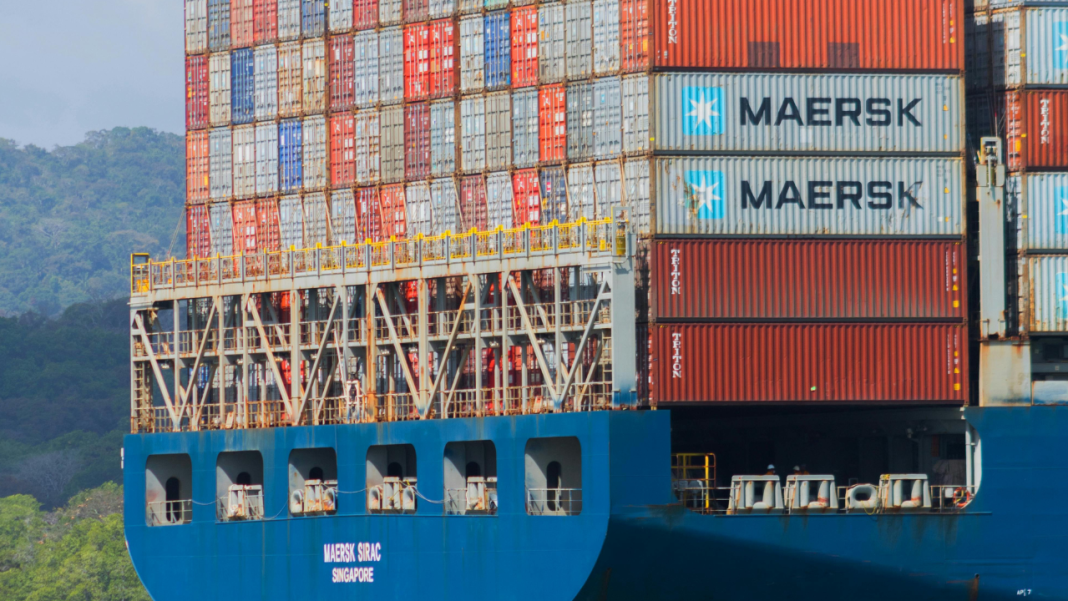
Ghana reached a historic moment last week when the Beijing Maersk, which is a 350-metre dual-fuel methanol vessel with a capacity of 17,480 TEUs, arrived. It became the largest Maersk ship ever to call at Tema Port. Meridian Port Services (MPS) berthed the ship at the joint-venture terminal.
The arrival reinforces Tema’s readiness to service mega vessels. This strengthens Ghana’s role as a strategic transhipment hub in servicing West Africa. It advances lower-carbon logistics in the region. This objective is achieved with the vessel’s methanol-enabled design. This initiative aligns with APM Terminals’2040 net-zero ambition.
As Beijing Maersk carried Ghana’s cocoa, it highlighted a powerful maritime message. That message would be that trade growth and sustainability progress can move forward together.
Given the progress made on the Gaza ceasefire, Maersk is closely monitoring developments in the region. There is no doubt that Maersk prioritises the safety of its crew, assets, and cargo above all else.
Despite ongoing geopolitical and tariff-driven volatility, IMEA trade flows remain quite resilient. It is supported by improved ocean reliability. In addition, there is a clear regulatory direction and sustained investment in digital customs systems throughout the region.
Saudi Arabia has shared that it has fully implemented SABER 2.0. This conformity requires shipment certificates in advance, especially for high-risk goods. The new blockchain-enabled verification strengthens compliance and enhances supply chain transparency.
Impact: implementation of stricter documentation besides timeliness. As such, incomplete certificates can trigger delays.
Maersk Support: Pre-clearance advisory and documentation guidance.
The UAE, Qatar and Oman have had success in deploying digital customs platforms. This reinforces their positions as global logistics hubs.
Impact: Faster, quite predictable clearance for compliant shippers. This would cause delays due to inaccurate documentation.
Maersk Support: Digital tools such as UNITED and Maersk Trade & Tariff Studios, which enable customers to prepare correct declarations and leverage new facilitations.
The operationalisation of the India-EFTA agreement & advanced India-EU FTA negotiations are opening new maritime export corridors. These are for the manufacturing, automotive, FMCG & engineering sectors. These advancements come at a crucial time as exporters navigate the effects of the Carbon Border Adjustment Mechanism (CBAM). Also included is the EU Deforestation Regulation (EUDR), besides tariff fluctuations.
Impact: Competitive edge for exporters. This is by using preferential corridors.
Maersk Support: Trade and Customs Consulting, which includes opportunity mapping and rules-of-origin validation, besides compliance action plans.
Cocoa & grape exporters, both in West and Southern Africa, are ramping up digital certification besides ESG compliance. This is to meet evolving EU import standards.
Impact: Demand sustained for end-to-end visibility. Besides this, it is meant for cold-chain reliability and verified traceability.
Maersk Support: Integrated cold chain & visibility solutions. This is mainly designed to support exporters in sustaining access to premium markets.