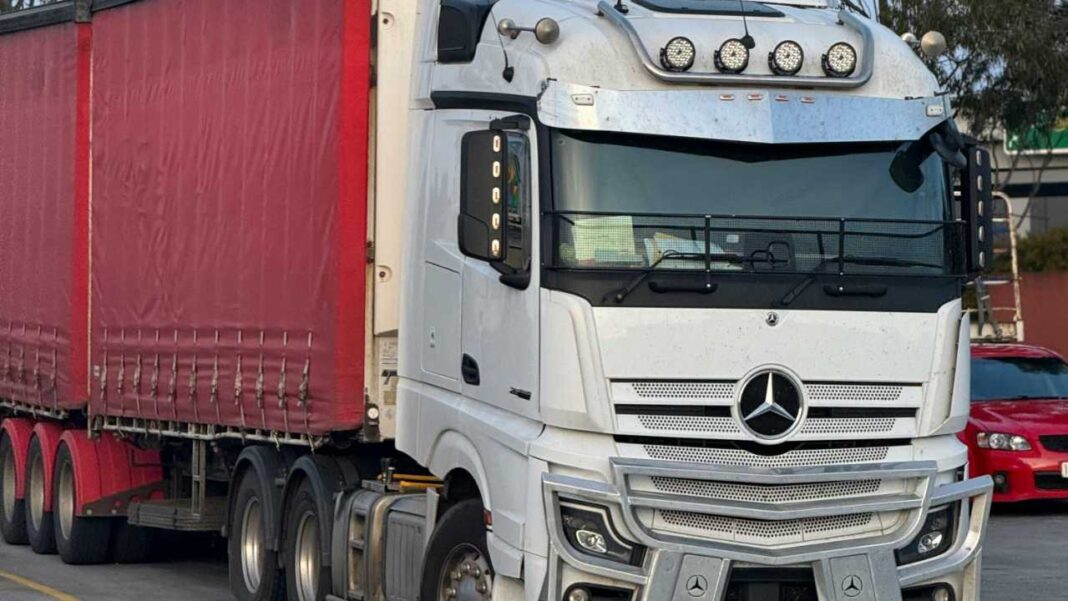
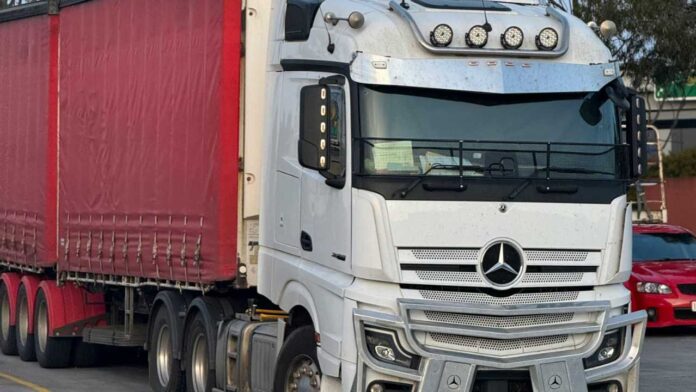

A Daimler Truck fuel-cell vehicle — the Mercedes-Benz GenH₂ Truck — was tested in day-and-night regular logistics shifts, spaced out over a year at Rhenus Group in Duisburg last week. Extensive distances enabled practical, real-world performance insights.
The Rhenus Group has put a Daimler Truck fuel-cell vehicle into regular logistics operation for the first time. In partnership with four other companies, Rhenus is participating in the second phase of a customer-oriented practical testing program for this Mercedes-Benz GenH₂ Truck. The year-long trial aims to generate robust insights for the further development of alternative drive technologies and for their future application in road freight transport.
This hydrogen-powered truck is fully integrated into day-to-day processes at the Rhenus site in Duisburg. It is in use five days a week, both during the day and overnight; as a result, the vehicle operates on the road almost around the clock. Its routes range from regional operations of about 150 kilometres to long-distance hauls of up to approximately 650 kilometres. This broad usage pattern covers a wide spectrum of transport needs, spanning local distribution to demanding long-haul assignments.
Due to high utilisation and diverse transport profiles, the truck tends to achieve exceptionally high daily distances, placing Rhenus among the partners with the most extensive real-world testing experience. Continuous operation enables a reliable assessment of the vehicle’s performance and of its technological maturity under real-life conditions.
Duisburg was intentionally chosen as the test location. As a central hub in the European Rhenus logistics network, it features high transport volumes and is also close to existing hydrogen refuelling infrastructure.
For Rhenus, the primary objective of the field test is to gather operational insights from everyday use — from the refuelling process to the handling of hydrogen-specific systems, as well as range behaviour and refuelling times when compared with diesel trucks. All data and observations are being evaluated systematically in close collaboration with Daimler Truck. The findings will feed into both the strategic assessment of alternative drive systems and the further development of the vehicle technology itself.
The Mercedes-Benz GenH₂ Truck is specifically designed for heavy-duty long-haul transport. Operating with a gross vehicle weight of around 40 tons, it has a range of over 1,000 kilometres. By using liquid hydrogen as its energy source, the truck offers a powerful alternative to conventional diesel vehicles.
Thilo Meutzner, Managing Director of Rhenus Road Freight in Germany, said that, particularly in energy-intensive heavy-duty and long-haul transport, there is significant potential for hydrogen-powered trucks. He added that these field tests help to realistically assess the conditions under which this technology could be adopted more broadly in the future. It is already clear that scaling up will depend heavily on expanding refuelling infrastructure, ensuring the availability of green hydrogen, and establishing competitive cost structures.
From Rhenus’s perspective, cooperative projects of this nature are a key driver in advancing the decarbonisation of heavy-duty transport. Close collaboration between vehicle manufacturers and logistics providers makes it possible to develop technological innovations in practice and to incorporate operational requirements from the outset.
“As an international logistics service provider, we see ourselves not only as a user but as an active partner in advancing sustainable transport solutions,” Meutzner said. “By gradually integrating alternative drive technologies, we are focused on systematically reducing emissions across the entire value chain. Our collaboration with Daimler Truck plays a concrete role in this effort; it generates insights that will benefit the entire sector.”
Rhenus Group is one of the leading logistics specialists, with global operations and annual turnover of approximately EUR 8.2 billion. Some 41,000 employees work at 1,330 business sites in more than 70 countries, developing innovative solutions along the complete supply chain.