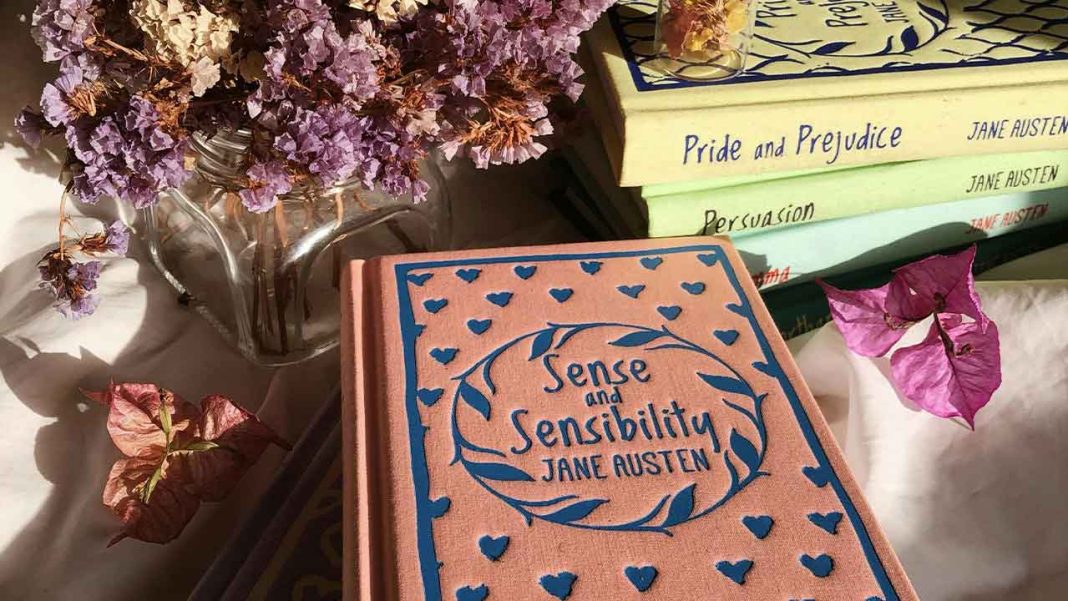

Austen’s novel, Sense and Sensibility, is a small, sharp moral compass pointing squarely at the messy, complicated nature of humanity. The story opens briskly with “The family of Dashwood had been established in Sussex for a long period of time.” The reader immediately understands the setting (Sussex) and the stakes (property claims, family heritage/history/genealogy, and the legal snags involved in obtaining a deceased relative’s inheritance). The plot characteristics and development (characters are developed as a result of their actions/decisions) are preceded by how Austen establishes the setting through description of the characters.
At the heart of “Sense and Sensibility” are the contrasting experiences of two very different sisters: Elinor, who personifies measured restraint, and Marianna, who admires external feelings expressed to an extreme. While Austen creates an argumentative contrast between the two characters and their temperament and their interaction with society, Elinor maintains stability/continuity of family through her quiet intelligence level (keeping family together), and Marianna uses her passionate approaches to experiences to create artwork. The amount of friction (occasionally, this friction is hilarious, and sometimes it is brutal) between the two sisters creates the sparkle within the novel.
Austen uses economical but rich prose, which features many social scalpel-like nuances, to create full worlds at the intersection of ambition, gratitude, and class anxiety. Each casual dinner invitation or small hypocrisy transforms into an entire world of these emotions. The example of Mrs John Dashwood’s early inheritance crisis and her petty politicking illustrates how the legal formalities of these laws create emotional and material precarity for women and turn the domestic into a site for political theatre. The emotional ramifications of money (or lack thereof) are as much a character in Mrs Dashwood as are Marianne Dashwood and Colonel Brandon.
The myriad pleasures of the novel are many and varied. Comedy is evident in Mrs Jennings’s expansive attempts at matchmaking and Sir John’s excessive hospitality, but so too is moral complexity reflected through Colonel Brandon’s quiet suffering and Willoughby’s dangerously charming personality combining to provide an even balance with regards to morality. Many scenes will stick with readers, as the walks Marianne takes that lead up to Willoughby’s notorious tumble over a hillside become so vividly illustrated that readers will feel as if the entire landscape has become its character and an integral part of the overall plot.
Apart from the story, two elements that add to the appeal of Sense and Sensibility are the concept of “taste” and the presence of an ironic narrator.
In terms of “taste”, virtually all the art forms and literature that the characters engage in (i.e., music, drawing, and reading) serve as an indication of their moral and aesthetic fitness (or lack thereof). The ways in which Marianne displays her love for music and Elinor demonstrates more stable enjoyment show where each character stands in relation to the ethical universe that connects them.
As far as the narrator is concerned, the technique Austen employs will allow readers to admire a character before she undermines that admiration with an ironic comment (often a few lines later). By utilising this method, Austen also teaches the reader to read each person and the society in which they live with greater subtlety.
Austen uses humour that is both satirical and edgy, combined with a type of love and kindness, to create a new way for her new and returning readers to perceive her style and content overall; for instance, something that may have been taken for granted by one generation of readers could be interpreted differently by today’s readers, or something humorous or ironic from the past may evoke a much more emotionally powerful response in a different time period.
In each instance, the novel will appeal to readers who want a dramatic escape through literary works as well as those who want to have some moral contemplation (e.g., “to develop an appreciation of the moral consequences of reading what we are reading”).
As a last intriguing curiosity, Austen makes something that could have simply been an intimate domestic melodrama into an ongoing investigation of the public structures (laws, money and class) that affect private emotions. Every heartbreak feels like a political act, and every reconciliation can be seen as a miniature social agreement or treaty. So, as you read Sense and Sensibility you’ll be forced to extend and sharpen your sympathy. The book will give you a humane education in the guise of a warm, enjoyable read.