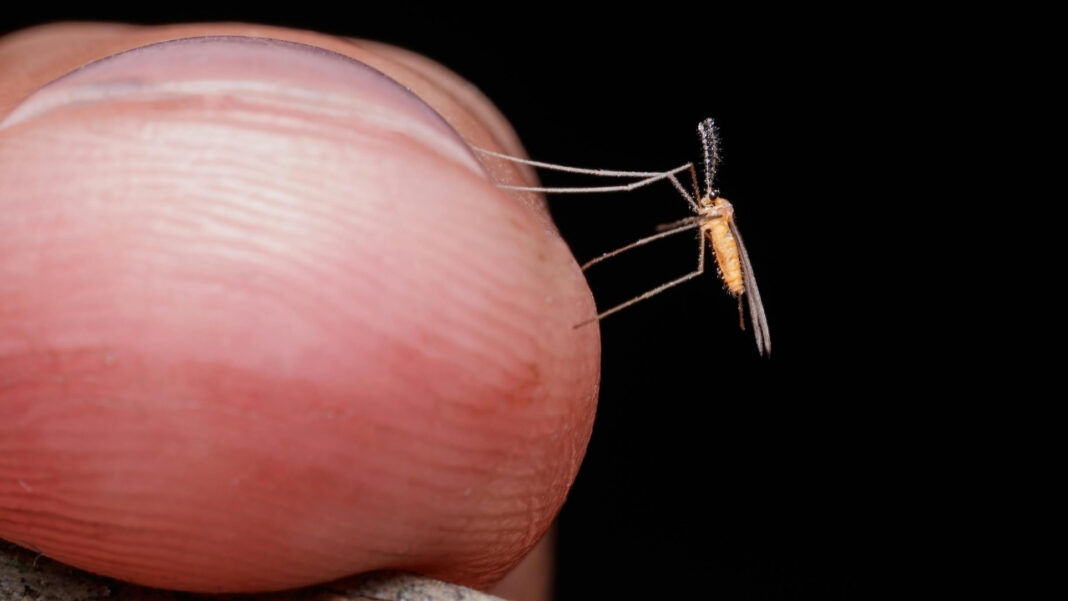

Researchers from Georgia Tech and the Massachusetts Institute of Technology created a model to predict how female mosquitoes fly when hunting humans. The researchers observed hundreds of mosquitoes flying around a volunteer. They collected 20 million data points to study their movements.
The study published in Science Advances is the first to show how mosquitoes fly visually. It can help improve mosquito control. It may also help reduce diseases. Mosquitoes are not just annoying; they can spread dangerous diseases like malaria, yellow fever, and Zika. These diseases kill more than 700,000 people each year. By understanding how mosquitoes behave, scientists can find better ways to catch and control them.
The researchers made an interactive website. People can see how mosquitoes fly and respond to different signals. To collect data, they used 3D infrared cameras. The cameras tracked mosquitoes as they moved around objects. The team studied how mosquitoes reacted to colours, shapes, and carbon dioxide from humans. In one test, a volunteer sat inside a chamber. He wore clothes in different colours. The researchers watched how mosquitoes moved around him. They wanted to see where mosquitoes liked to land. The study focused on female Aedes aegypti mosquitoes. These are also called yellow fever mosquitoes. They live in places like the southeastern United States, California, and many other parts of the world.
The study revealed that mosquitoes do not swarm together because they follow each other. Instead, each insect responds independently to environmental signals, often arriving in the same spot at the same time. David Hu, a professor at Georgia Tech, compared it to a crowded bar: people go there for drinks and music, not because they followed each other. Mosquitoes behave in a similar way, following the cues that attract them rather than copying one another.
The researchers ran three main experiments using different combinations of visual cues and carbon dioxide. In the first, mosquitoes were attracted to a black sphere but only while flying toward it. Once they reached the sphere, they often flew past without lingering.
In another test, the team used a white sphere combined with carbon dioxide. Mosquitoes approached more slowly, and only if they were nearby. Interestingly, the insects appeared to “double check” the object before settling around it.
The most effective setup combined a black sphere with carbon dioxide. This combination caused mosquitoes to swarm, remain around the target, and attempt to bite. “We knew visual cues and carbon dioxide attracted mosquitoes, but we didn’t know exactly how they used both cues together,” said Christopher Zuo, a Georgia Tech master’s student who led the study. “They behave like tiny robots we just had to figure out the rules.”
Once the researchers understood how mosquitoes responded to stationary objects, Zuo tested their attraction to humans. He wore black, white, or mixed outfits and stood in the chamber with mosquitoes circling him. Cameras captured the flight paths, which were later analyzed by MIT researchers to identify the most likely patterns.
The results showed mosquitoes treated Zuo’s body like an object, with the largest swarms forming around his head and shoulders, their usual biting targets. When Zuo wore long sleeves, pants, and covered his head, he experienced fewer bites.
The team made an interactive website. Users can watch mosquito behavior in real time. They can change cues, colors, or carbon dioxide levels to see reactions. Users can also upload a photo as a target. The tool helps scientists and the public understand mosquitoes better.
The researchers hope their findings will lead to improved mosquito control methods. For example, suction traps currently use constant cues, like steady carbon dioxide or light, to attract mosquitoes. Zuo explained that activating these cues intermittently might work better, as mosquitoes do not always stay at the target if both signals are not present at the same time. This research helps us understand how mosquitoes behave. This could help stop the spread of deadly diseases around the world.