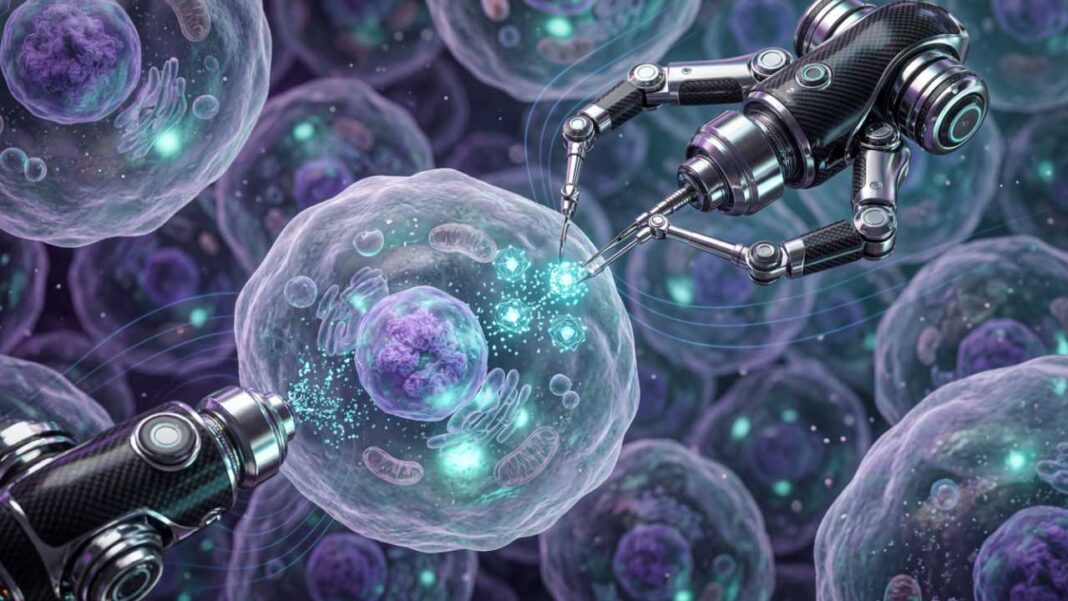

Science & Technology (Commonwealth Union) – Scientists from the Indian Institute of Science (IISc) have produced a new technique for the precise quantum sensors through thick biological environments—such as the inside of living cells—using magnetic microbots. The approach could enable real-time, minimally invasive monitoring of factors like local viscosity and temperature within cells.
Cells are soft and gelatinous, which makes it difficult for extremely small particles to move around inside them. Nanometre-scale quantum sensors, for instance, struggle to travel freely because viscous drag slows them down, making measurements harder to obtain.
Ambarish Ghosh, professor at the Centre for Nanoscience and Engineering (CeNSE) at IISc and corresponding author of the study published in Advanced Functional Materials indicated that in soft environments, measurements depend on the chance that the analyte comes close to the sensor and the question remains is whether they can instead move the sensor closer and scan the surroundings for the analyte.
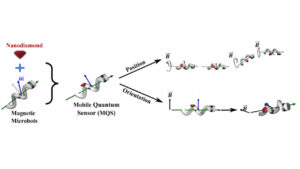
To tackle this problem, Ghosh’s team paired a nanodiamond quantum sensor containing a nitrogen-vacancy (NV) defect with a magnetically guided microbot.
When a nitrogen atom takes the place of a carbon atom in the diamond lattice next to an empty site, an NV defect forms.
Electrons at this defect contain quantum spin states that react according to their atmosphere. Researchers gave an example, where alterations in temperature, magnetic fields, and other physical properties can alter the spins in ways that are measurable.
When a laser was shined on the nanodiamond, it sends off fluorescence that can be utilized to get to know a lot of things in regards to the cell. However, the most challenging component was described as putting the sensor in the right place. On prior occasions scientists made use of optical tweezers, which are tightly focused laser beams, to move nanodiamonds. However, the strong light used in this method can hurt or kill living cells.
The IISc team resolved the issue by linking the nanodiamond sensor to a microbot that was controlled by magnets and passed via the fluid in a corkscrew-like motion. As a result of the microbot having iron in it, it has the ability to respond to a rotating magnetic field that is applied from the outside. The microbot spins to match the field as it rotates. Because it is shaped like a helix, this rotation moves it forward. The researchers were able to control the sensor’s movement in three dimensions with no need for light as a resultof this design. Light is only used for fluorescence-based measurements, not for propulsion. This helps lower phototoxicity and unwanted heating.
An additional issue at the nanoscale is that molecules around the sensor move randomly, which is called Brownian motion. This can make the sensor change its orientation in ways that are hard to predict.
This effect can introduce noise and weaken the sensitivity of measurements.
However, by precisely controlling the microbot’s orientation with the external magnetic field, the researchers were able to stabilise the nanodiamond, limit noise, and obtain a clearer signal.
“We are able to counter brownian motion with magnetic manipulation. This makes this platform more promising than optics or any other techniques,” explained Ghosh.
To build their sensor, the researchers had to carefully integrate a nanodiamond with a magnetic micro-motor while ensuring that the properties of each component did not disrupt the other. “It was not straightforward because the sensor itself could be influenced by the magnetic elements,” explains Eklavy Vashist, Research Associate at CeNSE and the study’s first author. The team solved this challenge by placing the nanodiamond about one micron away from the iron head of the microbot, where the motor’s magnetic field has little to no impact on the sensor.
According to Ghosh, the sensor could also be used to explore the interior of living cells and detect molecules such as Reactive Oxygen Species (ROS), which play an important role in processes like cancer development and ageing.