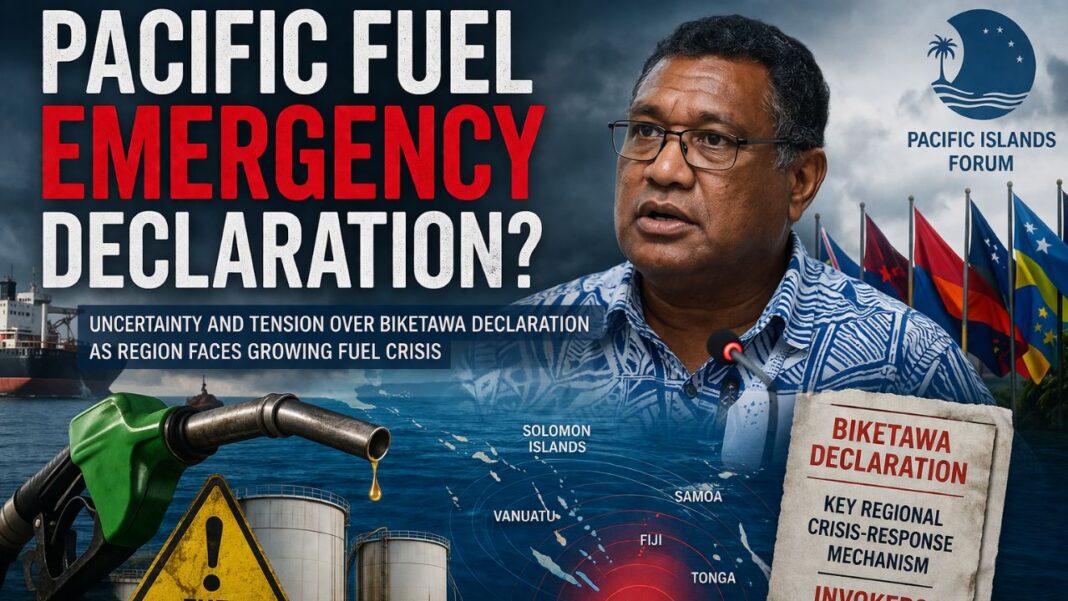

A report which was done by the Australian Broadcasting Corporation (ABC) News on 23rd April 2026 has raised many questions regarding whether a formal declaration for fuel emergency had been sent out by the Pacific or if it were just political statements which moved faster than official regional agreement.
This confusion rose to the surface after Jeremiah Manele, who is the Prime Minister of the Solomon Islands and the Pacific Islands Forum (PIF) chair, had announced that the Biketawa Declaration had been invoked by the Pacific leaders. This act comes as a key regional crisis-response mechanism. As declarations such as these are normally used for highly major emergencies, which include the COVID-19 pandemic and security investigations which were held in the past.
Manele’s announcement suggested the Pacific was entering a coordinated phase of “high alert” to prepare for possible fuel shortages linked to global instability and disruptions in oil supply chains. The move was widely interpreted as a formal regional emergency response, signalling concern that fuel imports are critical for electricity generation, transport, and essential services, as they could soon be severely affected.
However, high uncertainty was highlighted in this report, which was done by ABC. The uncertainty reigned about whether there had been an agreement to trigger a declaration made by all Pacific Island Forum members. It was reported that numerous countries were not consulted before the announcement was declared and that it remained uncertain if the troika of leaders possessed the authority to activate the mechanism unilaterally.
This has prompted the region to go into a stage of diplomatic tension, which, according to some reports, has left some countries also in a state of surprise due to the public framing decision. Even though there are large agreements that the Pacific continues to face fuel security risks regarding the growing fuel crisis, as a result of this situation, leaders are still left divided on how formal and urgent the regional response should be.
Some analysts say the unclear declaration may still boost coordination between Pacific governments and partners like Australia and New Zealand, while others warn it could weaken trust and delay decisions. It remains uncertain whether the Pacific has formally entered a fuel emergency framework or if leaders are still negotiating a coordinated regional response plan.