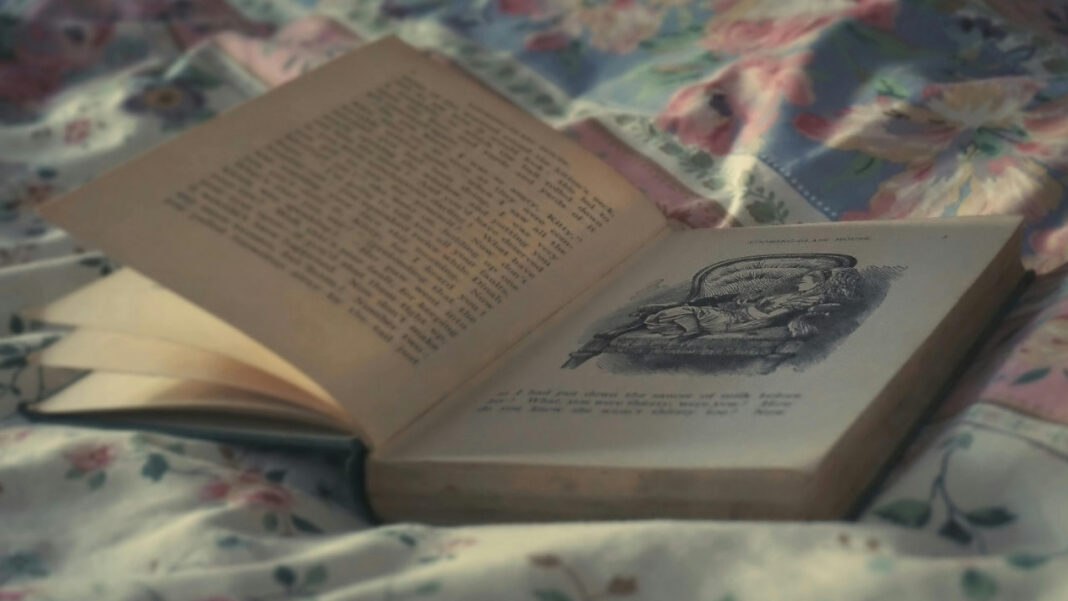

A small number of works of literature throughout history have ever so skilfully blurred and confused the boundaries between fantasy and philosophy in literature, as has Lewis Carroll‘s Alice’s Adventures in Wonderland ( 1865). This timeless tale of a little girl who follows after a white rabbit is much more than an ordinary children’s story—it is an incredible maze of logic, satire, absurdity, and fantasy that will continue to enthral those who pick it up long after, over one hundred fifty years later.
At the very first moment when Alice “fell down the rabbit hole.”, Carroll leads readers into a world where what should normally be impossible seems instead plausible. Bunnies race with alarms, caterpillars philosophically question their identity, and words spiral off into riddles and paradoxes. The financial surface has a depth and a wisdom that are remarkably intelligent, which encourages people to challenge outside of what they consider normal. Carroll teaches us to question whatever societal “norms” we might accept as facts because he has written an incredibly ingenious piece that blurs fantasy and philosophy in innovative ways.
The novelty in the story is not only that Lewis Carroll was a writer but also that at the University of Oxford he was an academic mathematician. His educational influence can be seen throughout the telling of this story through wordplay, puzzles (logical), and reverses (in a story-telling sense) as well as nonsensical dialogue that would be interpreted like thought experiments (similar to mathematics) by way of his characters. A prime example of this influence is the Mad Hatter‘s Tea Party, which can be interpreted as nothing but comedic chaos; however, it represents a satirical view against the rigid nature of Victorianism and the illogical nature of time itself.
The principal reason this story works is because Alice (the main character) represents humanity through her various characteristics of curiosity, scepticism, intelligence, obsessive frustration and extreme annoyance in trying to find meaning in a world where very little makes any sense at all, as well as how similar readers might relate to her through their own confusion and sense of wonder. Furthermore, throughout the story, as Alice grows and decreases in size, Carroll explores the many complex themes of identity, growing up, and self-awareness— ideas that many will find very deep in comparison to what most people believe to be just a story for kids.
The absurdity of Wonderland’s unusual characters is part of what makes them unforgettable. The Cheshire Cat, with his wide grin; the tyrant Queen of Hearts; and the White Rabbit, who is always late, have all become cultural icons and characters that transcend literature and have become known throughout the world. Their dialogue is some of the most quoted in literature, as it reflects human irrationality.
The novel also has an additional dimension of magic through the collaborative illustrations by John Tenniel. His haunting but whimsical artwork has contributed to defining visually the world of Wonderland and to influencing years of fantasy artwork, film, and animation. Without Tenniel’s iconic illustrations, the world of Wonderland might not have had the same strong image in the reader’s mind.
Another reason why this book is so special is because of how timeless it is. There are many issues that contemporary readers will identify with today: confusion, change, anxiety, and questioning in an increasingly unpredictable world. Just as Wonderland is a reflection of the world that we live in today: a place where the rules are constantly being changed, authority figures seem ridiculous, and deeper meaning usually does not reveal itself until after the chaos is over.
Alice’s Adventures in Wonderland forever rewrote the definition of children’s literature, transitioning from the Victorian ideal of morality-driven storytelling to one of pure imagination, which provides the opportunity to educate, encourage, invigorate, and inspire people using mere imagination alone.
To read Alice is to give yourself over to curiosity itself. Each page of the book allows you to lose yourself in Alice’s dreamlike world, where you experience nonsense that ultimately reveals challenging truths regarding logic, society, and human nature.
This work of pure art is whimsical and intellectual, playful and philosophical, and chaotic and orderly at all times. It is a true artistic creation that continues to grow more interesting each time it is read again.