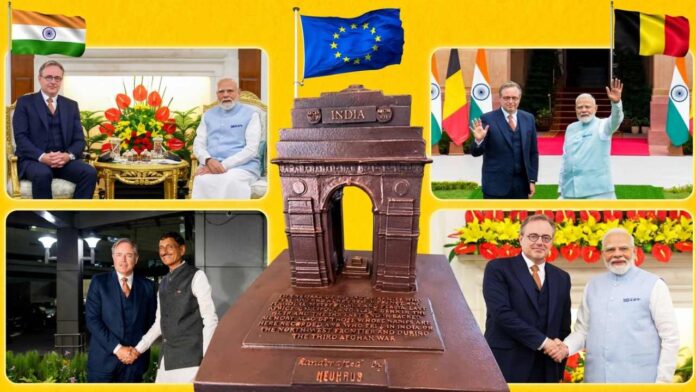

India (Commonwealth Union)_ Belgian Prime Minister Bart De Wever’s three-day visit to India this week marked an important step in relations between the two countries. It was his first India visit since becoming prime minister in February 2025 and the first by a Belgian prime minister in nearly two decades. De Wever travelled with Belgium’s Defence Minister and Minister of Foreign Trade Theo Francken, senior officials, business leaders and representatives of the Belgian defence industry. His agenda covered defence, trade, investment, technology, renewable energy, critical minerals, connectivity and people-to-people ties. A wider objective was to strengthen Belgium’s role in India-EU relations following the conclusion of the India-EU Free Trade Agreement negotiations.
Also read: One chair, three titans, a big race: The final battle for Tata’s top chair heats up! Who will win?
A warm welcome
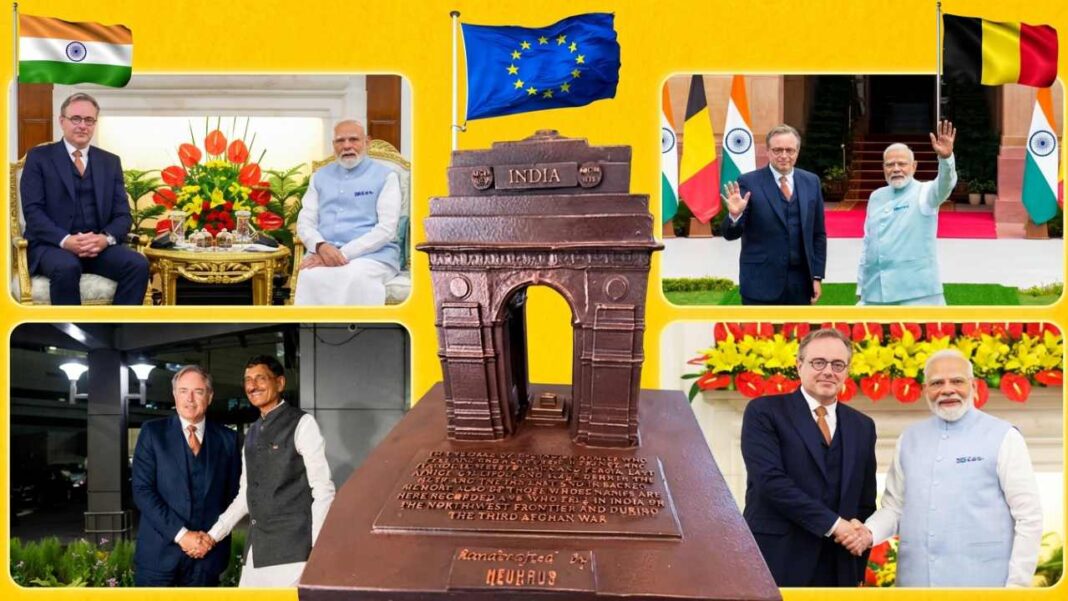
De Wever was welcomed in New Delhi by Minister of State for Defence Sanjay Seth. He began his program by paying tribute to Mahatma Gandhi at Rajghat, a symbolic start to a visit centred on strengthening long-standing ties. Prime Minister Narendra Modi later hosted De Wever and the Belgian delegation for a luncheon. The two leaders then held detailed discussions on bilateral, regional and global issues, with particular attention to areas where both countries see scope for practical cooperation. The visit also included a strong business component. Belgian officials and companies joined the delegation, reflecting Brussels’ interest in expanding commercial ties with one of Europe’s fastest-growing major economies.
The chocolate diplomacy
De Wever brought a distinctly Belgian touch to the visit with a chocolate replica of India Gate intended as a gift for Modi. But the sculpture was damaged during the journey, prompting the Belgian leader to joke that chocolate may be excellent for diplomacy but not for diplomatic travel. Behind the light-hearted moment was a serious historical message. De Wever referred to the Indian soldiers who fought and died in Belgium during the First World War, particularly in the Flanders region. He said their sacrifice remains an important link between the two countries. He promised to send a replacement chocolate replica from Belgium, this time hoping it would arrive intact.
Bilateral meeting
The main political engagement took place between Modi and De Wever in New Delhi. Their talks covered defence and security, trade and investment, renewable energy, technology, semiconductors, critical minerals, maritime cooperation and connectivity. Both sides want to diversify the relationship beyond traditional areas such as diamonds and pharmaceuticals. Belgium sees opportunities for cooperation with India in advanced manufacturing, clean technology, defence production, chemicals, nuclear energy and critical supply chains.
The leaders also highlighted the importance of the new India-Belgium Strategic Dialogue, launched in Brussels in July 2026. The initiative gives the two countries a regular platform to discuss political, economic, security and technological issues. The two sides also agreed to work towards doubling bilateral trade over the next five years and welcomed an Investment Fast-Track Mechanism to help businesses overcome regulatory and other investment-related obstacles.
Bart De Wever praises India
Belgian Prime Minister Bart De Wever praised India’s remarkable transformation and growing global influence during his visit to New Delhi. He described India as a major economic and technological power and an increasingly important player in global affairs. Speaking alongside Prime Minister Narendra Modi, De Wever called India the world’s largest democracy and one of the fastest-growing major economies. He said India’s influence now stretches far beyond South Asia, making it an important partner for Belgium. De Wever also highlighted the changes India has undergone over the past two decades, particularly during Modi’s tenure. His remarks reflected Belgium’s growing interest in strengthening ties with India across trade, technology, defence and other strategic areas.
MoUs signed
The visit produced several government-level agreements and institutional outcomes.
- The Letter of Intent on Defence Cooperation will provide a formal framework for expanding defence ties, including military exchanges, training, research and industrial cooperation.
- The Memorandum of Understanding on Renewable Energy will strengthen cooperation in clean energy and support wider efforts towards a sustainable energy transition.
- An agreement was also signed between India’s Central Bureau of Investigation and Belgium’s Federal Police on combating transnational organised crime, cybercrime and related offences.
- Another MoU between India’s Ministry of External Affairs and Belgium’s Ministry of Foreign Affairs will promote cooperation in diplomatic training.
- The two countries also agreed on an Investment Fast-Track Mechanism, a Dialogue on Consular Matters, the appointment of a resident Indian Defence Attaché in Brussels, and the institutionalisation of the India-Belgium Business Forum.
Defence MoUs
Defence-industry cooperation was another major outcome. The agreements included:
- Society of Indian Defence Manufacturers (SIDM) and Belgian Security and Defence Industry Association (BSDI)
- Larsen & Toubro Ltd. and Exail Robotics SAS, France, and Exail Robotics Belgium
- Kalyani Strategic Systems Ltd. and FN Herstal
- Tembo Classic Engineering Pvt. Ltd. and Lachaussée SA
- India Optel Ltd. and OIP
- Krishna Industries Pvt. Ltd. and Pitagone
- DGVK Enterprises Pvt. Ltd. and Sol1 BV
- Kalyani Strategic Systems Ltd., Thales Belgium S.A. and Thales India Pvt. Ltd.
Together, these agreements indicate that defence ties are moving beyond government-to-government discussions towards deeper industrial partnerships and joint opportunities.
Confederation of Indian Industry (CII) business event
De Wever’s program moved to Mumbai the next day, where economic and commercial issues took centre stage. He visited the Bharat Diamond Bourse, highlighting one of the oldest and most important links between Belgium and India. Antwerp remains a global centre for the diamond trade, while Mumbai and Surat are major hubs for India’s diamond industry. He also inaugurated the renovated and expanded HRD Antwerp laboratory at Bandra Kurla Complex. The facility underlined the continuing importance of Belgium-India cooperation in diamond grading and the wider jewellery industry. De Wever also participated in business and industry engagements, including a networking event involving the Port of Antwerp-Bruges. He addressed a Confederation of Indian Industry business event focused on the India-EU Free Trade Agreement and opportunities for companies on both sides.
Also read: Vijay joins Modi and Rahul in the 2029 PM race: How did Vijay become a serious contender for India’s PM post in just two years?
India-EU Free Trade Agreement
The India-EU dimension was central to the visit. India and the European Union concluded negotiations for their Free Trade Agreement on January 27, 2026. The agreement still needs to go through the required legal and approval procedures before implementation. For Belgium, the deal presents an opportunity to expand its economic relationship with India while strengthening broader European engagement with New Delhi. During the visit, Modi and De Wever welcomed the conclusion of the FTA and called for progress on the India-EU Investment Protection Agreement and the Geographical Indications Agreement. They also welcomed progress under the India-EU Trade and Technology Council. Belgium’s position inside the European Union gives its relationship with India added importance. Hence, cooperation between Brussels and New Delhi on trade, technology, investment and supply chains can contribute to the wider India-EU partnership.
Belgium supports India’s UNSC bid
The relationship also has a political dimension. Belgium reaffirmed its support for India’s candidature for permanent membership of a reformed and expanded United Nations Security Council. Both countries backed the need for a more representative UN system and agreed to support each other’s bids for non-permanent membership. India is seeking the 2028-2029 term, while Belgium is seeking the 2037-2038 term. This support adds another layer to the growing strategic relationship between the two countries.
Other engagements
Beyond formal talks, De Wever’s itinerary was designed to strengthen links between governments, businesses and institutions. His meetings with business representatives, his visit to the diamond sector and his engagement with the ports and logistics industry all reflected Belgium’s interest in expanding its economic footprint in India. The visit also built on the Belgian economic mission led by Princess Astrid in 2025, which brought hundreds of participants from companies, chambers, universities and public institutions to India. Education and people-to-people connections are another part of the relationship. Thousands of Indian-origin residents live in Belgium, while Indian students continue to study at Belgian universities, including KU Leuven, Ghent University and the University of Antwerp.
Belgium-India relations
India and Belgium established diplomatic relations in 1947, soon after India became independent. Their relationship has since developed around trade, investment, education, technology and strong people-to-people links. Economic ties are expanding beyond the traditional diamond trade. Belgium has expertise in pharmaceuticals, chemicals, machinery, transport and maritime logistics, while Indian companies are strong in pharmaceuticals, engineering, diamonds, chemicals and automotive components. Critical minerals, semiconductors, defence manufacturing and clean energy could become the next major areas of cooperation. The two countries are also seeking to use their new Strategic Dialogue to give the relationship greater continuity. The 80th anniversary of diplomatic relations in 2027 will provide another opportunity to showcase this expanding partnership.
Concluding the visit
De Wever’s India visit was more than a diplomatic exchange. It combined political discussions, defence cooperation, business outreach and efforts to strengthen the wider India-EU relationship. For India, Belgium offers an important gateway into European markets, logistics networks and institutions. For Belgium, India represents a major economic and strategic partner with growing global influence. The immediate challenge will be turning the agreements signed during the visit into concrete projects. Defence partnerships, investment facilitation, clean energy cooperation, technology links and the India-EU FTA could provide the foundation for the next phase of ties.
The visit also showed how the bilateral relationship is becoming part of a larger India-Europe partnership. By deepening its engagement with India, Belgium can help connect New Delhi more closely with European trade, technology and strategic networks. The next milestone could come when Modi visits Belgium at a mutually convenient time, following De Wever’s invitation. That visit, along with the 2027 diplomatic anniversary, could provide another opportunity to build on the momentum created in 2026.