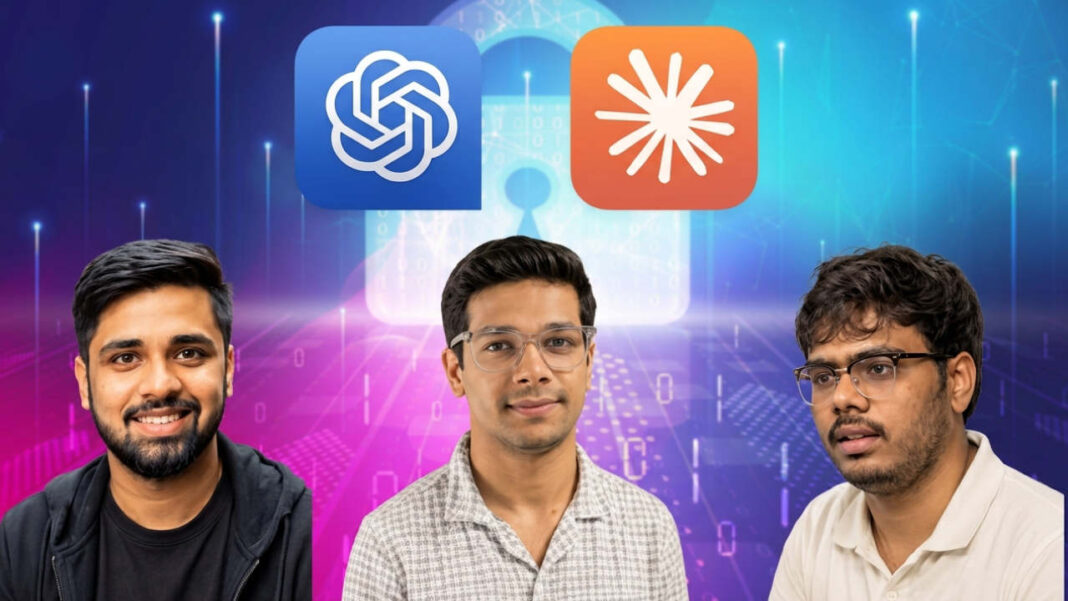

USA (Commonwealth Union)_ Artificial intelligence is rapidly changing the world of technology, and Indian engineers and cybersecurity researchers are increasingly finding themselves at the centre of that change. Accordingly, a recent security test involving OpenAI is one example of how skilled Indian researchers are using advanced AI tools to solve complex problems that once required far more time and resources. Three Indian-origin cybersecurity researchers, Mohan Pedhapati, Harsh Jaiswal and Rahul Maini, used Anthropic’s Claude AI while testing vulnerabilities in OpenAI’s systems. The researchers, who are part of cybersecurity startup Hacktron AI, were working under OpenAI’s bug bounty programme, which rewards security experts who discover and responsibly report weaknesses.
According to media reports, the team was able to connect two separate vulnerabilities and reach parts of OpenAI’s internal systems in less than 72 hours. Their work began with OpenAI’s community forum, which uses third-party software called Discourse. The researchers discovered a weakness involving the way certain image files were processed and used Claude to help develop an exploit. Reports said an earlier attempt using an older version of the AI model had failed, but Claude Opus 5 helped the researchers turn their findings into working exploit code. This eventually gave them remote access to OpenAI’s Discourse environment.
Also read: Meet India’s youngest female chess-rated player: But how old is she?
The researchers then identified another weakness involving OpenAI’s single sign-on system. This allowed them to obtain authentication information associated with employee accounts for services including ChatGPT and Codex. Using one compromised employee account, the researchers were able to reach OpenAI’s private GitHub environment. They demonstrated access to an internal software repository by submitting a pull request through an employee’s Codex account. Importantly, they did not download or inspect OpenAI’s source code.
Also read: Miss World 2026: Malaysian Tamil girl Taanusiya Chetty makes a stunning Miss World mark!
Once the vulnerabilities were reported, OpenAI fixed the weaknesses and revoked the affected access. The company also paid Hacktron AI a $6,500 bug bounty. What makes the episode particularly notable is the role of AI in the research process. The team reportedly completed the work in under three days while spending less than $3,000 on AI tokens. Claude helped with the initial exploit, while other AI tools, including OpenAI’s own GPT-5.6 Sol model, were used during later stages of the research. The incident is also a reflection of the growing capabilities of Indian cybersecurity talent.
Pedhapati, Hacktron AI’s CTO and co-founder, specialises in web exploitation, source-code review and mobile security. Jaiswal has more than a decade of experience in vulnerability research and has worked with organisations including Project Discovery, Zomato and Cure53. Maini has built a long career in bug bounty programmes and has received recognition from the cybersecurity community. Their work shows that advanced AI is not simply a tool for writing code or answering questions. In the hands of experienced researchers, it can become a powerful aid for solving difficult security problems. For India’s growing technology community, achievements like this highlight the expertise, creativity and determination of engineers who are making their mark on the global cybersecurity landscape.