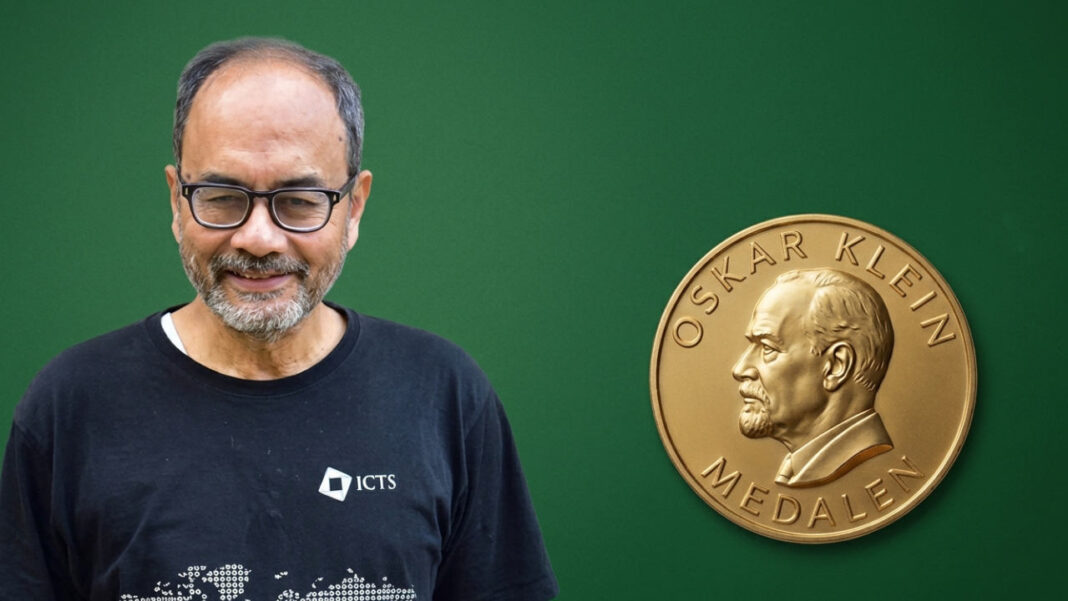

India (Commonwealth Union)_ Indian physicist Ashoke Sen has received the prestigious Oskar Klein Medal, becoming the first Indian scientist to receive the honour. The award highlights India’s growing contribution to global scientific research and recognises Sen’s outstanding work in theoretical physics. Sen is a professor at the Bengaluru-based International Centre for Theoretical Sciences (ICTS), where he holds the ICTS-Infosys Madhava Chair. He received the medal after decades of research that has helped better comprehend string theory, black holes and gravity.
Also read: Thirteen years of learning, one incredible invention: Meet India’s flying car innovator!
Recently, Sen delivered the Oskar Klein Memorial Lecture at Stockholm University‘s AlbaNova Centre. Titled ‘Gravity from Strings and Strings from Gravity’, the lecture explored ideas at the heart of modern theoretical physics. String theory seeks to explain how the fundamental forces of nature fit together, including the relationship between quantum mechanics and gravity. Although many of its predictions remain difficult to test experimentally, the theory offers a possible framework for understanding the universe at both the smallest and largest scales.
Sen is widely recognised for his research on S-duality, black-hole entropy and string field theory. His achievements have earned him several major international awards. In 2012, he received the Breakthrough Prize in Fundamental Physics, followed by the Dirac Medal in 2014. He was also awarded the Infosys Prize in Mathematical Sciences in 2009 and the Shanti Swarup Bhatnagar Prize in 1994. His contributions have also been recognised in India. He received the Padma Shri in 2001 and the Padma Bhushan in 2013. He was also elected a Fellow of the Royal Society in 1998.
Also read: A proud moment for India: Indian social worker Reema Nanavaty wins a prestigious US award!
After completing postdoctoral research in the United States, Sen returned to India and spent many years at the Harish-Chandra Research Institute in Prayagraj. During this period, he developed important parts of his research on string theory. Congratulating Sen, ICTS Director Rajesh Gopakumar praised his presence at the institution and his role in promoting scientific excellence. Sen’s achievement comes amid growing international recognition for Indian scientists. Theoretical physicist Deepak Dhar received the Dirac Medal in 2026 and has also won the Boltzmann Medal. Last year, Indian-origin American physicist Jainendra Jain was among the recipients of the Wolf Prize.
Established in 1988, the Oskar Klein Medal honours distinguished contributions to physics. Named after Swedish physicist Oskar Klein, it is awarded by Stockholm University and the Nobel Committee for Physics of the Royal Swedish Academy of Sciences. Previous recipients include Nobel laureates Chen-Ning Yang, Steven Weinberg and Hans Bethe. Sen’s recognition reflects how Indian scientific talent continues to make a lasting impact on research worldwide.