
Victoria’s trading economy is showing renewed momentum, with new figures from the Port of Melbourne pointing to another year of record container activity and a noticeable change in the kinds of goods moving through Australia’s largest container port.
The Port of Melbourne handled 3.52 million twenty-foot equivalent units (TEU) during the 2025–26 financial year, according to its latest Trade in Review report. The result represents a second consecutive year of record container throughput and provides a significant indicator of the scale of commercial activity across Victoria and southeastern Australia.
Port of Melbourne – Trade in Review FY2026
Trade growth extends beyond household consumption
While consumer products continue to account for an important share of imports, the latest figures suggest that the composition of trade is becoming more closely connected with business investment and industrial activity.
The Port of Melbourne reported stronger volumes in industrial and construction-related commodities during FY2026, with products including cement and gypsum among the areas recording significant growth. That shift is important because cargo movements through the port offer a real-time window into activity involving manufacturers, construction companies, distributors, retailers and other businesses throughout the Victorian economy.
The development comes against an international backdrop marked by tariff uncertainty, geopolitical disruption and changes in global shipping conditions. Rather than producing a broad collapse in cargo movements, however, the latest data indicate that businesses and supply chains have been adjusting to changing circumstances.
Port of Melbourne chief executive, Saul Cannon, has described the changing composition of cargo as evidence of an economy adapting to new international conditions rather than simply losing momentum.
Agricultural exports remain an important pillar
Exports have also retained a diversified base. Agricultural products continue to play an important role in Victoria’s overseas trade, while the latest review identified stronger export activity involving beef, paper and paperboard and scrap metal.
The performance of individual commodities has not been uniform. Softer conditions in products such as cotton and wheat were partly offset by stronger performance elsewhere, illustrating the importance of having a broad export base when international commodity markets fluctuate.
Earlier Port of Melbourne data reflected that more than 660,000 TEU of export containers transited the port during calendar year 2025. This is with agricultural products forming a major component of those shipments. Southeast Asia accounted for more than one-quarter of container exports. This was whilst the United States (U.S.) remained an important destination for Victorian agricultural products.
China reshapes vehicle-import patterns
The automotive sector provides one of the clearest examples of changing international supply chains.
During FY2026, China became the largest source of imported motor vehicles transiting Melbourne. China overtook Japan for the first time. Port data reflects that China’s market share of vehicle imports surged dramatically. That was over the longer term. Also, it increased from about 1% in FY2020 to 28% 6 years later in FY2026.
The change reflects broader developments in global vehicle manufacturing. Also in Australia’s evolving import relationships. It also reflects how changes in manufacturing locations besides international supply chains may quickly become visible at major ports.

Global uncertainty tests supply-chain resilience
The record result has emerged despite several disruptions affecting international commerce.
Changes in U.S. tariff policies and instability surrounding the Strait of Hormuz created additional uncertainty for international supply chains during the period covered by the report. The Port of Melbourne said Victorian trade nevertheless remained broadly resilient, with exporters continuing to access multiple markets and fuel supply chains adapting to changing sourcing arrangements.
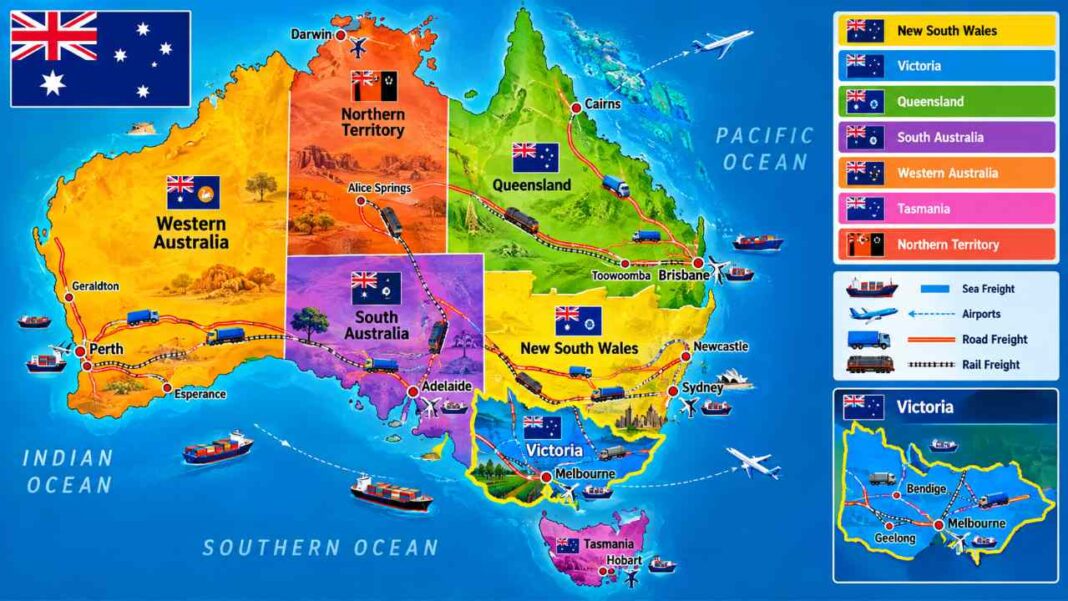
The port’s importance extends beyond Melbourne itself. Its extensive container and general-cargo operations serve businesses throughout Victoria and south-eastern Australia, making changes in throughput relevant to freight operators, manufacturers, agricultural producers, importers, retailers and logistics companies.
Infrastructure becomes increasingly important
The latest record also puts greater emphasis on the infrastructure required to accommodate continuing trade growth.
Port of Melbourne’s previous financial-year results reflected total trade reaching 113.6 million revenue tonnes in FY2025, while container throughput reached 3.39 million TEU. The 3.52 million TEU result in FY2026 followed that earlier record.
With cargo volumes expanding and trade patterns becoming more complex, the efficiency of road, rail, port and distribution networks will remain significant for Victorian businesses. Port performance is therefore not simply a measure of ships and containers; it is closely connected with the ability of companies to receive inputs, move finished products and reach overseas customers.
Port of Melbourne Trade Statistics
A broader signal for Victoria
The latest figures do not mean that every part of Victoria’s economy is expanding at the same pace, nor do port volumes provide a complete measure of economic performance. They do, however, provide a substantial indicator of the scale and direction of goods-based commercial activity.
The combination of record container throughput, stronger industrial imports, continuing agricultural exports and rapidly changing vehicle supply chains points to a Victorian trading economy that is adjusting to a different global environment.
For exporters and importers, the challenge will be to maintain that momentum while managing international volatility, freight costs, changing market access conditions and increasingly complicated supply chains.
For Melbourne, meanwhile, the record reinforces the strategic role of its port as a gateway between Victorian businesses and international markets. As global trade continues to change, the latest figures suggest that the state’s economic story is increasingly being reflected not merely in how much cargo passes through the port, but in what that cargo says about investment, consumption, manufacturing and Australia’s changing commercial relationships with the world.