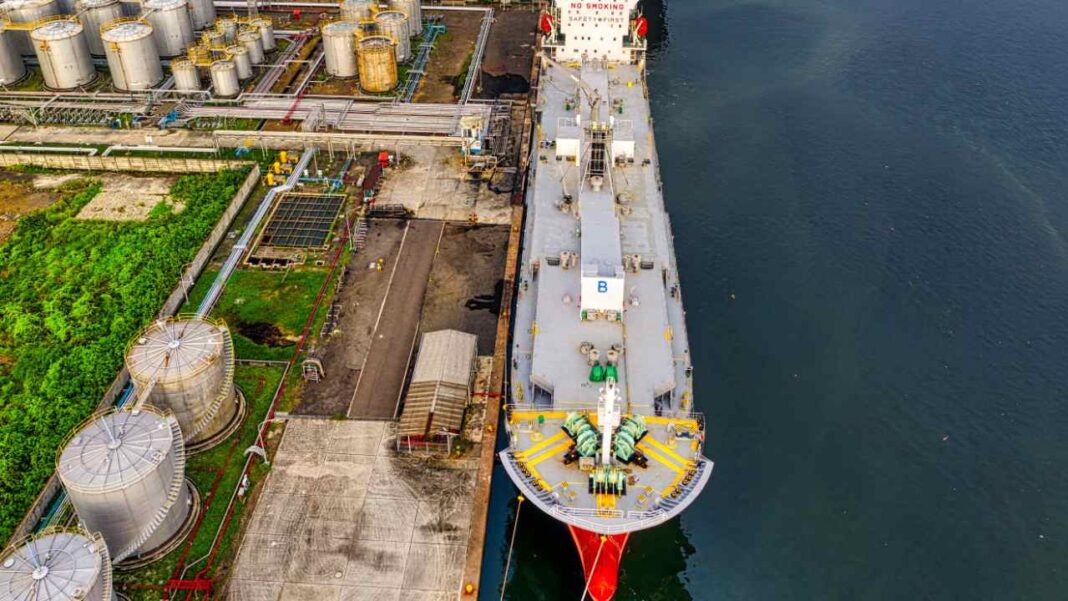

KANDLA, Gujarat, India, October 8, 2026 — What if the next big fuel station for the world fleet is not an oil terminal but a port that will generate fuel using renewable electricity, water, and captured carbon?
This is exactly what India is doing at Deendayal Port, where the foundations for the first-ever port-based e-methanol production facility were laid on 26th September 2026, which may bring about a significant change in India’s position in the global maritime energy chain.
The estimated cost of the ₹2,300 crore project (roughly US$238 million) will be shared by the Deendayal Port Authority (DPA) and Assam Petro-Chemicals Ltd (APCL), as it is going to be a joint venture. Once the facility is ready, it will produce about 150 tonnes of e-methanol per day with the fuel being used in ships on the network between Asia and Europe.
The data becomes fascinating when studying the chemistry, as E-methanol is produced using renewable energy-based green hydrogen and stored carbon dioxide. Unlike traditional grey methanol, which uses fossil feedstock for production, the project focuses on bio CO₂, creating the chance of considerably low carbon marine fuel.
Kandla is not entering the challenge at random.
A partnership between DPA and APCL was announced on the 29th of January 2026. DPA is investing ₹567.32 crore or $58.7 million with 75 acres of port territory, desalinated water and green hydrogen. The investments are quantified into a 76:24 ratio between DPA and APCL.
The project consists of two stages. The first stage implies the development of 50 tonnes of production capacity for an additional amount of ₹1,200 crore or $124.2 million and will be completed by January 2027. The second stage aims to produce 100 tonnes per day, with an estimated investment of ₹1,100 crore, or $113.8 million, to be completed by March 2027.
Realising the facility’s full potential would yield approximately 54,750 tonnes of e-methanol annually. However, the primary challenge arises from the upstream side. The estimates say that to maximise production output, around 28 tonnes of green hydrogen and 206 tonnes of CO₂ are needed every day, as well as at least 250 tonnes of water, which is necessary for the electrolytic dissociation process.
The government states that the new fuel may be produced at a cost of about US$750 a tonne against approximately US$1,300 generated worldwide. Thus, Kandla may achieve a price advantage of around 42 percent. However, the true economic indicators will be known only after the technology is commercially adopted.
Moreover, there is more strategic importance to the timing. According to the International Maritime Organization’s 2023 climate change strategy on the use of greenhouse gas emissions, emissions from operations should reach zero by 2050. And at least 20 percent decrease in the emissions volume with respect to 2008 should take place by 2030.
Kandla has already taken the initial step. On April 2, 2026, Kandla performed India’s first methanol bunkering operation, which signals the intention of the port to not only produce green fuel but also to introduce it directly into the supply chain of maritime logistics.
The initiative is part of India’s larger plans in the field of green hydrogen. The National Green Hydrogen Mission, which was recognised on January 4, 2023, was launched in the amount of ₹19,744 crore (equal to US$2.04 billion) with the goal of producing a minimum of 5 million tonnes of green hydrogen a year by 2030.
Thus, the only question to answer now is not whether ships are able to run on “green” fuel but whether ports like Kandla can produce, store and deliver sufficient volumes of “green” fuel for transforming global shipping supplies. The answer given by India is being prepared already at the docks.