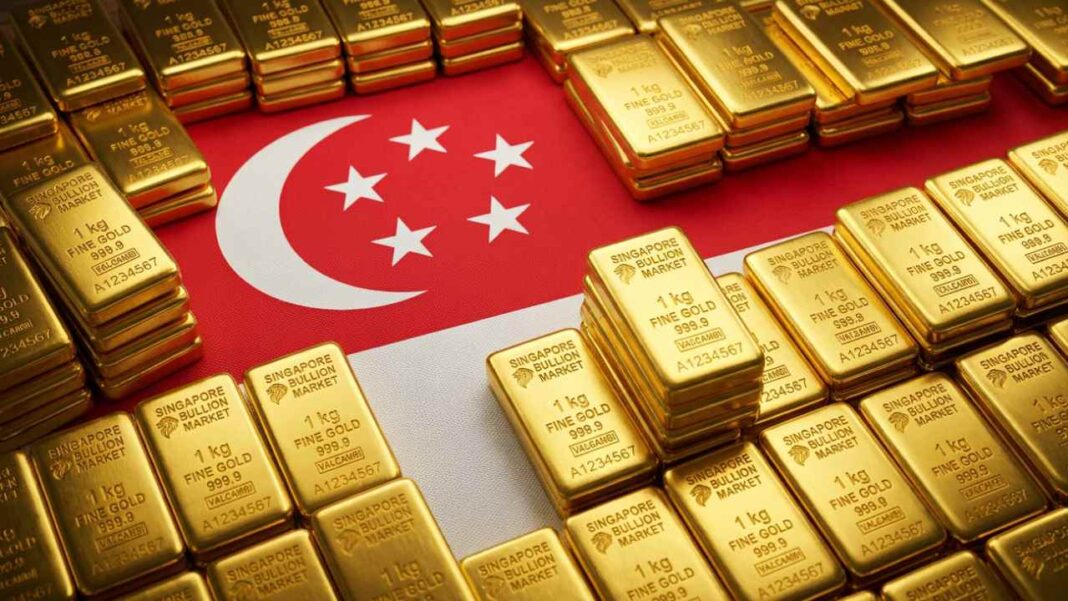


Singapore (Commonwealth Union)_ Wealthy investors are moving their gold from conventional financial centers amid geopolitical tensions, economic uncertainty and fears of financial instability to protect their wealth. This is why Singapore is fast becoming a favorite destination for holding physical gold for high-net-worth individuals from the US, Europe and the Middle East. The city-state is capitalizing on its political stability, business-friendly policies and secure storage facilities to strengthen its position in the world gold market. Additionally, Singapore also benefits from predictable governance, a strong financial system and policies designed to encourage precious-metals trading.
According to reports, precious metals trading firm J. Rothbart & Company estimated that private gold holdings in Singapore had increased around 16-fold since 2014, exceeding 800 tonnes in 2025. Much of this growth came from Europe, with demand expected to remain strong. Singapore’s growing appeal is reflected in its expanding vault infrastructure. Le Freeport, a high-security storage facility often compared with America’s Fort Knox, has a reported capacity of at least 1,700 tonnes of gold. In May, the facility said rising demand had left most of its underground vaults full.
Also read: Passenger drones over Colombo? Sri Lanka gets ready for drone-powered travel!
Another major player is The Reserve, a six-storey secure storage facility near Changi Airport. Its founder, Gregor Gregersen, said it held approximately US$1.5 billion worth of gold and silver. New storage orders from January to April 2025 were up 88% YoY, with sales of bullion bars more than doubling. Most of the new orders were coming from clients overseas, who were worried about market volatility, sanctions and financial uncertainty. A big part of that shift is to maintain less reliance on banks and conventional financial systems. The collapse of Silicon Valley Bank in 2023 has also raised concerns about the strength of financial institutions. In general, a wealthy investor may want to own gold with more direct control over his assets than electronic claims or pooled investments. Private vaults outside the banking system are therefore becoming increasingly attractive.
Also read: India raises concerns over Hindu safety in Bangladesh ahead of Durga Puja!
In addition, the government has provided support for the development of the gold market with tax incentives for qualifying investments in physical precious metals. The Singapore Exchange’s plan to establish a clearing system for over-the-counter gold trades may further boost its status as a regional trading center. The shift is also raising questions about Switzerland’s traditional position as a leading wealth-storage centre. Some European investors have reconsidered their reliance on Swiss vaults after Western governments froze Russian assets under sanctions. This has encouraged wealthy individuals to spread their holdings across different jurisdictions rather than depend on a single country.
The implications of this shift go beyond Singapore. Private wealth moving across borders could put pressure on established financial centers to compete for investment and storage business. Banks also could face pressure to provide better asset protection and clearer custody arrangements. But higher physical gold demand could underpin prices in the long-term although market movements will continue to be dictated by interest rates, inflation and central bank purchases. For the world’s leading economies, the trend underscores a wider worry: trust in financial institutions and government policies is becoming more relevant in where capital is held. Singapore’s rise does not necessarily signal a complete retreat from Western markets, but it shows that wealthy investors are placing greater importance on diversification, security and political stability when protecting their fortunes.