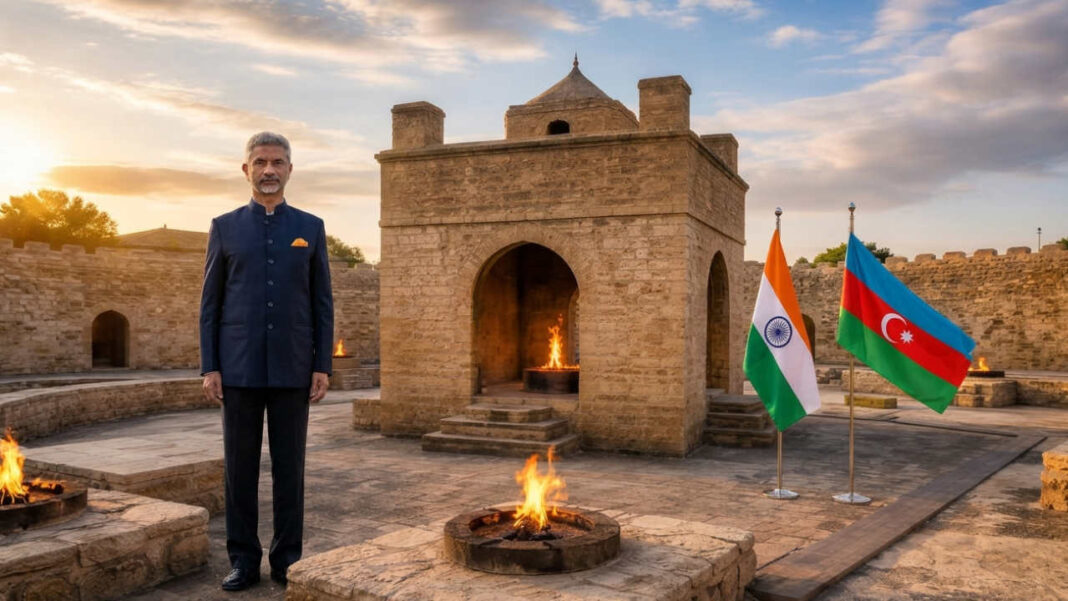

India (Commonwealth Union)_ External Affairs Minister S Jaishankar visited the Ateshgah Fire Temple in Baku during his visit to Azerbaijan this week. The stop was the highlight of a one-day trip meant to review bilateral ties. It was also the first visit to Baku by an Indian External Affairs Minister in eight years, since the late Sushma Swaraj travelled there in 2018. Earlier in the day, Jaishankar held productive talks with Azerbaijani Foreign Minister Jeyhun Bayramov. They discussed ways to strengthen cooperation in trade and investment, energy, tourism and connectivity, and also reviewed regional and global developments. In a joint press statement, Jaishankar said both countries share an interest in peace, progress and prosperity, and described terrorism, conflict and instability as common challenges. He also welcomed the recent agreement between Azerbaijan and Armenia and said he hoped it would bring lasting peace. He also repeated India’s view that disputes should be settled through dialogue and diplomacy.
Standing inside the temple, Jaishankar called it a symbol of the long-shared history and culture between the people of India and Azerbaijan. His words matched what visitors can see on the stone walls: old inscriptions in Sanskrit, Punjabi and Persian, some of them prayers to Hindu deities including Lord Shiva, Lord Ganesha and Jwala. These carvings are traces left by Indian traders and pilgrims who once travelled through this region. The temple sits in Surakhani, on the edge of Baku, and is commonly known as the Fire Temple of Baku. Its name comes from the Persian words “atash,” meaning fire, and “gah,” meaning place. The pentagonal stone complex was built largely in the 17th and 18th centuries by Hindu, Sikh and Zoroastrian merchants and pilgrims travelling along the trade routes. Its central altar is surrounded by small cells that once housed worshippers.
Also read: Passenger drones over Colombo? Sri Lanka gets ready for drone-powered travel!
The site’s story is tied to the land itself. Natural gas reserves beneath the Absheron Peninsula once sent flames up from the ground. These “eternal fires” gave the region its reputation and drew people interested in fire-related religious practices. That helps explain the link to Zoroastrianism, one of the world’s oldest living religions. It follows the teachings of the ancient Iranian prophet Zoroaster and places great value on truth and purity. Fire holds symbolic importance in the faith as a sign of purity and a way to focus prayer. Zoroastrians, however, do not worship fire as a god.
Also read: India raises concerns over Hindu safety in Bangladesh ahead of Durga Puja!
The Indian connection is just as clear. Historical inscriptions and the design of the complex show that Hindu and Sikh visitors also prayed there. Many came from India, travelling along the Grand Trunk Road and the Silk Road to reach the Caspian region. In this way, the temple records a time when trade and faith moved together across borders. Today, the Ateshgah is a museum and one of Azerbaijan’s major cultural attractions. It gives visitors a view of the area’s religious and commercial history. Jaishankar’s visit put that shared past in focus, at a time when New Delhi and Baku are looking to build closer ties.