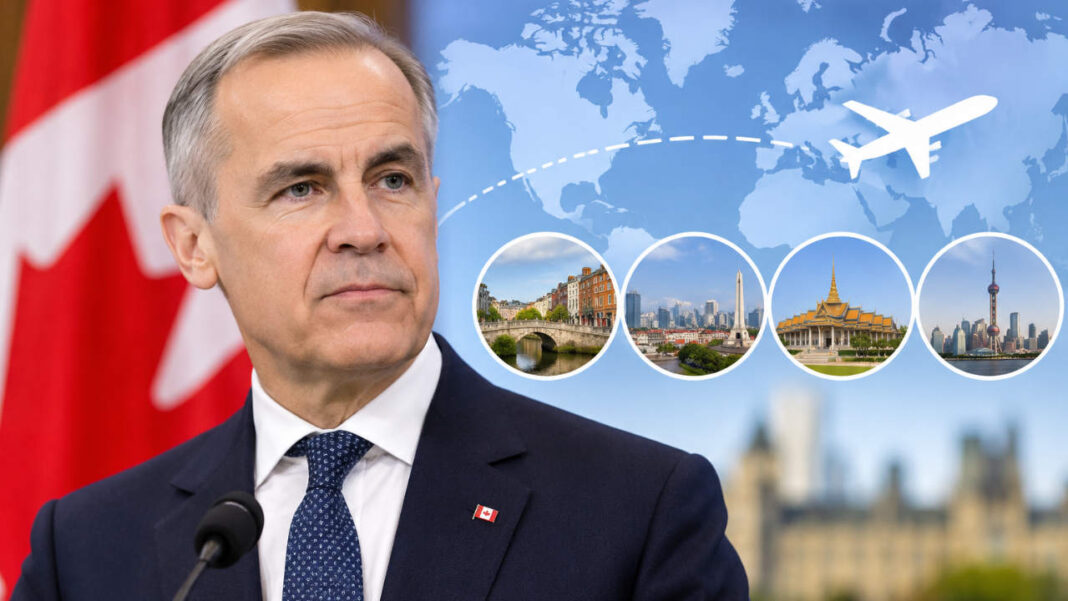
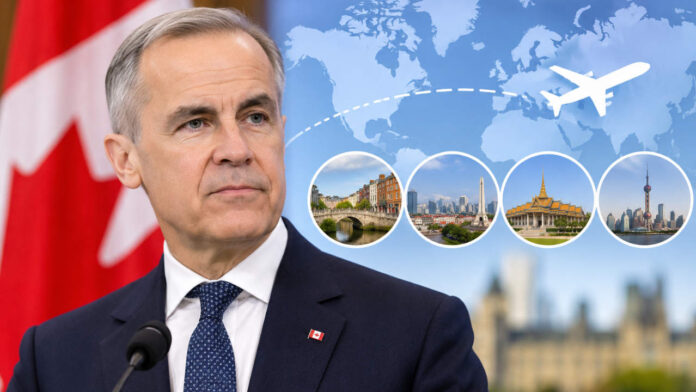

Canadian Prime Minister Mark Carney has begun an international trip to Ireland, the Philippines, Cambodia, and China as Ottawa seeks to strengthen trade, security, and diplomatic relationships. Scheduled from November 11 to 19, the journey includes four major summits during a time of uncertainty in global trade and international relations.
Carney’s first stop is Dublin, where he will attend the European Political Community summit on November 12. Canada is the only non-European country participating. Discussions will cover cooperation on security, infrastructure, and political stability. The visit follows closer engagement between Canada and the European Union, including talks about a possible associate membership arrangement for Canada.
He will then travel to Manila for the Association of Southeast Asian Nations (ASEAN) summit, where Canada is attending as a guest of the chair. Ottawa hopes to advance negotiations on free-trade agreements with ASEAN and the Philippines. Both deals aim to expand Canadian access to Southeast Asian markets. Canada is also developing cooperation with the Philippines in energy, defense, and maritime security.
In Phnom Penh, Carney will attend the Francophonie summit. The gathering offers Canada an opportunity to strengthen relationships with French-speaking countries, including partners across Africa. Canada is due to host the next Francophonie summit in 2028, making this meeting relevant to its preparations and diplomatic priorities.
Prime Minister Mark Carney’s final stop is Shenzhen, China, for the Asia-Pacific Economic Cooperation (APEC) leaders’ meeting on November 18 and 19. He is expected to meet Chinese President Xi Jinping. Carney has stated that he intends to raise concerns about foreign interference in Canada while exploring ways to improve trade ties. Recent discussions have focused on market access for Canadian agricultural and seafood exports.
The trip reflects Ottawa’s effort to reduce its dependence on a single trading partner and build stronger international connections. However, the government faces pressure to prove that summit discussions and agreements deliver practical benefits for Canadian businesses and workers. Ultimately, results will matter far beyond the diplomatic meetings.