
Most of the time, almost every individual has a stage they passed in fashion where they’d think it looked fabulous at the time, when in reality it was just a cringe moment caught in time. Trends disappear, only to return years later with a fresh audience ready to embrace and take back what the previous generation once desperately tried to forget. But fashion’s latest obsession feels particularly amusing: some of the styles making their way back into wardrobes are the very ones people spent years making fun of, claiming they were ‘fashion fails’ or ‘fashion embarrassments.’
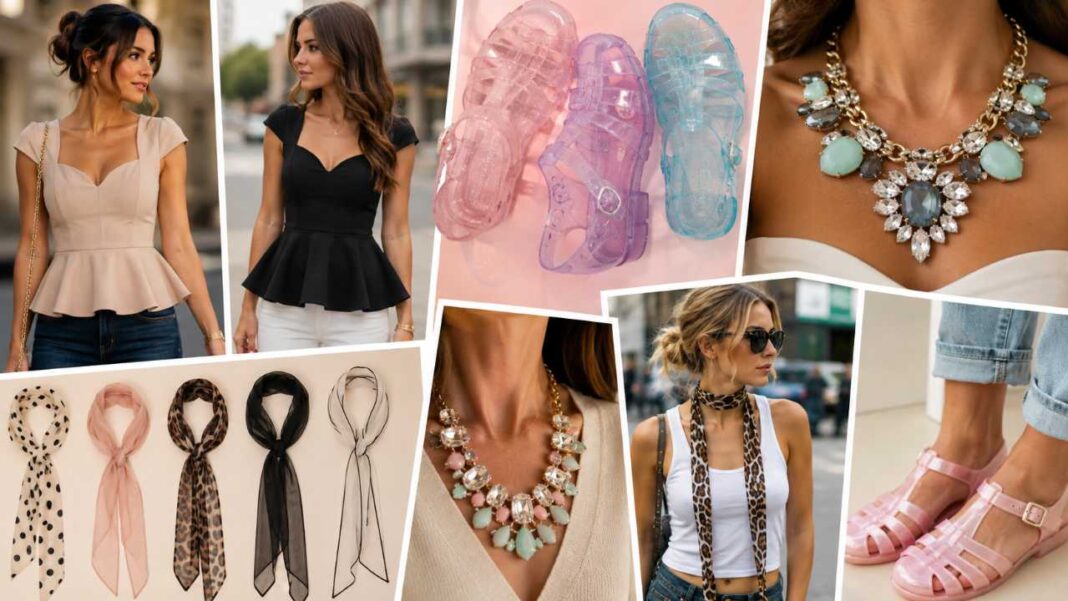
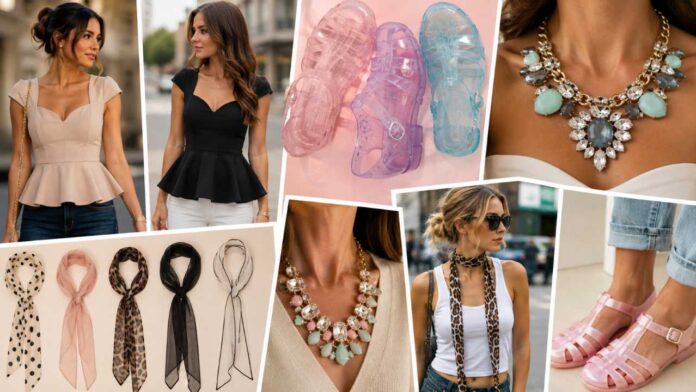
Fashion items such as peplum tops, skinny scarves, jelly shoes, classic Mary Janes, and oversized statement necklaces were once symbols of fashion eras many believed should remain permanently in the past, without a second glance. However, as 2026 continues to bring back nostalgia, these supposedly embarrassing trends are slowly finding their way back onto runways, social media feeds, and city streets, capturing new generations in an unexpectedly new way.
The peplum top is perhaps one of the most surprising returns. This specific fashion statement was initially made popular during the early 2010s; its fitted waist and flared silhouette eventually, with time, became associated with an era many fashion lovers preferred to leave behind. Today, however, designers are revisiting the shape with a more refined, unique, and different approach. Modern peplums are much sharper, more sculptural and sleek, and less focused on the exaggerated ruffles that defined their earlier popularity. Some, even structured with wires in a corset manner, make it a perfect twist of having a taste of old fashion turned with a modern twist.
Then there are skinny scarves. Once wrapped around the necks of celebrities and teenagers throughout the 2000s, these thin accessories eventually became a source of online fashion jokes. Their return ended up showing how quickly public opinion can change when an old item is styled differently. Paired with tailoring, slip dresses, or minimalist outfits, the skinny scarf has gone from a nostalgic relic into an intentional fashion statement.
Jelly shoes are another unexpected revival, as they were at one point, one of the most cringed-at fashion pieces. For many, the colorful plastic footwear brings back memories of childhood rather than high fashion. Yet modern versions have appeared in more sophisticated forms. This proves that even shoes once associated with playgrounds can be reinvented for adult wardrobes, connecting age gaps with no rules in a beautiful manner.
Statement necklaces are also reclaiming their place after years of minimalist jewelry dominating fashion. During the height of the “quiet luxury” era, understated accessories and subtle styling were seen as the epitome of sophistication, pushing these bold and oversized pendants into a shadowed area. Now, fashion appears to be craving personality again. Bold chains, oversized pendants, and eye-catching jewelry that have pops of color and culture are becoming part of a wider movement towards expressive dressing.
So why do trends we once considered embarrassing suddenly become desirable again?
Part of the answer lies in distance. Once enough time has passed, fashion loses some of its emotional baggage. What once felt outdated begins to feel nostalgic. Younger generations who did not experience a particular trend the first time can also discover it without the same sense of embarrassment.
Social media has fastened this cycle. Platforms such as TikTok and Instagram constantly rediscover old photographs and replay them on our feeds and our ‘for you’ page. Celebrity outfits and forgotten fashion moments are redefined again. A trend that was mocked one year can suddenly become ironic, nostalgic, or fashionable the next.
Perhaps the real lesson is that fashion rarely believes in permanent mistakes. Trends are not simply reborn exactly as they were; they are edited, modernized and presented to a generation ready to see them differently.
Yesterday’s fashion disaster may therefore be tomorrow’s must-have item. In an industry built on reinvention, even the most embarrassing wardrobe memories can eventually make their way from cringe to catwalk.