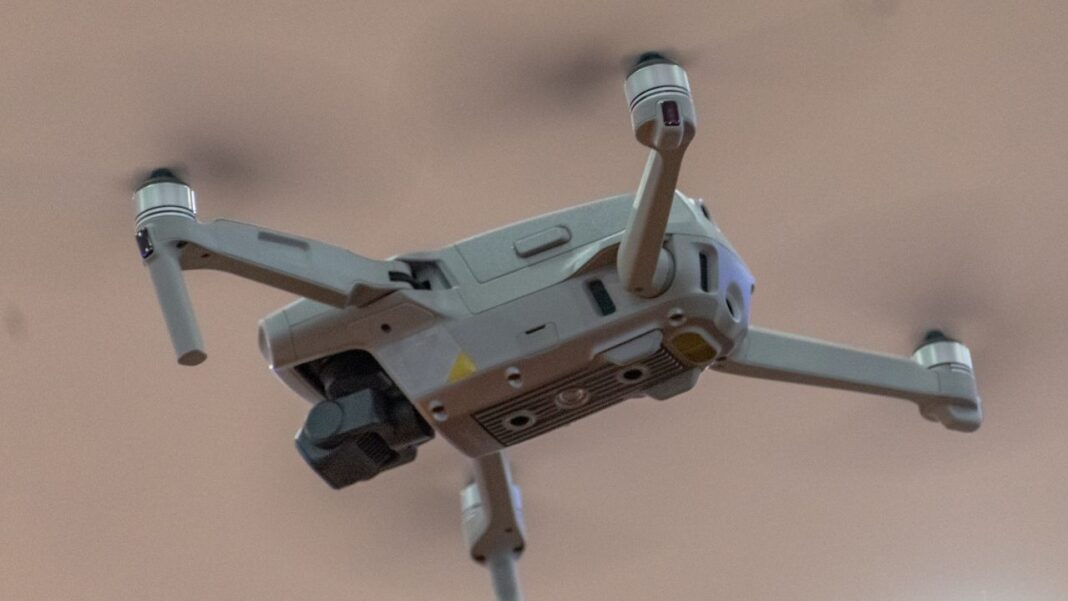


Science & Technology (Commonwealth Union) – Drone technology continues to expand to many different areas from capturing a crowd in a stadium, estimating crop quality to detecting marine debris.
When an earthquake occurs, drones could have the ability navigate through collapsed structures to create detailed maps of the area, providing rescuers with crucial information to locate survivors quickly.
However, this is a highly complex task for an autonomous robot, which must rapidly adjust its flight path to avoid unexpected obstacles while maintaining an efficient route.
Scientists at MIT and the University of Pennsylvania have designed a new trajectory-planning system that addresses both challenges simultaneously. Their approach allows a drone to respond to obstacles in mere milliseconds while following a smooth flight path that reduces travel time.
The system relies on a novel mathematical framework that guarantees the drone reaches its destination safely along a feasible path, while requiring less computational power than existing methods. This allows it to generate smoother flight trajectories more quickly than current state-of-the-art techniques.
The trajectory planner is capable of handling real-time flights using just the robot’s onboard computer and sensors.
Called MIGHTY, this open-source system eliminates the need for expensive proprietary software, which can cost hundreds of thousands of dollars. This makes it easier to deploy in a wider range of practical scenarios.
Beyond search-and-rescue missions, MIGHTY could be applied to tasks such as last-mile delivery in cities—where drones must navigate around buildings, power lines, and pedestrians—or for industrial inspections of intricate structures like wind turbines.
Kota Kondo, a graduate student in aeronautics and astronautics and lead author of the paper detailing the planner indicated that MIGHTY delivers performance on par with—or even exceeding—that of commercial solutions, using only open-source tools. This allows researchers, students, and companies worldwide to access it freely and by removing the cost barrier, MIGHTY democratizes advanced trajectory planning and enables a much larger community to build on this technology.
Kondo collaborated on the paper with Yuwei Wu, a graduate student at the University of Pennsylvania; Vijay Kumar, a UPenn professor; and senior author Jonathan P. How, who holds the Ford Professorship in Aeronautics and Astronautics and serves as a principal investigator at MIT’s Laboratory for Information and Decision Systems (LIDS) and the Aerospace Controls Laboratory (ACL). Their findings are published in IEEE Robotics and Automation Letters.
As a child, Kondo experienced the aftermath of the Fukushima Daiichi nuclear disaster following the Great East Japan Earthquake. With schools closed, he spent much of his time at home watching news coverage of workers navigating and securing the damaged reactor site. Many of these workers had to enter highly dangerous areas to manage the situation, exposing themselves to significant levels of radiation.
Kondo indicated that it is when he became driven to develop autonomous robots capable of operating in hazardous and rapidly changing environments, collecting critical information, and safely relaying it back to humans.
This task demands an advanced trajectory-planning tool—software that determines the safest route for a robot to travel from one point to another.
However, many existing solutions involve compromises that restrict performance.
Some commercial tools can quickly generate smooth paths but come with price tags in the hundreds of thousands of dollars. Open-source options, on the other hand, often fall short of commercial performance or can be cumbersome to operate.
MIGHTY, developed by Kondo and his team, is an open-source system that creates smooth, high-quality trajectories, adapts to obstacles in real time, and is efficient enough to run on a robot’s onboard hardware during flight.
“Optimizing the spatial and temporal components together gets us better results, but now the optimization becomes so much bigger that it is harder to solve in a feasible amount of time,” explained Kondo.