
How did the riot start?
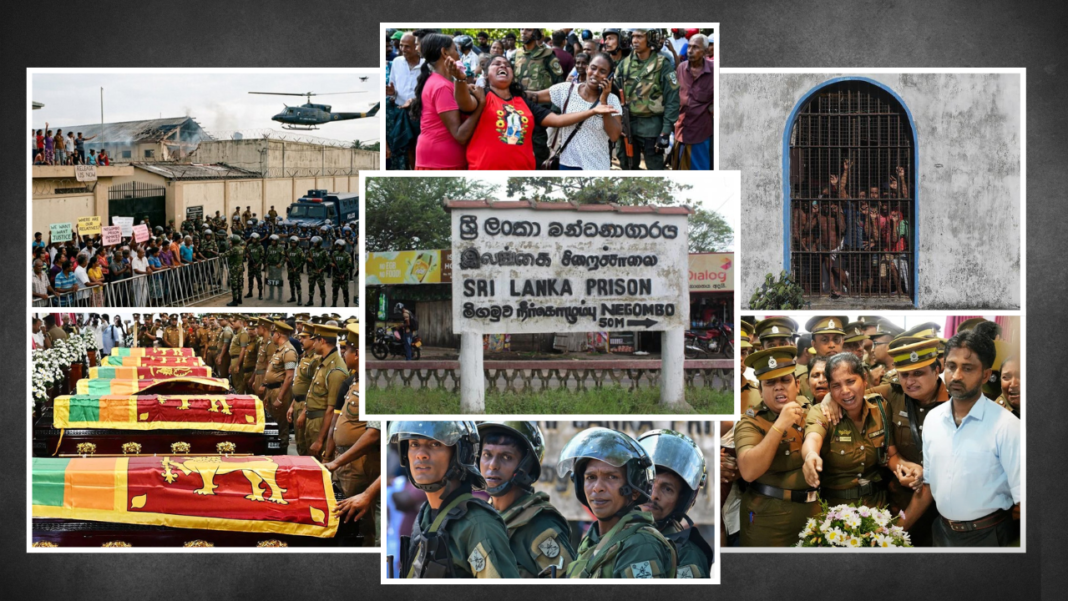
Sri Lanka (Commonwealth Union)_ What began as a fight between rival crime gangs behind bars at Negombo Prison quickly escalated into one of the deadliest prison riots in Sri Lanka’s recent history. Dozens were killed and many others injured in two days of violence, exposing the chronic problems within the country’s overcrowded and under-resourced prison system. Authorities said tensions between drug-trafficking gangs operating inside the prison had triggered the unrest. The conflict reportedly erupted after a number of inmates were accused of leaking information to prison officials about an illicit drug operation. Those allegations triggered violent retaliation that soon spread across the prison. The first clash broke out on Sunday between convicted prisoners and inmates being held on remand.
What initially appeared to be an isolated confrontation rapidly escalated as more prisoners joined the fighting. Prison officials struggled to contain the violence as rival groups attacked each other with improvised weapons. By Monday morning, the situation had become far more dangerous. At breakfast time, prisoners went on the rampage, launching a fresh series of attacks, overpowering prison officers and trying to seize control of parts of the jail. Several guards were attacked as they tried to restore order, while some inmates managed to get hold of guns inside the prison, raising the threat level dramatically. The disorder quickly turned into an attempted jailbreak. Groups of inmates chased prison officers towards the main entrance in an effort to escape before heavily armed security forces pushed them back.
Police Special Task Force personnel, riot control units and additional police officers surrounded the prison while the military remained on standby in case the violence spread further. The developments were also monitored by the authorities from the air using surveillance drones and a Sri Lanka Air Force helicopter, while armed personnel guarded the prison perimeter. Outside the gates, worried relatives waited for news of loved ones inside. It got even more chaotic when female prisoners in an adjoining section climbed on the roof in protest and demanded to be let out of the prison. Their demonstration ended in tragedy after part of the roof collapsed, leaving several women injured. For nearly two days, security forces fought to regain control while ambulances continuously transported the dead and wounded to nearby hospitals.
Also read: China’s bold new economic corridor could be a new headache for India!
The deadly riot claims 27 lives
By the time order was restored, the prison had witnessed one of the deadliest outbreaks of violence in decades. The death toll continued to rise as injured victims succumbed to their wounds. Nearly a hundred inmates and prison staff were treated for injuries, with many suffering gunshot wounds, deep lacerations and serious blunt-force trauma. The most seriously injured were taken to the National Hospital in Colombo for specialized care. Residents living near the prison said they heard continued gunfire during the height of the violence.
Inside the prison compound, rioting inmates broke into several high-security areas, allowing them to move freely between sections and intensifying the clashes. The riot also caused extensive damage to the prison’s infrastructure. Surveillance cameras, security scanners, administrative offices, the main stores and medical facilities suffered heavy damage. Officials estimated the financial losses would exceed Rs. 100 million. Although authorities eventually succeeded in restoring order, the violence left behind a prison deeply scarred by destruction and loss.
Seven prison officers killed in violence
Seven members of the Prisons Emergency Action and Tactical Force, the specialist unit charged with dealing with dangerous situations inside prisons and fighting organised criminal activity within prisons, were among those killed. They died trying to prevent the violence spreading. In the early stages of the riot, several officers were killed after inmates hit them with large stones and other improvised weapons, prison officials said. Their deaths marked one of the darkest days in the history of Sri Lanka’s prison service.
Those who died were Chief Jailer S.H.G. Chandrawansa; Sergeant Dilan Sri Abeywardena; Sergeant R.P.R. Sanjeewa; Sergeant B.N.N. Tharanga; Sergeant T.N.R. Thilakasiri; Sergeant D.W. Pushpakumara; and Sergeant A.D. Tharanga. These officers were committed professionals who stayed on duty despite the fast-deteriorating situation and pressed on to protect fellow officers and inmates. The Department of Prisons later honored the fallen officers, calling them heroes who gave their lives in the line of duty in an effort to prevent even greater tragedy.
An Indian prisoner among the victims
The riot also claimed the life of an Indian national identified as 73-year-old Unnikrishnan S, making the incident an issue of international concern as well. Following the violence, Indian prisoners who had been housed at Negombo Prison were transferred to other correctional facilities as part of emergency security measures. Officials from both countries remained in contact regarding the incident while authorities continued to establish the identities of all those affected.
Also read: The 30-day jail rule could unseat top leaders: India’s new bill targets jailed PMs and CMs!
Families left in agony
Outside Negombo Prison, the emotional toll was just as devastating. From the first reports of violence, hundreds of relatives gathered outside the prison gates, desperately seeking information about loved ones inside. Mothers, wives, fathers and siblings waited for hours, many with no way of knowing whether family members had survived. As ambulances entered and left the prison, anxiety grew among the waiting crowds. Officials periodically announced lists of transferred prisoners and those receiving medical treatment, but many families complained that the information was incomplete or inaccurate.
Some names appeared repeatedly while others were missing altogether, leaving relatives confused and distressed. Many eventually travelled between the prison, hospitals and mortuaries in search of answers. At hospitals, security remained tight as visitors were issued tokens before being allowed to see injured inmates. Lists of patients were displayed on notice boards while families searched desperately for familiar names. For many, the uncertainty proved almost as painful as the violence itself.
Prison system under immense pressure
The Negombo riot has once again highlighted the deep structural issues plaguing the Sri Lankan prison system. While the island’s prisons originally housed a little over 10,000 inmates, they now accommodate over 41,000 people. Many prisons operate at multiple times their intended capacity. Negombo Prison itself is an example of how dire the crisis is. Built to hold around 650 inmates, it was home to well over 2,000 prisoners when the riot broke out, making it a scenario where effective supervision was extremely difficult.
Overcrowding has resulted in poor living conditions, increased tension among inmates and mounting problems for prison officers charged with keeping order. Limited resources, poor infrastructure and shortages of staff have added to the system’s fragility. Human rights groups have repeatedly warned that long delays in court proceedings, the increasing numbers of remand prisoners and overcrowding in detention facilities have created an environment where violence can explode without warning. The Negombo tragedy has renewed the national debate over whether the authorities can implement long-promised prison reforms before another similar disaster occurs.
Past prison riots in Sri Lanka
The Negombo prison riot is not an isolated incident. It is the latest chapter in a long and troubling history of deadly violence inside Sri Lanka’s prisons, where overcrowding, weak security and organized criminal networks have repeatedly fuelled bloodshed. One of the most serious incidents in recent years occurred in 2020 at Mahara Prison during the Covid-19 pandemic. As fears over the spread of the virus grew in already overcrowded cells, unrest broke out among inmates demanding better protection and early release. The confrontation ended in a shootout between the security forces, resulting in 11 prisoners dead and over 100 injured. An even grimmer episode unfolded in 2012 at Welikada Prison, when a security forces raid spiralled into a massacre, claiming the lives of nearly 27 inmates.
Court proceedings later exposed grave concerns about the conduct of the operation, leaving enduring questions about accountability and the use of force in prisons. Sri Lanka’s prison history also bears the painful scar of the 1983 Welikada Prison riot, when dozens of Tamil detainees lost their lives amid the anti-Tamil violence known as Black July. More than four decades later, that tragedy remains one of the country’s most painful reminders of the consequences of unchecked prison violence. Against this backdrop, the Negombo riot has once again highlighted the urgent need for lasting reforms rather than temporary responses.
Also read: The 2026 best island on earth revealed: Sri Lanka takes the top spot!
Investigations underway
As calm gradually returned to Negombo Prison, the focus shifted to finding out exactly how the violence escalated so rapidly. The government appointed a three-member committee led by a retired Supreme Court judge to conduct an independent inquiry into the incident. At the same time, the Criminal Investigation Department launched multiple investigations while a separate team from the Department of Prisons began examining the security failures that allowed inmates to gain access to weapons and move through restricted areas. Investigators believe the violence began when inmates linked to an internal drug trafficking network attacked prisoners suspected of sharing information with prison authorities. Two prisoners killed in the first clash later died of their wounds, leading to more fighting throughout the jail. Officials are trying to understand how guns were available during the riot, why security failed and whether organized criminal gangs had a major hold inside the prison. The findings of these enquiries are expected to be crucial for future prison reforms.
Hundreds of prisoners transferred to other jails
In the immediate aftermath of the riot, prison authorities launched one of the largest emergency prisoner transfers in recent years. Around 700 inmates were relocated from Negombo Prison to other facilities across the country, including Angunakolapelessa, Bogambara, Anuradhapura, Polonnaruwa and Kuruwita. Female inmates, including several foreign nationals, were transferred separately to Wariyapola and Bogambara prisons. Officials said the transfers were necessary to reduce pressure on Negombo Prison while repairs and security assessments continued. Additional prisoners were later moved under heavy security to prisons in Jaffna and Batticaloa as authorities worked to restore stability across the prison network. Despite these transfers, approximately 1,000 inmates remained at Negombo Prison, requiring continued security operations by prison officers supported by the Police Special Task Force and the Sri Lanka Army. The redistribution of prisoners is expected to continue until officials are satisfied that conditions inside Negombo Prison have stabilized.
House arrest proposal under discussion
The deadly riot has sparked discussions on long-delayed legal reforms aimed at reducing overcrowding. Justice Minister Harshana Nanayakkara announced that the government intends to introduce legislation allowing selected remand prisoners to remain under house arrest while awaiting trial. Under the proposed system, eligible suspects would be monitored electronically instead of being held in already overcrowded prisons. According to the minister, excessive use of remand detention remains one of the main reasons Sri Lanka’s prisons have exceeded their intended capacity. He also pointed to delays in granting bail, particularly in narcotics-related cases, as another factor contributing to the growing prison population. The proposed reforms are expected to ease pressure on correctional facilities while allowing authorities to focus on inmates convicted of serious offences.
Also read: From ceremonies to agreements: Defining moments of Modi’s Seychelles visit!
Government steps to ease the crisis
Alongside legal reforms, the government has announced several measures to expand prison capacity. Authorities have officially redesignated the former Bogambara prison premises for use once again as a correctional facility. In addition, plans are underway to convert part of an abandoned hospital near Galle into a new prison complex that can accommodate inmates transferred from overcrowded institutions. The move reflects the government’s effort to create additional space while addressing the chronic shortage of prison accommodation across the country. Officials have also pledged to strengthen security systems, improve surveillance equipment and review procedures designed to prevent weapons, drugs and organized criminal activity from operating inside prisons. But many observers say that these are important first steps, but that infrastructure alone cannot solve the deeper problems of delays in the justice system, rehabilitation programmes and prison management.
A final farewell to fallen officers
As investigations continued, the country took time to honour the prison officers who died during the violence. The flag-draped coffins of the seven members of the Prisons Emergency Action and Tactical Force were brought to the Department of Prisons headquarters in Colombo where colleagues gathered to pay their final respects. Religious observances and official tributes were held before the bodies were handed over to grieving families for funeral rites. The ceremonies were a reflection of both the grief felt throughout the prison service and the huge risks faced by officers tasked with keeping order in ever more challenging circumstances. For many of their colleagues, the officers’ deaths were a stark reminder of the dangers that exist behind prison walls every day.
What comes next?
Although calm has returned to Negombo Prison, the riot has left many questions unanswered. The tragedy has once again highlighted the impact of severe overcrowding, long delays in the courts, and the increasing sway of organised criminal networks operating within prisons. It has also underlined the urgent requirement for better security measures, improved intelligence gathering and tighter controls to stop the smuggling of drugs and weapons into penal institutions. Just as important is the need to improve the treatment and welfare of inmates in line with accepted human rights standards whilst safeguarding the safety of prison officers working in increasingly difficult conditions.
The presence of foreign nationals among the inmates has also underscored the significance of protecting prisoners, regardless of their nationality, to maintain international confidence in Sri Lanka’s justice system. Security remains tight at the Negombo Prison, and officials say the situation is under control, but the real test of the riot’s long-term impact will be whether it leads to meaningful reform across Sri Lanka’s prison system, not how quickly order was restored. For now, the scars of the country’s deadliest prison riot in years are a stark reminder of the serious consequences of ignoring problems that have been festering for decades.