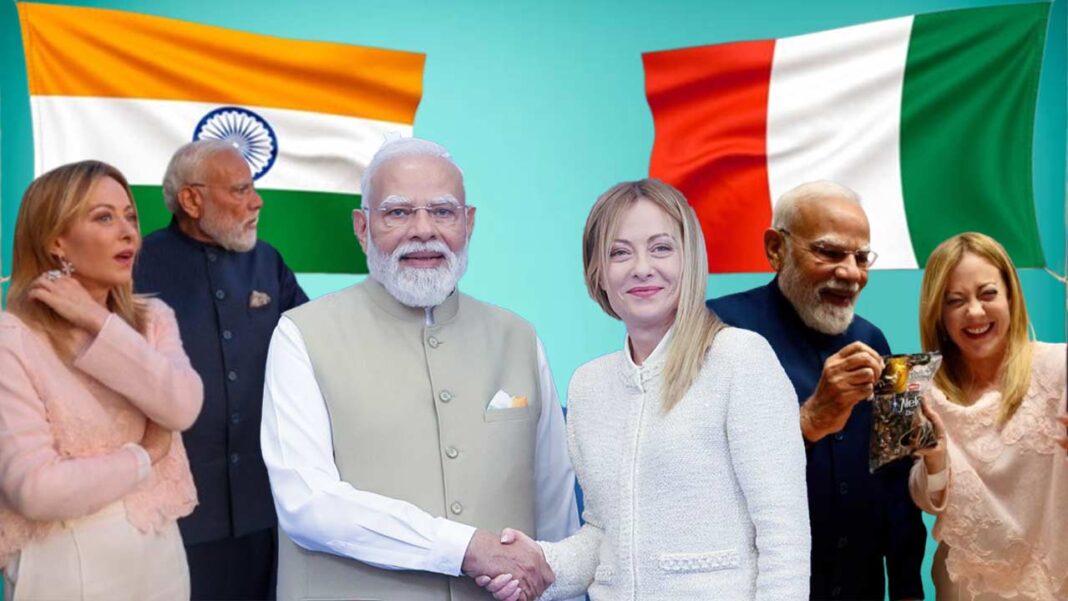

India (Commonwealth Union)_ Prime Minister Narendra Modi arrived in Rome for the final leg of his five-nation foreign tour, receiving a warm welcome from Italian Prime Minister Giorgia Meloni, highlighting the strengthening of relations between the two countries. This was Modi’s first bilateral visit to Italy after attending the G7 Summit in 2024. Meloni greeted Modi with a friendly post on social media, calling him “my friend”, and the two leaders also exchanged pictures at the iconic Colosseum. The cordial reception highlighted the close personal understanding that has developed between them over the past few years. During his arrival, Modi was welcomed by Italy’s Deputy Prime Minister Antonio Tajani and members of the Indian community living in Italy. As part of the ceremonial exchanges, he was presented with a painting of the ghats of Varanasi, symbolising India’s rich cultural and spiritual heritage.
Engaging with the Indian community
One of the first engagements of the visit was an interaction with the Indian diaspora in Rome. Hundreds of community members welcomed the Prime Minister, underlining the close bonding between India and the diaspora. The cultural programme saw performances by Italian artistes trained in Indian classical dance forms such as Kathak, Bharatanatyam and Kuchipudi. Italian artistes also performed Indian classical music on instruments like sitar, tabla, bansuri and santoor, reflecting the growing popularity of Indian culture in Italy. Modi addressed the gathering and spoke about India’s rapid economic growth, expanding digital economy and rising global influence. He highlighted India’s progress in innovation, manufacturing and technology and urged the diaspora to continue to act as a bridge between the two countries.
Bilateral talks take centre stage
Modi’s extensive discussions with Prime Minister Giorgia Meloni were the central theme of the visit. The two leaders held both one-on-one and delegation-level meetings aimed at expanding cooperation across several important sectors. Their talks covered trade, investment, defence, science, technology, artificial intelligence, energy, education, research, culture and people-to-people exchanges. They also exchanged views on major regional and international developments, including the situation in West Asia and the Russia-Ukraine conflict. A major outcome of the meeting was the decision to upgrade India-Italy relations to a Special Strategic Partnership, signalling a new phase in bilateral cooperation. Leaders also pledged to deepen economic links, with both sides agreeing to raise bilateral trade to 20 billion euros by 2029 and urging businesses to invest in resilient supply chains and new manufacturing opportunities.
Also read: UNICEF issues shocking climate warning to India: 392 million children at risk!
Strong push for trade and innovation
Trade remained one of the central themes of Modi’s visit. Both sides welcomed progress in economic cooperation and agreed to boost investment in emerging sectors. India and Italy also reiterated their support for the early conclusion of the India-European Union Free Trade Agreement which is anticipated to further enhance trade and business opportunities. Another important subject of discussion was innovation. The two governments announced their intention to create an India-Italy Innovation Centre to link startups, industries and research institutions. The initiative aims to promote joint research, technological development and entrepreneurship.
Defence and maritime cooperation
Defence emerged as one of the biggest highlights of the visit. India and Italy finalized a Defence Industrial Roadmap that will guide future cooperation in defence manufacturing and advanced military technologies. The roadmap focuses on joint development and production of defence equipment, including helicopters, naval platforms, marine systems and electronic warfare technologies. Both countries also agreed to strengthen industrial partnerships in strategic sectors. The two leaders further announced the launch of a dedicated Maritime Security Dialogue to improve cooperation in maritime safety, information sharing and regional security. Along with defence, both governments agreed to deepen cooperation in shipping, logistics, port modernization and the blue economy, recognizing the importance of maritime connectivity for future economic growth.
Addressing global challenges
The discussions also covered global and regional security issues. The two leaders voiced concern over the continuing tensions in West Asia and emphasized the importance of peace and stability in the region. They highlighted the need for unhindered maritime trade and safe passage of commercial shipping through major international waterways. The two leaders reaffirmed their commitment to international law and the peaceful resolution of international disputes. The two countries strongly condemned terrorism and violent extremism in all forms, including cross-border terrorism, and agreed to strengthen cooperation in tackling emerging security threats.
Also read: Inside Modi’s landmark Norway visit that strengthened India-Nordic ties: Key moments and takeaways!
Expanding education and cultural links
Beyond strategic and economic cooperation, the visit also focused on strengthening educational and cultural partnerships. India and Italy agreed to improve collaboration between universities, research institutions and higher education centres. Both countries will encourage greater mobility of students, researchers and skilled professionals, particularly in science, technology, engineering and mathematics. The two governments also announced that 2027 will be celebrated as the Year of Culture and Tourism between India and Italy. The initiative is expected to promote tourism, deepen cultural exchanges and create new opportunities for artists, students and professionals from both countries.
Award at the FAO headquarters
A significant highlight of the visit was Prime Minister Narendra Modi being conferred the Agricola Medal 2026 by the Food and Agriculture Organization of the United Nations in Rome. The honour is the organization’s highest recognition and was awarded for his contribution to food security, sustainable agriculture and rural development. The award ceremony took place at the FAO headquarters in the presence of Director-General Dr Qu Dongyu. Modi accepted the medal on behalf of India and dedicated it to the country’s farmers and agricultural scientists. He described it as a recognition of India’s long-standing commitment to ensuring food security and improving the lives of people dependent on agriculture. He also emphasized the deep cultural importance of farming in India, describing it as a bond between people and the land. The award added a global dimension to his Italy visit, focusing on India’s agricultural progress and policy direction.
Melodi moments and deep friendship
The visit also highlighted the visible personal chemistry between Modi and Italian Prime Minister Giorgia Meloni, beyond the formal diplomacy. The two leaders shared informal meetings, travel moments and a visit to the historic Colosseum, which quickly became a viral sensation on social media. One of the lighter moments of the visit came when Modi gifted Meloni with Indian sweets named ‘Melody Chocolates’, in a playful reference to the viral “Melodi” nickname created online by combining their names. The gesture was well received and added a friendly, informal tone to the diplomatic engagement. The two leaders also took part in a tree plantation ceremony and shared informal discussions over dinner, reflecting a comfortable working relationship that has developed alongside official diplomatic engagement.
Also read: Modi’s high-stakes Sweden mission reveals bigger ambitions that could reshape India-Sweden ties!
Exchange of symbolic cultural gifts
During his visit, Modi also exchanged several symbolic gifts, which highlighted India’s rich cultural heritage and artistic traditions. The symbolic gifts included handcrafted textiles and traditional items from different parts of India. One of the symbolic gifts to Meloni was a Muga silk stole from Assam, which is known for its golden sheen and natural production process. Another gift was a handwoven stole inspired by the Shirui Lily from Manipur, a rare flower indigenous to a specific region of India. In addition, he presented recordings of classical Indian music and a marble inlay box to Italian President Sergio Mattarella, highlighting India’s artistic legacy in music and craftsmanship . These exchanges were seen as a component of the larger effort to bolster cultural diplomacy between the two nations through heritage and creativity, moving beyond formal agreements.
Agreements and memorandums of understanding
The visit also saw the signing of a wide range of agreements across several sectors. Accordingly, India and Italy finalized multiple memorandums of understanding covering defence, energy, education, science, agriculture, mobility and culture. Key agreements included cooperation in critical minerals, maritime transport, artificial intelligence applications, climate research, Ayurveda, marine exports and higher education. These MoUs are designed to reinforce the long-term institutional ties between the two countries. The most significant agreement was the establishment of the framework for the mobility of Indian nurses to Italy, which would open new avenues for healthcare cooperation and meet workforce needs. Both countries also strengthened collaboration in research through partnerships between scientific institutions such as IITM Pune, ICTP, CMCC Foundation and Elettra Sincrotrone Trieste.
Major strategic outcomes
One of the most important outcomes of the visit was the adoption of a Defence Industrial Roadmap, designed to expand joint production and technological cooperation in defence manufacturing. This includes collaboration in naval systems, helicopters and advanced electronic warfare equipment. Another key outcome was the agreement on an India-Italy framework for maritime security cooperation. The initiative is aimed at improving coordination in the maritime domain, including shipping safety, logistics and port development. The two sides also expressed support for the India-Middle East-Europe Economic Corridor, which they described as a transformative project for global connectivity and trade. In addition, India and Italy agreed to work towards increasing bilateral trade to 20 billion euros by 2029, reflecting strong economic ambition in the relationship.
Strengthening global and economic cooperation
The two countries also discussed broader global challenges, including instability in West Asia and disruptions in global trade routes. They pledged to protect maritime freedom and safe navigation in vital international waters, and reasserted their commitment to counter-terrorism, strongly condemning terrorism in all forms including cross-border threats. On the economic side, both countries expressed optimism about expanding investment opportunities especially in clean energy, advanced manufacturing and digital technologies. The recent progress in India-EU trade negotiations was also welcomed as a positive step forward.
India-Italy relations
India and Italy’s relationship has grown steadily over recent years. Trade between the two countries has grown substantially, and investment flows have surged across various sectors. The visit cemented the Joint Strategic Action Plan for 2025-2029, which is anticipated to steer cooperation in defence, technology, clean energy, innovation, education and culture in the coming years. Both sides see the partnership as increasingly important in a changing global environment in which economic resilience and technological cooperation are becoming the core priorities.
Concluding the visit
Prime Minister Narendra Modi completed his visit to Italy with a series of high-level engagements that strengthened bilateral ties and expanded cooperation in various fields. The visit was a blend of diplomacy and personal interaction, involving formal agreements and strategic discussions as well as cultural exchanges and informal interactions. The elevation of ties to a Special Strategic Partnership was a significant development in India-Italy relations. As Modi concluded the last leg of his five-nation tour, the visit was marked by an intoxicating blend of strategic outcomes, cultural diplomacy and the palpable personal chemistry between the two leaders, setting a precedent for deeper cooperation in the future.