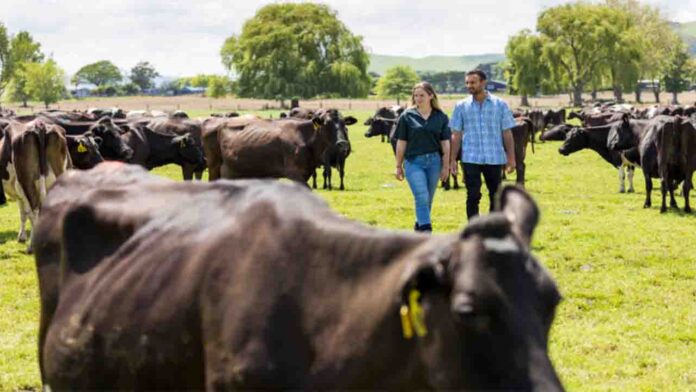

In the heart of Waikato, a paradigm shift in share-milking dynamics is taking place as two couples redefine the conventional model, proving that a true business partnership is built on honesty, openness, and a firm grasp of financial numbers. Brian Basi and Rachel Bunnik, operating as 50:50 sharemilkers for farm owners John and Maria Numan, have cultivated a business relationship that goes beyond mere percentages, focusing on what’s best for the entire farming enterprise.
Entering their second year as sharemilkers for the Numans, Basi and Bunnik are at the helm of a high-input farming system in Cambridge, strategically designed to maximize pasture utilization and optimize the profitable use of supplementary feed. Their success is rooted in a commitment to decisions that prioritize the well-being of the business rather than individual gains.
The farm’s high-input System 4, elevated to System 5 in the previous season with 42% imported feed, exemplifies their dedication to profitability. Despite the challenges posed by wet weather and flooding damage, the farm produced over 150,000kg MS, surpassing the three-year average of 145,000kg MS.
The Numans’ farm, characterized by its high-input system, captivated Basi and Bunnik due to its potential for improved return on capital. Recognizing the value of feed input, they prioritize pasture-first strategies, aiming to extract maximum performance from their cows year-round. The farm’s inputs include home-grown maize, PKE, imported maize, kiwifruit, and golden dried distillers grain (GDDG).
Efficient use of resources is central to their approach, evident in the minimal fertilization of maize crops, relying instead on effluent and muck from the feedpad. This resourceful strategy not only reduces costs but also underscores their commitment to sustainability.
To ensure profitability, Basi and Bunnik calculate and assess every supplement entering the feed system. Their decisions are driven by a focus on enhancing profit per hectare rather than maximum profit per cow. The goal is to strike a balance that ensures both the farm owners and sharemilkers receive a satisfactory return on their investments.
The duo maintains a meticulous approach to grazing, aiming for consistent pre-graze targets and careful management of residuals to sustain grass energy. Their commitment to the well-being of the grass, akin to an “energy battery pack,” enables rapid post-grazing regrowth, contributing to sustained productivity.
Beyond their accomplishments, the couple’s journey includes winning the Share Farmer of the Year title for Waikato in the Dairy Industry Awards. The accolade not only provided valuable feedback on their business but also fostered a mindset shift in assessing opportunities and building networks.
In a sector often driven by tradition, Basi and Bunnik’s innovative approach to share-milking underscores the potential for collaborative, financially savvy partnerships to thrive in the dairy industry. Their story serves as an inspiring testament to the power of honesty, numbers, and a forward-thinking mindset in shaping the future of dairy farming partnerships.