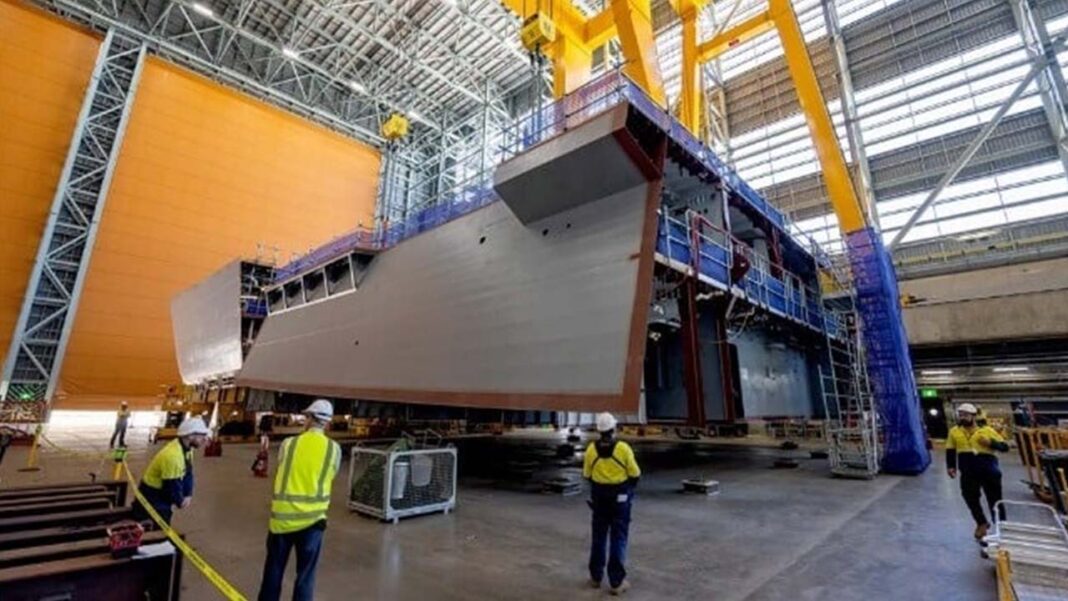

Commonwealth_ The Australian government has reaffirmed its commitment to bolstering the naval shipbuilding industry, unveiling an ambitious plan to strengthen national defense and expand employment opportunities within the sector. Prime Minister Anthony Albanese’s administration aims to significantly enhance shipbuilding efforts as part of a broader strategy to ensure Australia’s long-term maritime security while fostering economic growth through job creation.
The 2024 Naval Shipbuilding and Sustainment Plan, recently released by the government, outlines a comprehensive roadmap for naval shipbuilding over the next three decades. This updated strategy represents a record investment in Australia’s defense capabilities, with projected spending potentially exceeding US$100 billion and a minimum commitment of at least US$82 billion. The plan underscores the Albanese government’s intent to prioritize domestic shipbuilding, marking a shift from previous policies by including 55 newly announced vessels and introducing other transformative initiatives.
At the core of the revised plan is a forecasted long-term demand for naval shipbuilding, which includes an ambitious nuclear-powered submarine program. The plan also advances the development of enhanced surface combatants and various support ships, such as landing craft, to bolster Australia’s maritime defense infrastructure. Deputy Prime Minister Richard Marles highlighted the unprecedented scale of this investment, stating, “Through the most significant investment in maritime capability in Australia’s history, we will see generations of naval construction projects happen right here, with plans to construct and upgrade over 70 vessels across South Australia and Western Australia.”
The plan emphasizes creating a robust domestic shipbuilding industry with long-lasting benefits for Australia. According to government projections, the initiative will generate an intergenerational pipeline of naval construction projects, supporting approximately 8,500 jobs in shipbuilding and sustainment by 2030. Over the next 30 years, the nuclear-powered submarine program alone is expected to create around 20,000 additional jobs, cementing shipbuilding as a cornerstone of Australia’s industrial and defense strategy.
To ensure the availability of a skilled workforce capable of meeting the demands of this expanded shipbuilding program, the government plans to invest nearly US$1 billion in vocational education programs. These initiatives aim to equip Australians with the skills needed to support the growing industry. Additionally, the government has allocated US$150 million to attract, train, and retain a new workforce specifically for the nuclear-powered submarine program. These education and training investments reflect the government’s broader goal of fostering sustainable job growth and ensuring the availability of qualified personnel to sustain the sector’s long-term development.
The new plan also seeks to enhance Australia’s defense readiness by creating a navy and army that are more lethal and better equipped to respond to evolving strategic challenges. The government envisions a maritime force capable of addressing the complex security environment in the Indo-Pacific region and beyond. By expanding its naval capabilities, the government aims to reinforce Australia’s position as a key player in regional defense and maintain a strong deterrence posture.
The long-term vision articulated in the 2024 Naval Shipbuilding and Sustainment Plan represents a significant departure from previous strategies, emphasizing a future built on Australian expertise and resources. The Albanese government’s focus on domestic shipbuilding aligns with its commitment to fostering economic resilience and self-reliance in critical industries. By constructing and upgrading over 70 vessels across South Australia and Western Australia, the government is not only enhancing national defense but also supporting regional economies and creating opportunities for local communities.
The plan’s multifaceted approach, combining record investment, workforce development, and an emphasis on domestic production, underscores the government’s commitment to ensuring Australia’s maritime security. It also reflects a broader strategy to build a resilient defense industry that can adapt to changing geopolitical dynamics. In Deputy Prime Minister Marles’s words, the plan is “a future made in Australia” and a testament to the government’s dedication to keeping Australians safe.