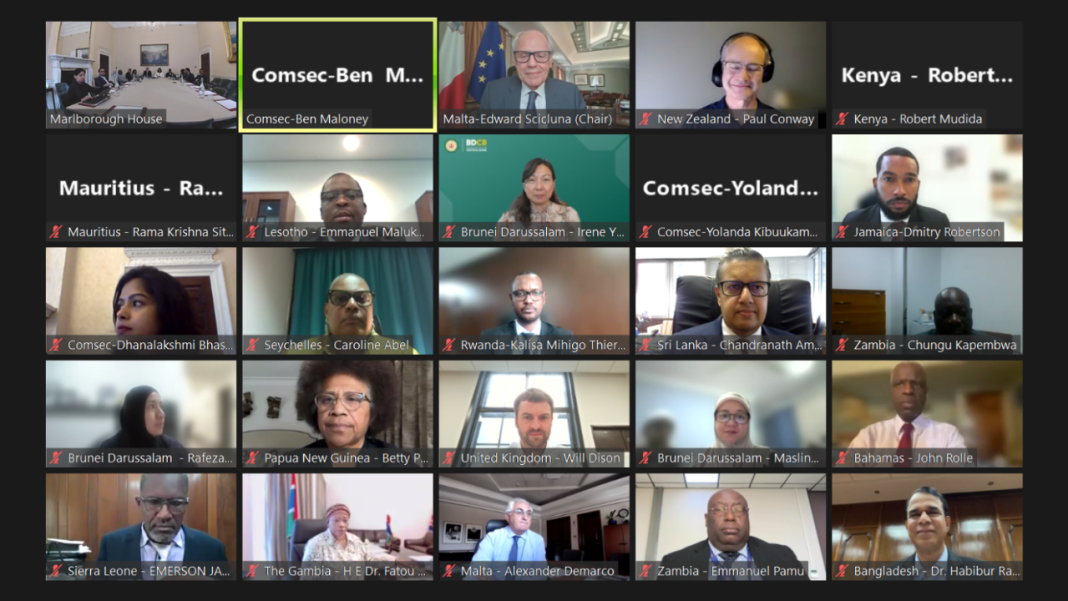

(Commonwealth)_ The Commonwealth Central Bank Governors met to consider the economic requirements of association member states with 56 countries, share experiences, and seek possibilities for more closeness in integration. The meeting was held prior to the Commonwealth Finance Ministers Meeting next month in Washington and was a precursor to policy agenda-setting.
Governors and chief economists focused their debate on pressures created through ratcheting up geopolitical tensions, mounting trade tariff wars across the world, and increasing perceptions of risk in international financial markets. Led by Professor Edward Scicluna, Governor of the Central Bank of Malta, the session drew on a set of proposals that flowed from an extensive discussion paper.
Among its key proposals was the establishment of a Commonwealth Financial Resilience Hub to enable mutual risk analysis and cross-membership sharing of best practice between the member states. The hub would serve as an avenue of innovation and collaboration to help countries develop more resilient mechanisms in response to economic shocks and resilience in the longer term. The delegates also brought up the matter of creating a peer-to-peer learning and technical support mechanism for reinforcing macro-fiscal and financial stability in the Commonwealth.
Another proposal advocated creating a Technical Assistance Fund to offer rapid, needs-based support to member states with a special focus on small and vulnerable economies. The envisioned fund would bridge gaps in support instruments provided by making the availability of highly specialised expertise quicker, avoiding lengthy procurement processes that hamper effective responses in times of financial strain.
Stakeholders also emphasised further developing domestic financial markets through new channels like climate-resilient financial instruments, more use of digital finance tools, and streamlining of governance frameworks. Technology gateways such as Commonwealth Meridian were suggested as a channel for enhancing transparency, efficiency, and confidence in public debt management procedures.
The meeting took place against the backdrop of a highly volatile global economic environment. The majority of the member nations are under strain from cross-cutting challenges like persistent inflation, tenuous supply chains, and rising political risks, rendering policy-making intricate. Tightening fiscal space and growing debt burdens further compound these challenges for a number of the smaller members.
New figures point to the seriousness of the situation. Eighteen Commonwealth members have more than 100 per cent general government debt as a share of GDP, while a further 24 are between 60 per cent and 100 per percent. Three have already resorted to the route of debt restructuring, with mixed success in finalising agreements with creditor groups. The figures illustrate the erosion of policy space at a time when nations require it to move quickly to respond to external shocks.
Speaking at the session, speakers highlighted the special contribution the Commonwealth can make in the form of coordinated dialogue and collaborative action. The Commonwealth Secretariat’s profound convening power, combined with its tradition of knowledge sharing and capacity building, allows it to rally collective effort. Efforts in progress include regional training workshops, technical cooperation programs, and policy lesson exchange forums among members.
Senior Secretariat officials explained how the planned Financial Resilience Hub and Technical Assistance Fund will complement the initiatives. Both of these tools are designed to allow central banks and finance ministries to respond better to the next emerging crises by reducing response times for mobilising finance and expertise. With greater collaboration and enabling member states to access technical assistance, the Commonwealth will empower member states with the support necessary to move through a period of unparalleled international uncertainty.
The governors considered the meeting an opportune moment to synchronise strategies before the meeting of finance ministers in Washington. As economic challenges around the world grow more serious, the proposals ironed out in Malta will likely frame further deliberation on how the Commonwealth keeps members financially healthy and fosters sustainable development within the group.