
India (Commonwealth Union)_ Prime Minister Narendra Modi landed in Addis Ababa on a two-day state visit at the invitation of Ethiopian Prime Minister Abiy Ahmed Ali, marking the second part of his three-nation journey. The visit is significant because it was the first by an Indian prime minister to Ethiopia since 2011. In the days running up to the visit, Addis Abeba was clearly ready to welcome the Indian leader. The streets were decked with welcome posters, hoardings, and Indian flags, indicating the excitement surrounding the visit. Ethiopia is increasingly seen by New Delhi as an important African ally and a reliable voice in the Global South. Against this backdrop, the visit was aimed at deepening cooperation across political, economic, and people-centric areas. Officials on both sides viewed the engagements as an opportunity to give fresh momentum to an already expanding bilateral relationship.
Also read: Hope after destruction: UN steps in with $35M humanitarian aid for cyclone-hit Sri Lanka!
A warm welcome for PM Modi
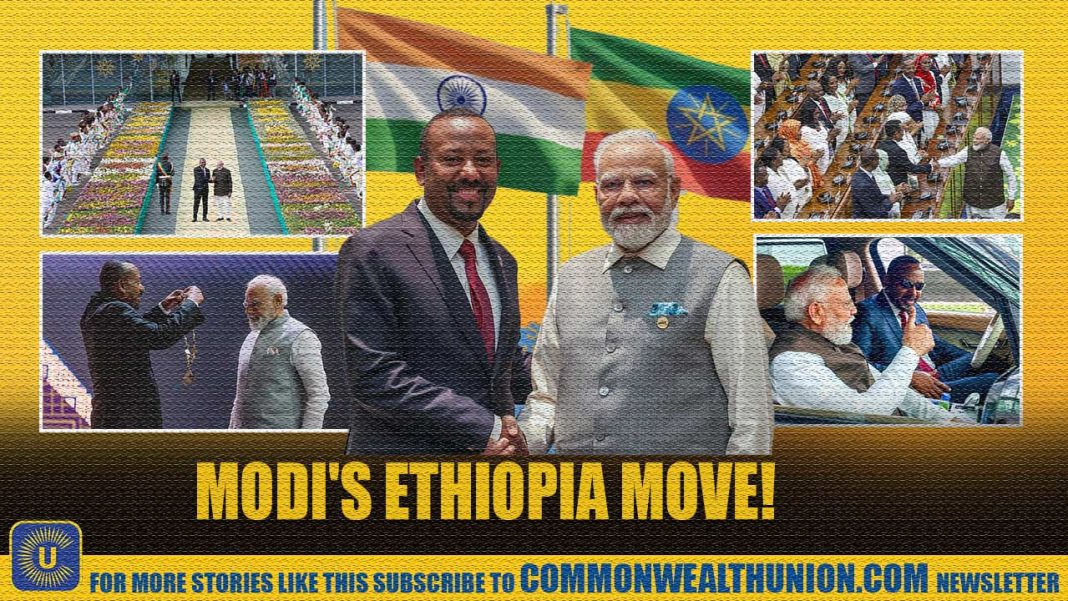
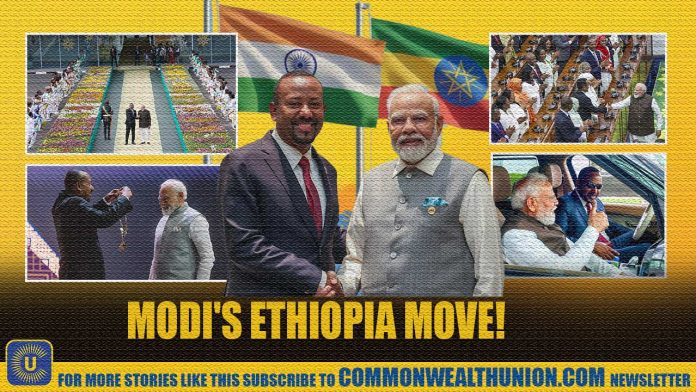
Prime Minister Modi was greeted at the airport by Prime Minister Abiy Ahmed Ali, setting the tone for the visit. The Ethiopian leader personally greeted his Indian counterpart, emphasizing the warmth and mutual respect that characterize relations between the two countries. Shortly after his arrival, Prime Minister Modi and Prime Minister Abiy planted a tree at the Ethiopian House of People’s Representatives as part of India’s “Ek Ped, Maa Ke Naam” project, which promotes sustainability and shared responsibility for the future. The Indian leader also paid his respects at the Adwa Victory Monument and visited the Adwa Museum, where he learned about Ethiopia’s long history and battle for independence and self-government. These examples demonstrated a common appreciation for tradition, perseverance, and national pride.
Meeting the Indian diaspora
Members of Ethiopia’s Indian community gathered in large numbers to greet Prime Minister Modi at his hotel in Addis Abeba. Many had waited for hours, waving Indian flags and singing slogans as they greeted the prime minister with flowers and warm smiles. The atmosphere was joyous and passionate, highlighting the diaspora’s strong affinity with India. Prime Minister Modi mingled with community members and attended cultural performances. A group of performers sang a Hindi song from the Bollywood film Veer Zaara, which received widespread acclaim.
Sharing a video of the performance on social media, Prime Minister Modi noted how popular Indian music and culture are in Ethiopia. The Indian community in Ethiopia has a long and significant history. Indian settlers, mostly from Gujarat, began arriving in the late 19th century. Thousands of Indian professors have made substantial contributions to Ethiopia’s educational system throughout the years, and many of them serve in remote places. Today, about 150 Indian academics teach at Ethiopian universities, and the Indian diaspora numbers approximately 2,500 people. Many work for Indian companies operating in Ethiopia, while others support Ethiopian businesses in a variety of ways.
Also read: UN mission hit: Deadly drone strike kills six Bangladeshi UN peacekeepers in Sudan!
Engagement with the Ethiopian Prime Minister
Prime Minister Abiy Ahmed Ali’s personal involvement throughout the visit stood out. He not only received Prime Minister Modi at the airport but also personally drove him to many engagements, including the Science Museum and Friendship Park, which were added to the itinerary as a special courtesy. The Ethiopian leader also invited Prime Minister Modi to attend a traditional Ethiopian coffee ceremony at the airport, which represents friendship, hospitality, and mutual respect. These unscripted and personal moments reflected the developing familiarity between the two presidents, as well as the trust and goodwill that underpin India-Ethiopia relations.
Modi receives Ethiopia’s highest award
During the visit, Prime Minister Modi was conferred Ethiopia’s highest civilian honor, the “Great Honour Nishan of Ethiopia,” making him the first global head of state to receive the award. The honor was presented by Prime Minister Abiy Ahmed at a special ceremony held at the Addis International Convention Centre. The award recognized Prime Minister Modi’s role in strengthening India–Ethiopia ties and his broader leadership on the global stage. Accepting the honor, Prime Minister Modi said he dedicated it to the people of India and expressed deep humility in receiving recognition from one of the world’s oldest civilizations. He also thanked the Ethiopian leadership and people while praising Prime Minister Abiy’s efforts to promote unity, sustainability, and inclusive development within Ethiopia.
Also read: Modi’s Jordan stop: A quiet power move!
Modi’s Parliament speech
The highlight of Prime Minister Modi’s visit was his official engagement with the Ethiopian Parliament, where he gave a joint address. During this speech, he emphasized that the expanding of the Global South was not intended to be a threat to any particular country but rather to develop a world that is fair and equal for everyone. He described a future based upon global economic prosperity, access to technology, respect for national sovereignty, the sharing of wealth, and governance structures that are responsive to the present day.
Modi noted that both nations share a common vision of creating a more equitable, just, and peaceful global environment. He stated that due to Ethiopia’s position at the crossroads of Africa and India’s geographic importance in the Indian Ocean, both countries represent natural partners for promoting regional peace, security, and connectivity. He called for greater cooperation in all areas, including trade & investment, mining, food security, and regional stability.
Bilateral discussions with the Ethiopian Prime Minister
Prime Ministers Modi and Abiy held extensive discussions in one-on-one, restricted, and delegation-level formats. They reviewed the full scope of bilateral relations, rooted in centuries-old civilizational links and strengthened by strong people-to-people ties. Recognizing the growing importance of the partnership, the two leaders agreed to elevate India–Ethiopia relations to the level of a strategic partnership. Prime Minister Modi highlighted India’s pride in welcoming the African Union as a permanent member of the G20 during India’s presidency in 2023. He also thanked Ethiopia for its support following the Pahalgam terror attack and for its commitment to the global fight against terrorism.
The discussions covered cooperation in trade, investment, technology, education, defense, and innovation. Prime Minister Modi expressed India’s readiness to expand collaboration in health security, digital health, traditional medicine, affordable medicines, food security, sustainable agriculture, and agri-tech. Both leaders noted that development cooperation between the two countries continues to strengthen people-to-people ties. Economic engagement was a major focus. The leaders discussed cooperation in digital public infrastructure, mining, critical minerals, and clean energy.
Prime Minister Modi highlighted that more than USD 5 billion has been invested by Indian firms in Ethiopia for various sectors such as manufacturing and pharmaceuticals, with the creation of more than 75000 jobs locally. Both sides reiterated their mutual commitment to work together within the framework of global organizations such as the UN, as well as advocate for the views of the ‘Global South.’ In addition, discussions were held relating to cooperation in climate change, renewable energy, and disaster preparedness with support from various international initiatives, including the International Solar Alliance and other global partnerships. Prime Minister Modi said India looked forward to working closely with Ethiopia as a BRICS partner and in future India–Africa engagements.
MoUs signed
During the visit, India and Ethiopia signed three memoranda of understanding aimed at enhancing cooperation in key areas. These included agreements on training for United Nations peacekeeping operations, mutual administrative assistance in customs matters, and the establishment of a data center at Ethiopia’s Ministry of Foreign Affairs. The agreements were signed in the presence of both prime ministers and reflect a shared commitment to institutional and capacity-building cooperation.
India–Ethiopia relations
India and Ethiopia share a strong and steadily growing bilateral relationship, supported by regular high-level exchanges and cooperation across sectors. Indian companies rank among the largest investors in Ethiopia, with investments exceeding $5 billion in textiles, manufacturing, agriculture, and healthcare. These investments have generated significant employment and contributed to Ethiopia’s economic development. Bilateral trade between the two countries reached over $550 million in the 2024–25 financial year, with Indian exports forming the bulk of the trade.
Ethiopia’s recent entry into the BRICS grouping reflects its search for new partnerships as it rebuilds after internal conflict. India, which is set to host the next BRICS summit, remains an important partner for Ethiopia, particularly as ties with some Western countries have faced challenges. India also continues to be a preferred destination for Ethiopians seeking affordable healthcare and higher education, further strengthening people-to-people links.
Modi concludes Ethiopia visit
Prime Minister Modi concluded his two-day visit to Ethiopia and departed for Muscat, Oman, the final stop of his three-nation tour. In another personal gesture, Prime Minister Abiy Ahmed once again drove Prime Minister Modi to the airport and bid him farewell. In a message shared after his departure, Prime Minister Modi described it as an honor to address the Ethiopian Parliament and reaffirmed India’s commitment to strengthening ties with Ethiopia. The visit, marked by warmth, symbolism, and substantive outcomes, highlighted the deepening partnership between the two nations, guided by shared values, mutual trust, and a common vision for peace and development.