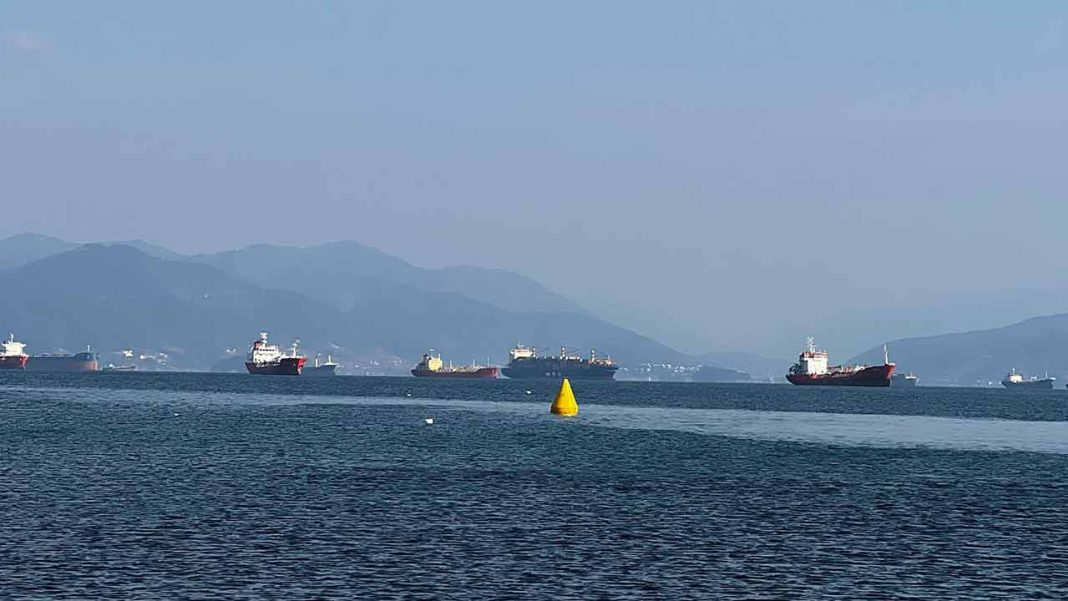

Analysts are focusing on small increases in congestion at key regional ports around the globe, with concerned interest as shippers expect a flurry of activity in the New Year, in what’s termed a ‘weird market’.
Supply chain visibility company Beacon’s monthly report on 100 global ports witnessed the initial increases in congestion. This applies to congestion in Asia, North America and Europe, as well as other regions. It is unclear whether these slightly elevated levels of congestion are the rumblings of something bigger or a symptom of some other, likely minor problems.
Zhoushan tops the list of vessels at anchor, with Beacon reporting 24 ships awaiting a berth on 1 December. This accounted for a decrease of 4 ships compared with data from 4 months back in August, although it reflects an increase of 14 vessels from a month back in November.
Tianjin has also witnessed a rise in the number of ships at anchor, recorded at 15 as of 1 December. It amounts to a significant rise of 14 ships compared to 1 August and was repeated during the last month of November.
Colombo and European ports, such as the North African hub Tangier, as well as some North American terminals, have also raised concerns.
Beacon CEO Fraser Robinson told Seatrade Maritime News that this year has witnessed a clear worsening in port congestion. The analysis revealed that nearly 70% of the ports experienced an increase in average anchor times year-over-year. 30% of ports witnessed increases of two hours or more, while only 15% saw reductions of the same magnitude.
Citing Robinson, the Red Sea crisis has played a major role in these deteriorating conditions. He further cited that in Shanghai, congestion levels have been higher than the previous year’s levels in 11 of the 12 months since the onset of the crisis. Other major ports, including Rotterdam, Valencia, Piraeus, Jebel Ali & Singapore, have all witnessed similar trends.
Director of the Global Shippers’ Forum (GSF), James Hookham, believes that the threat of strikes and tariffs is having an impact, as well as the usual rush of cargo ahead of the Chinese New Year, which falls on around 29 January. However, Hookham conceded that the current market was ‘weird’ and that he was surprised there was not more congestion than was presently witnessed. Hookham was of the view that the liner shipping sector seems to be in a state of continual crisis. He conceded that this was due to the unavailability of the Red Sea and added that he does not fully understand the situation.
Meanwhile, Drewry’s port analyst, Eirik Hooper, confirmed that the consultant had also seen an elevation in port congestion, although adding that it was ‘regionally specific’.
In the US, the brief strike on the East Coast and hurricanes had caused disruption, and in addition, refurbishment work in Norfolk has witnessed increases in congestion at both Savannah & Norfolk. Meanwhile, industrial action in both Vancouver & Montreal had extended wait times in Canada, too.
Hooper was quoted as saying that record volumes are gumming up the system a bit, too. It’s not catastrophic, but the system is creaking with delays in China’s largest ports, throwing off schedules further along the supply chain.
Hooper clarified that the major regional hubs, Singapore & Malaysia, remain unaffected. However, there is increased nervousness about industrial action in the US, given that negotiating positions appear to be further apart.
Drewry has lowered its 2025 growth predictions to 2.6% for this year from a previous 2.9% declared earlier this year. This reflects a substantial fall in this year’s growth, now expected to be 6%.
MDS Transmodal analyst Antonella Teodoro assessed the situation for the coming year, stating that since last December, fleet capacity has expanded by more than 3.4 million TEU, equating to an annual increase of 13%.