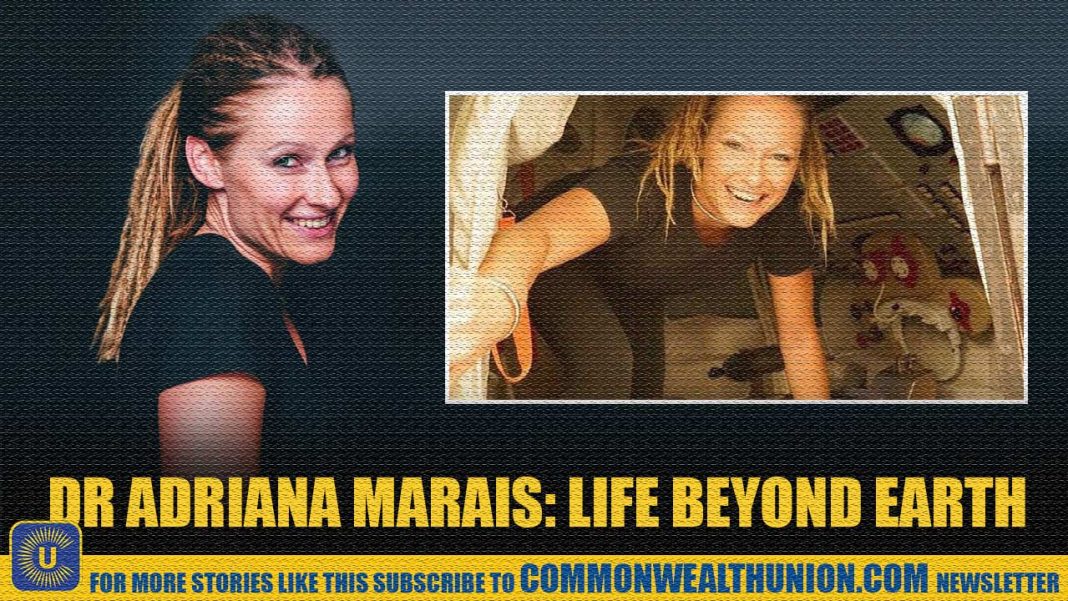

Few scientists move as comfortably between abstract theory and harsh physical reality as Dr Adriana Marais. Trained as a theoretical physicist and driven by questions about life’s deepest origins, Marais has built a career that spans quantum biology, space science and innovation in extreme environments, her work rooted in preparing humanity, practically and ethically, for what comes next.
Born and educated in South Africa, Marais has become one of the country’s most recognisable voices in global space exploration. Her research explores how quantum processes may have influenced the emergence of life, while her applied work focuses on how humans might survive—and thrive— beyond Earth. This rare combination of scientific depth and real-world experimentation has put her at the forefront of conversations about the future of civilisation.
Marais’s dive into academia began at the University of Cape Town, where she completed a first-class degree in theoretical physics. She went on to earn a master’s degree in quantum cryptology and later a PhD in quantum biology, focusing on quantum effects in photosynthesis and the origins of the building blocks of life. Her research connects physics, chemistry and biology, contributing to emerging studies that explore how quantum processes may play a vital role in living systems.
Marais gained recognition early on, receiving a L’Oréal-UNESCO International Rising Star Talent Award for her work on the origins of life in 2015. The Royal Society of South Africa awarded her the Meiring Naudé Medal the following year. In 2025, her work was acknowledged with the Forbes Woman Africa Academic Excellence Award and Women in Tech Global’s Most Disruptive Woman in Tech Award.
Despite her deep commitment to academia, Marais has never limited herself to a laboratory setting. Having lectured internationally, including serving as a visiting lecturer at the Centre for Quantum Technologies in Singapore, she later transitioned into the industry as Head of Innovation at SAP Africa. The experience sharpened her interest in finding solutions for complex, resource-constrained environments.
Marais’ vision centres on a distinctly African perspective of space exploration. As a director of the Foundation for Space Development Africa, she plays a leading role in the Africa2Moon Project, Africa’s first mission to the Moon. Selected for launch to the lunar south pole aboard China’s Chang’e-8 mission, Africa2Moon aims to deploy a pioneering lunar radio telescope capable of science not possible from Earth.
She initially garnered attention in 2013, when she was shortlisted as one of 100 astronaut candidates for the Mars One project, a private initiative that proposed a permanent human settlement on Mars. Although Mars One ultimately declared bankruptcy in 2019, the experience reinforced Marais’s belief that preparing for life beyond Earth must begin here and now, grounded in realism rather than spectacle.
Her conviction eventually led to the founding of Proudly Human, an organisation dedicated to preparing mankind for extreme environments through science and sustainability. Its flagship initiative, the Off-World project, is a series of long-duration habitation experiments in some of the earth’s harshest locations, ranging from deserts to undersea facilities. The experiments test off-grid infrastructure, team dynamics, and sustainable living systems that could one day support life on the moon or Mars, while also offering solutions for vulnerable communities on earth.
Marais’s work increasingly connects space science with social impact. She is developing economic models and blockchain-based systems tailored for resource-limited environments, and she continues research through Stellenbosch University and the National Institute for Theoretical and Computational Sciences. As an advisor to the Geneva Science and Diplomacy Anticipator, she also contributes to global discussions on space resources and governance.
In 2025, Marais published her book, Out of This World and Into the Next. The book reflects on how expanding into space could help humanity become better stewards of Earth, not by escaping its problems, but by rethinking how societies organise resources, technology and values.
Despite her achievements, Marais often stresses resilience over heroism. From completing the Two Oceans Ultramarathon to summiting Mount Kilimanjaro, she views endurance as both a personal discipline and a metaphor for humanity’s future.