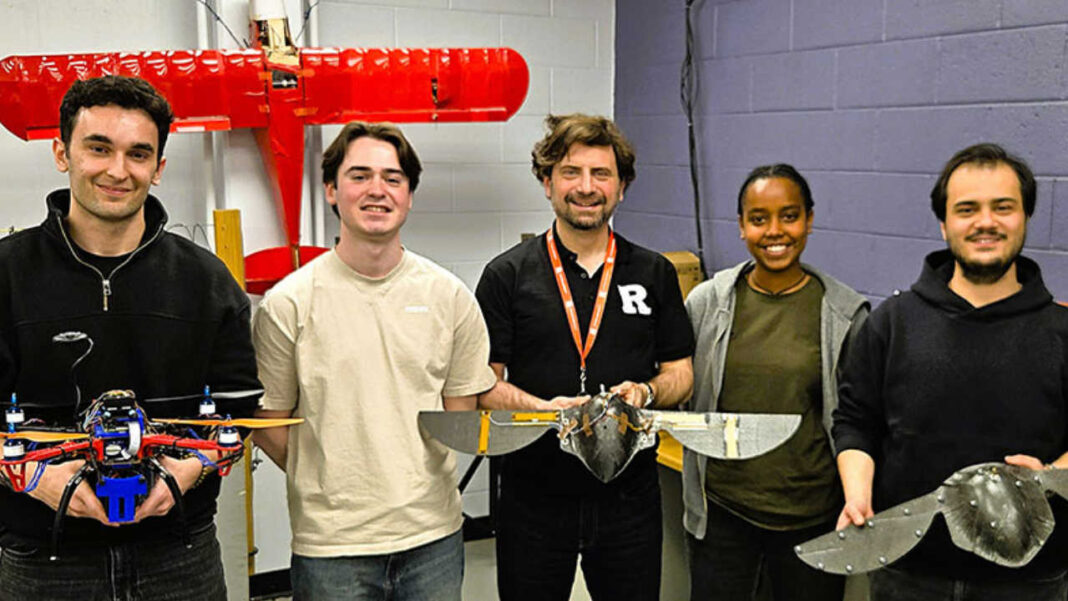

Science & Technology (Commonwealth Union) – Rutgers University engineers have made a significant breakthrough toward developing bird-inspired drones that mimic the way real birds fly. Rather than depending on traditional electromagnetic motors, these drones use electrically responsive materials to flap their wings and move through the air.
In research published in the journal Aerospace Science and Technology, aerospace engineers Xin Shan and Onur Bilgen present a “solid-state” bird-like drone—commonly called an ornithopter—whose flexible wings can flap and twist without the need for motors, gears, or mechanical linkages. Instead, the design takes advantage of the piezoelectric effect, where certain materials deform when an electric voltage is applied.
Bilgen, an associate professor in the Department of Mechanical and Aerospace Engineering at the Rutgers School of Engineering, explained that electricity is supplied directly to the piezoelectric components, enabling the wing surface to move without additional mechanical parts. The wing consists of a layer of piezoelectric material and carbon fiber, forming a composite structure. When voltage is applied to the piezoelectric layer, the entire structure bends and flexes, allowing the wings to move as required for flight.
Ornithopters have a structure similar to that of birds, giving them a level of maneuverability that makes them ideal for future roles such as search and rescue missions, environmental monitoring, inspections in hard-to-reach places, and urban parcel delivery. In these situations, aircraft must carefully navigate around buildings, cables, people, and other obstacles.
The researchers also developed an advanced computer simulation that integrates all the key physical elements involved in flight, including wing and body movement, aerodynamics, electrical behavior, and the control system. This model enables engineers to experiment with and refine designs in a virtual environment before constructing real prototypes, helping to reduce costs and development time while accelerating innovation.
“We’ve scientifically demonstrated that this type of ornithopter is possible when we make certain material assumptions,” he explained. “We can show the feasibility of designs that are not yet physically achievable.”
The researchers indicated that, at present, the primary limitation lies in the performance of piezoelectric materials. Bilgen pointed out that current materials do not yet offer sufficient capability; however, their mathematical model allows them to explore future possibilities using reasonable assumptions.
Bilgen first encountered the concept of ornithopters in 2007 during his time as a graduate student. However, his fascination with the idea grew much stronger in 2013 when he began seriously investigating how flapping-wing flight could be redesigned using smart materials. Although several companies have experimented with bird-inspired drones, most current versions still rely on motors, gears, and traditional actuators to move their wings.
According to Bilgen, these mechanical systems struggle to replicate the efficiency of real bird wings, which constantly bend and adapt to changing air conditions. He believes engineers can learn a great deal from nature.
Bilgen further noted that anything designed for speed must be lightweight, which is why bird wings are so delicate and why aircraft wings are designed in a similar manner.
Although birds and insects have inspired this research, Bilgen stated that the objective is not merely to copy nature. He emphasized that the goal is to go beyond what nature can achieve.
Until now, most robotic bird prototypes have relied on mechanical systems designed to imitate bones and muscles. Bilgen’s team, however, is pursuing a more straightforward approach. Their aim is to create flapping flight without bone-like frameworks or muscle-style actuators, allowing the wings to move in a much simpler way.