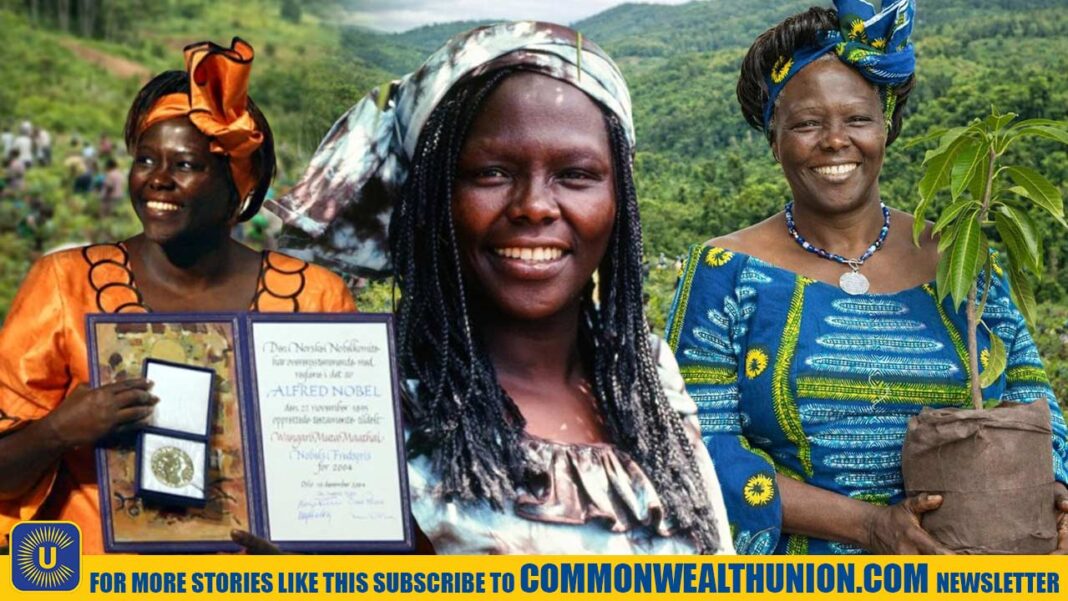

Born in 1940 in rural Kenya, Wangari Maathai grew up to be a remarkable environmentalist, activist and leader whose work transformed landscapes but also people’s lives. Growing up, she always maintained a close relationship with nature. In the years of her childhood, Maathai experienced clean rivers, fertile soil and forests which thrived far beyond her imagination. But as the years went on by, she grew up to witness the nature she loved so dearly disappeared due to the clearing of woodland and poor land management. This connection she developed would later on lead to the shaping of her life’s mission, which focused on environmental conservation and sustainable development.
Without hesitation, Maathai poured all her determination into her education. She eventually became the first woman in East and Central Africa to earn her PhD. After continuing her studies abroad, she returned to her hometown, Kenya, in the late 1960s and was immediately flabbergasted at how the environment had changed. She found that the forests she loved so dearly had all been wiped away, that the clean waters in the rivers she saw growing up had all dried out, and that her people, the rural communities, where especially the women were grappling to find bare necessities such as firewood, clean water and food. She recognised that these challenges extended beyond environmental issues, deeply intertwining with poverty and inequality.
In the year 1977, Wangari Maathai founded the Green Belt Movement, a grassroots initiative that encouraged rural women to plant trees in their communities. What began as a simple idea soon grew into a powerful movement. Women were taught how to grow seedlings, plant trees, and care for the land, giving them both income and independence. Over the years, the movement helped plant tens of millions of trees across Kenya, restoring degraded land and improving livelihoods.
The Green Belt Movement was not solely focused on planting trees. Maathai understood that environmental destruction was primarily connected to the injustices faced by society and the political inequality present. She made it her goal to empower women far beyond their potential by creating a movement that addressed numerous challenges at once. At the core of this foundation were environmental conservation, economic stability, and human rights. The trees provided wood for making fires, prevented soil erosion, protected water sources, and even created small incomes for families.
However, Maathai’s journey was not without its challenges. She often faced significant challenges due to government opposition for speaking out against land misuse and deforestation. She faced critical harassment, got arrested and was publicly shamed and criticised for her determined activism. Despite all these challenges, she maintained her composure and inspired all young women to advocate for their rights. Her belief that ordinary people possessed the power to create change was influential to the most vulnerable hearts and created a long-lasting impression on others. Her courage turned her into a symbol of resistance and hope, not just in Kenya but around the world.
In 2004, Wangari Maathai made history by becoming the first African woman to win the Nobel Peace Prize. The award recognised her unique approach to connecting environmental conservation with peace, democracy, and sustainable development. Her work demonstrated that protecting the environment is essential for building stable and healthy societies.
Wangari Maathai’s legacy continues to inspire generations day-by-day. The Green Belt Movement remains active today, promoting tree planting, conservation, and community empowerment. Her story is a powerful reminder that even small actions, like planting a single tree, can grow into movements that change the world.