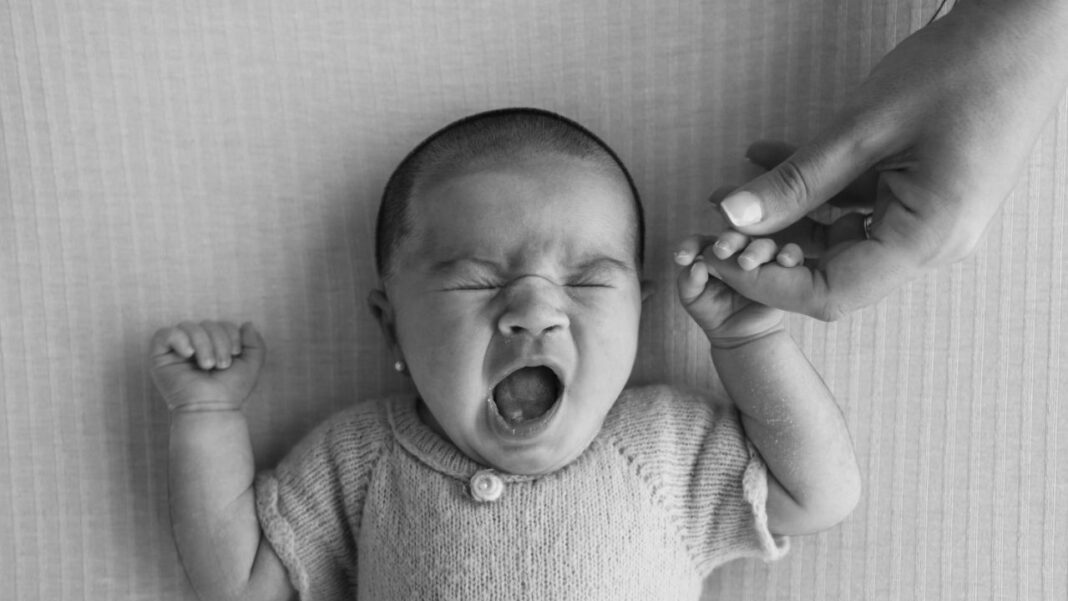


There’s something oddly fascinating about how contagious yawning can be. New research suggests that this simple behaviour might have started much earlier than expected, even before birth. Scientists now believe that unborn babies may “pick up” yawns from their mothers while still in the womb.
This idea comes from a recent scientific study that examined pregnant women and their foetuses in real time. The research study is published in the journal Current Biology. The research team used ultrasound imaging to watch babies inside the womb. At the same time, they recorded the facial expressions of the mothers. This allowed them to compare what the mother was doing with what the baby was doing moments later. One part of the experiment involved showing the pregnant women different videos. Some of these videos included people yawning.
The goal was to see if the videos would trigger a response in both mother and baby. The scientists studied 38 pregnant women. All of them were between 28 and 32 weeks into pregnancy. At this stage, clear foetal movements are visible. To detect minimal changes, the researchers also used artificial intelligence tools.
These helped track tiny movements in the foetuses’ faces, such as mouth and nose motion, which are linked to yawning. The results showed a clear pattern. When a mother yawned, her unborn baby was more likely to yawn as well. This usually happened about 90 seconds later. This delay mirrors the phenomenon observed in adults, where yawning can propagate from one individual to another. However, the researchers noted something important. Simple mouth opening by the mother did not trigger the same response. Only true yawning seemed to matter. Because of these findings, scientists believe the reaction is not random.
It may be a form of early biological connection between mother and child. Researchers suggest a few possible explanations. One idea is that yawning changes how the mother breathes. It can affect chest movement, diaphragm activity, and internal pressure. The foetus may detect these physical changes. Another idea is that yawning could trigger hormone changes in the mother. These hormones might then send signals that the unborn baby can sense.
The authors described their findings as the first strong evidence that foetal behaviour can respond to maternal action in this way. They also argue that their work challenges older beliefs. Previously, researchers often regarded foetal movements as mere reflexes.
Now, researchers suggest they may be more connected to the mother than previously thought. Yawning in the womb actually begins quite early. It has been observed after around 11 weeks of development. At this stage, there is no air in the lungs, so the movement looks different from adult yawning. Instead of taking in air, the foetus slowly opens its mouth, makes breathing-like motions, and then closes it again. It is more like a patterned movement than a true breath.
Earlier research has estimated that unborn babies may yawn about 3.63 times per hour. This suggests it is a regular part of early development. Researchers from the University of Parma conducted the study. Professor Damiano Menin, one of the scientists involved, explained that many animal species exhibit yawning, but its precise purpose remains unclear. He noted that humans begin yawning very early in development, even before birth, and continue the behaviour throughout life.
Overall, the findings suggest that the womb may not be a completely isolated environment. Instead, it could be a space where early interaction between mother and baby already begins in subtle ways.