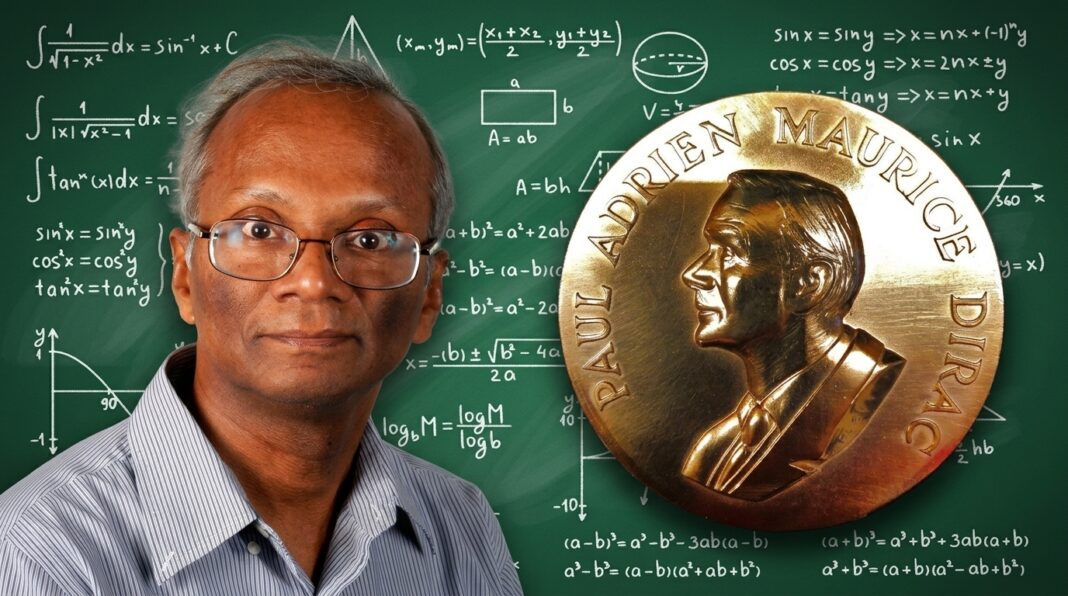

India (Commonwealth Union)_ India has another reason to celebrate as theoretical physicist Deepak Dhar has been named one of the recipients of the prestigious 2026 Dirac Medal for his contributions to statistical mechanics. The honour recognises his work in understanding how simple interactions can lead to complex behaviour in large systems. Dhar is among four physicists receiving this year’s medal from the International Centre for Theoretical Physics (ICTP). The other recipients are Bernard Derrida, Marc Mézard and Haim Sompolinsky. The Dirac Medal, first awarded in 1985, honours scientists who have made significant contributions to theoretical physics.
Also read: How the Sri Lankan and Indian diaspora are powering Canada’s progress!
For India, Dhar’s recognition is particularly significant. He becomes only the second Indian to receive the medal, after string theorist Ashoke Sen, who was honoured in 2012. His achievement adds to a growing list of Indian scientists whose work has earned international recognition. Much of Dhar’s research has focused on statistical physics and stochastic processes. One of his best-known contributions is the Abelian sandpile model. The concept uses a simple example: grains of sand are gradually added to a pile. For a long time, nothing major may happen, but eventually one additional grain can cause a chain reaction and trigger a much larger collapse.
Also read: Meet the Indian-origin CEO ranking just behind Elon Musk: His whopping package will shock you!
This seemingly simple idea has helped scientists study how large and complicated systems can suddenly change. Similar concepts have applications in areas ranging from earthquakes and traffic flow to financial markets. Dhar’s journey to the top of theoretical physics began in Uttar Pradesh, where he was born in 1951. He studied at Allahabad University and IIT Kanpur before moving to the United States for his doctoral studies at the California Institute of Technology. He completed his PhD in 1978 and worked with Nobel-winning physicist Richard Feynman as a teaching assistant. After returning to India, Dhar joined the Tata Institute of Fundamental Research in Mumbai, where he spent much of his career.
Later, Dhar became a professor at IISER Pune, contributing to research and mentoring younger scientists. Since 2024, he has been associated with the International Centre for Theoretical Sciences in Bengaluru as an INSA Distinguished Professor. The Dirac Medal adds to Dhar’s impressive list of honours. He received the Shanti Swarup Bhatnagar Prize in 1991, the Boltzmann Medal in 2022 and the Padma Bhushan in 2023. For India, Dhar’s latest achievement is more than a personal milestone. It is a proud reminder of the depth of scientific talent emerging from the country and the impact Indian researchers continue to make on the global stage.