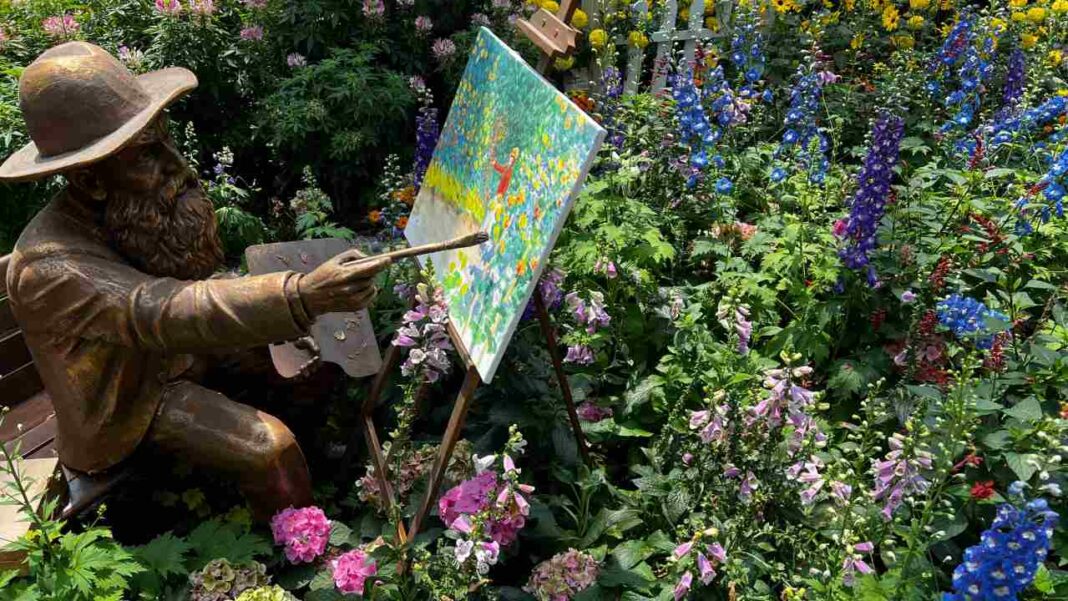

At the School of the Museum of Fine Arts at Tufts, five raised beds sit along Museum Way. They do not grow vegetables. They grow the raw materials for art.This is the fiber and dye garden. Each fall, students harvest the plants inside it. The harvest becomes pigment, ink, paper, and cloth. The beds hold orange cosmos, Hopi black dye sunflowers, safflower, St. John’s chamomile, and rhubarb. Last year, students also grew indigo and flax. Flax can become linen. It can also become paper.
Some of these plants can do more than one thing. Safflower is a good example. Its flowers can produce a soft yellow dye. But if you treat them with an alkaline process instead, they produce a deep red called carmine. Same flower, two very different colors.
Meet the Caretakers
Jamie Atchinson, a BFA student in the class of 2026, cared for the garden last summer. Atchinson watered the beds, planted seeds, picked flowers, and kept a detailed log of everything that happened.
Atchinson wants to teach art someday. For that goal, this kind of hands-on work felt essential.
“It’s important to me to have my hands involved in as many steps of the practice of making as I can,” Atchinson says. Watching the garden move from seed to harvest, start to finish, was the most rewarding part.
Assistant Professor of the Practice Leslie Rogers leads the project. It began in spring 2025. The goal was twofold: grow sustainable art supplies, and give students real experience with community-based art. That means creative work built around a specific place, done together with others.
Rogers sees the garden as part of something bigger. Art has grown very dependent on screens and technology. She thinks that dependence leaves something missing.
“The large and non-optional role of screens and computers in our lives has left a certain deficit,” Rogers says. She calls it exciting, even a relief, to remember that people can live well and make beautiful things without any help from machines. She loves bringing students to the garden to share that kind of knowledge.
Students who care for the garden hold a role Rogers calls the “student butterfly.” This year, that student is Soleil Yoder Salim, who studies psychology and studio art. Salim’s own art focuses on fiber work and papermaking. They were drawn to the garden the moment Rogers first mentioned it, back in a freshman fibers class.
“It’s been a great opportunity to better understand the origins of these processes, and to connect the materials we are using to their source,” Salim says.
From Garden to Quilts
Last fall, Rogers ran a series of community quilting workshops. The dyes came straight from the garden. Many participants had never sewn or dyed anything before. According to Rogers, they quickly “became obsessed with quilting.” Together, they made 14 quilts. The quilts were sold at SMFA’s annual art sale. The money funded student gardening stipends, a new trellis, and more gardening supplies.
The garden also gets support from Tufts’ Office of Sustainability, through its Green Fund. That fund backs sustainability projects across campus. Getting the garden built took real effort from the sustainability committee and the facilities staff. Their work turned a small idea into a working garden.
“Truly, this has been a community effort through and through,” Atchinson says.
A Sense of Belonging
The garden has built community among students, too. Lin Xu, class of 2028, had experimented with natural dyes since middle school. She arrived at SMFA with journals full of that early work. Rogers saw the journals during a student review and invited Xu to join the garden team. In an Introduction to Fibers class, Xu harvested marigolds, cosmos, sunflowers, and indigo for natural-dye demonstrations.
Xu is an international student. For her, the garden has meant something deeper than art supplies.”Here, I found a sense of home, and Leslie has been so supportive in helping me do the things I love,” Xu says. “It’s given me a sense that I belong here.”
That welcome reaches beyond the student body. People walking by, including tourists and museum staff, often stop to look. They ask questions. They compliment the colors. Some even track the plants’ progress over time.
“There’s something about gardening outside that’s extremely disarming,” Rogers says. “The garden strengthened our community connections.”Even people unfamiliar with the idea of a dye garden get curious. They ask about the strange plants. They ask about the SMFA program itself.
“They come so starry-eyed, they want to talk about it, and they express so much love and appreciation for it, walking by every day on their commute, watching it grow all year,” Rogers says. Some tell her they had been waiting all summer just to say thank you. She admits she has been surprised by how much people love it even people who have no background in art at all.