
India (Commonwealth Union)_ Prime Minister Narendra Modi’s visit to Uzbekistan was aimed at taking India’s Central Asia strategy beyond traditional diplomacy. His two-day visit to Tashkent focused on trade, energy, defence, technology, connectivity, critical minerals and people-to-people ties. It was also Modi’s fourth visit to Uzbekistan, underlining the growing importance India attaches to the country. For New Delhi, Uzbekistan is not simply a regional partner. It is an important gateway to Central Asia, a region that matters for India’s energy security, connectivity and strategic interests. Modi’s visit sought to turn political goodwill into practical cooperation.
Warm welcome for PM Modi
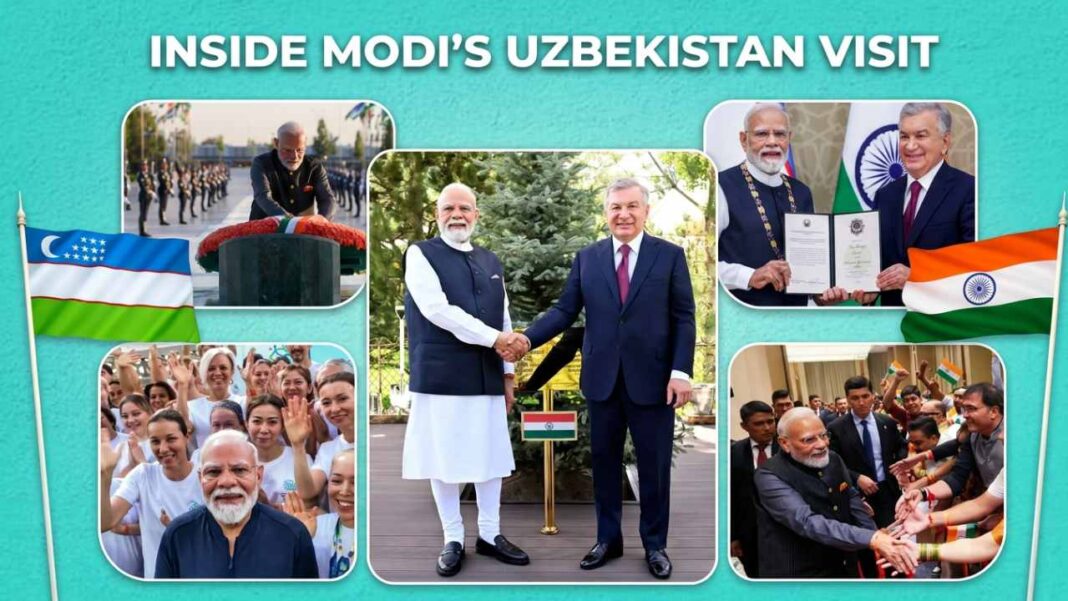
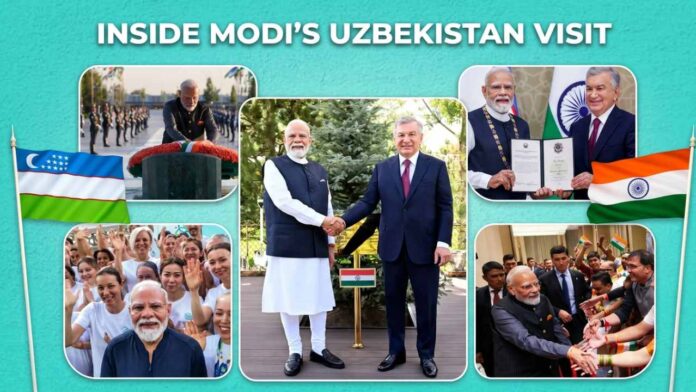
Modi arrived in Tashkent to a warm reception from Uzbek President Shavkat Mirziyoyev. He was given a ceremonial welcome and a guard of honour, while the city was illuminated in the colours of the Indian tricolour. The gesture reflected the close ties between the two countries, which are marking 15 years of their strategic partnership. Modi thanked Mirziyoyev for the hospitality and highlighted the personal warmth shown during his visit. The Prime Minister also visited Yangi Uzbekistan Park and paid tribute at the Independence Monument. He later visited the Shastri Memorial and the Mahatma Gandhi Centre at Tashkent State University of Oriental Studies, linking his current diplomatic mission with India’s long history of engagement with Uzbekistan.
PM Modi meets Indian diaspora
Modi also met members of the Indian community in Tashkent. Cultural performances, including Kathak, Andijan Polka and a fusion of Indian and Uzbek musical traditions, formed part of the programme. The outreach reflected another part of India’s Central Asia approach: using the diaspora and cultural links to deepen ties beyond government-to-government relations. Modi described the Indian community as a bridge between the two countries.
Bilateral discussions
The main focus of the visit was the bilateral meeting with Mirziyoyev. The two leaders agreed to elevate India-Uzbekistan relations to a comprehensive strategic partnership and discussed cooperation across trade, investment, defence, energy, digital connectivity, artificial intelligence, space, cybersecurity, healthcare, pharmaceuticals, education, food security and critical minerals. Trade was a major priority. India and Uzbekistan set a target of taking bilateral trade to $5 billion by 2030. The two sides also discussed greater investment and stronger business-to-business links. Defence cooperation was another key area. Modi called for stronger direct links between the two defence industries, including co-production and co-development. Both countries also welcomed progress in their joint military exercise, Dustlik.
Security discussions focused heavily on terrorism, extremism and separatism. India and Uzbekistan agreed on the need for a strong response against terrorist groups and their financing networks, safe havens and support infrastructure. Connectivity and urban development also featured in the talks. Modi highlighted India’s experience with projects such as Gujarat International Finance Tech-City and offered to facilitate exchanges between Indian and Uzbek officials working on major projects, including New Tashkent. The two sides also agreed to develop sister-city and sister-state partnerships to encourage closer cooperation at the regional level.
Exchange of gifts
The exchange of gifts added a cultural dimension to the visit. Modi presented Mirziyoyev with an Agra marble-inlay decorative plate, two varieties of Kangra tea and a sandalwood Shata Tantri Veena, or Santoor, associated with Jammu and Kashmir. He also presented the Uzbek President with the handwritten scoresheet of Uzbek chess grandmaster Javokhir Sindarov from the 2025 FIDE World Cup final in Goa. For First Lady Ziroat Mirziyoyeva, Modi presented a marble-inlay casket and Banarasi silk stole. The president’s daughter received a silver floral brooch. Uzbek Prime Minister Abdulla Aripov was also presented with an Agra marble-inlay plate and a marble casket with a Banarasi silk stole. The gifts reflected India’s effort to use culture and craftsmanship as part of its wider diplomatic outreach.
Modi conferred the highest award
Modi was conferred Uzbekistan’s highest honour, the Oliy Darajali Do’stlik Order, by President Mirziyoyev. He dedicated the award to the longstanding friendship between India and Uzbekistan. Modi said the honour belonged not just to him, but to 1.4 billion Indians. The honour carried significance beyond the ceremony. It reflected the political warmth between the two governments and the importance both sides place on their relationship.
MoUs signed
The visit produced 11 agreements covering culture, education, tourism, healthcare, mining and environmental cooperation. They were:
- Cultural Exchange Programme (2026-30): To strengthen cultural and people-to-people ties.
- Letter of Intent on Buddhist Heritage Sites: To restore and conserve the Buddhist sites of Fayaz Tepa and Kara Tepa in Termez.
- Archival Cooperation MoU: To promote cooperation between India’s National Archives and Uzbekistan’s Uzarchive.
- Ayurveda and Traditional Medicine MoU: To expand cooperation in Ayurveda and traditional healthcare systems.
- Mining and Geology MoU: To strengthen cooperation in geology and mineral resources.
- Tourism Partnership Programme (2026-28): To increase tourism and promote destinations in both countries.
- Diplomatic Training MoU: To strengthen cooperation in foreign service training.
- Economic and Financial Dialogue MoU: To create a structured platform for discussions on economic and financial issues.
- Environmental Protection Agreement: To expand cooperation on environmental protection and climate-related issues.
- Higher Education and Scientific Research MoU: To encourage academic cooperation and joint research.
- Gujarat-Samarkand Cooperation Agreement: To establish partnership relations between Gujarat and Uzbekistan’s Samarkand region.
- India also announced a $1 million grant for afforestation in the Aral Sea region, 100 Lal Bahadur Shastri Hindi-language scholarships and an ICCR Sanskrit Chair at Tashkent State University of Oriental Studies.
- On digital payments, NPCI International Payments Ltd and Uzbekistan’s National Interbank Processing Centre reached a commercial agreement allowing Indian UPI apps to scan Uzbekistan’s UZQR codes for merchant payments.
Also read: Why is China betting big on BRICS? Chinese President Xi’s India visit sends a global signal!
Uranium deal
Energy security was one of the biggest strategic takeaways from the visit. India and Uzbekistan agreed to work towards a long-term arrangement for uranium supplies. The agreement is important for India’s expanding civilian nuclear program. India has limited domestic uranium resources and depends heavily on imports. Uzbekistan, meanwhile, is one of the world’s major uranium producers and also has reserves of minerals such as copper, lithium and rare earth elements. The new arrangement builds on an earlier uranium agreement signed by India and Uzbekistan in 2019. With India aiming to significantly expand nuclear power capacity, securing reliable supplies from several international partners has become an important part of New Delhi’s energy strategy. The uranium agreement also shows how India’s engagement with Central Asia is increasingly driven by economic and strategic needs, rather than diplomacy alone.
Other engagements
Modi’s programme also included a yoga-related event, where he praised Uzbekistan’s efforts to popularise the practice. He recalled Uzbekistan’s participation in the World Yogasana Championship in Ahmedabad and highlighted the growing cultural connection between the two countries. Soon after arriving in Tashkent, Modi visited Yangi Uzbekistan Park and paid tribute at the Independence Monument. He also visited the Shastri Memorial and the Mahatma Gandhi Centre, highlighting the long-standing cultural ties between India and Uzbekistan. The prime minister also used his visit to underline historical links. Tashkent has a special place in India’s political memory because former Prime Minister Lal Bahadur Shastri signed the Tashkent Declaration there in 1966.
India-Uzbekistan relations
The relationship between India and Uzbekistan has expanded steadily into trade, pharmaceuticals, education, IT, culture, defence and investment. Last year, the total bilateral trade touched USD 1.3 billion. Easier travel is expected to add another boost, with Uzbekistan moving towards visa-free stays of up to 30 days for Indian citizens. The two countries also have 14 direct flights a week, supporting tourism, business and people-to-people exchanges. For Modi, these developments fit into a broader strategy of building stronger Indian links across Central Asia. Uzbekistan offers opportunities in energy, minerals, trade and connectivity, while India brings strengths in technology, pharmaceuticals, education and digital services.
Why is Modi’s Central Asia visit important?
Central Asia has become increasingly important to India as geopolitical competition grows and global supply chains change. India wants reliable access to energy and critical minerals while also expanding its strategic presence in a region where several major powers are competing for influence. Modi’s Uzbekistan visit reflected this wider approach. Rather than focusing on a single issue, India is building a broad partnership covering security, trade, technology, culture and energy. The visit also showed that New Delhi views Central Asia as a long-term partner rather than a distant neighbourhood. Uzbekistan, in particular, is emerging as a key part of that strategy.
Concluding the visit
After Uzbekistan, Modi travelled to Bishkek for the Shanghai Cooperation Organisation summit. His Central Asian outreach comes as India seeks a stronger regional role through platforms such as the India-Central Asia Dialogue and the upcoming India-hosted Central Asia summit in 2027. The Uzbekistan visit therefore went beyond ceremonial diplomacy. From uranium and critical minerals to defence, digital payments, tourism and education, Modi’s agenda reflected a practical approach to Central Asia, strengthening old ties, creating new economic links and building partnerships that serve India’s long-term strategic interests.