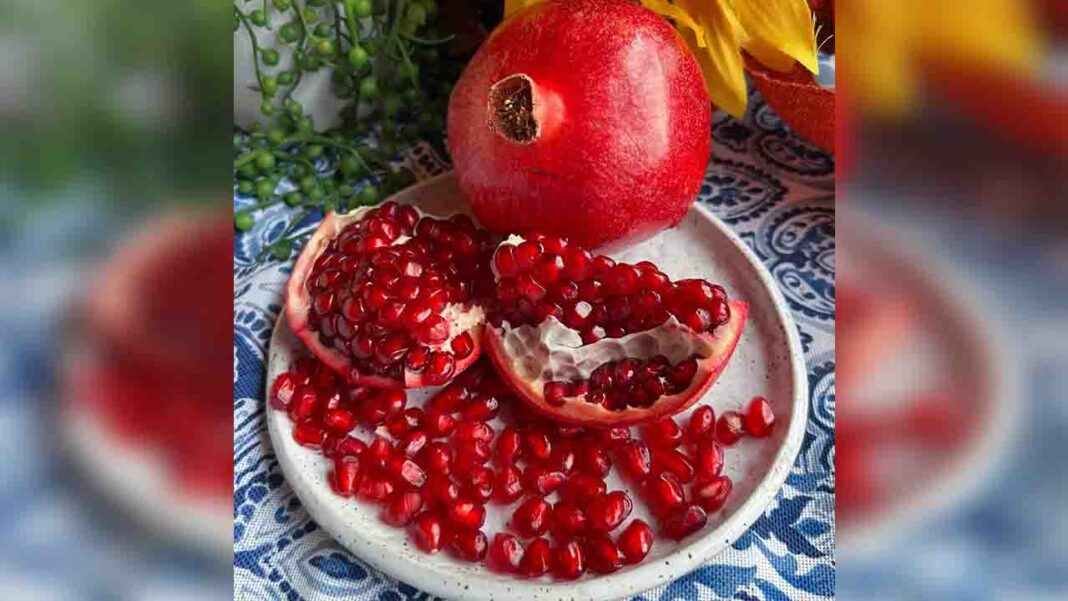

Renowned for its regal crown and deep red allure, the pomegranate stands out as one of the most visually captivating fruits. Yet, its external charm only hints at the myriad wonders concealed within this super fruit. Beyond its aesthetic appeal, the pomegranate delights with a sweet-sour flavor and boasts a high antioxidant content, captivating both manufacturers and consumers alike (University of Florida: IFAS – Extension, 2013). Not limited to the seedy fruit alone, the leaves and flowers of pomegranate trees find use in the creation of teas.
Exploring the Pomegranate: Belonging to the family Punicaceae, the pomegranate (Punica granatum L.) holds a unique status with only one genus and two species, with the latter, Punica protopunica, found on the island of Socotra and lacking economic significance. Native from Iran to the Himalayas, the pomegranate has a rich history, cultivated since ancient times across the Mediterranean regions of Asia, Africa, and Europe. Introduced to California by Spanish settlers in 1769, the state has now become the largest grower of pomegranates in the United States (Purdue University, 1987; NASS, 2018).
Navigating Marketing Channels: The pomegranate’s marketing season typically spans from September to October, with arils (the ruby red juicy coating surrounding the seeds) being a sought-after delicacy. Recognizing the challenge for consumers in extracting arils, offering pre-packed, ready-to-use arils adds significant value (Pomegranate Council, 2011). Additionally, the health benefits of pomegranate juice, known for its high antioxidant and anti-inflammatory properties, make it a valuable product, often blended with other antioxidant-rich fruits. Pomegranates’ versatility extends to their role as decorations during fall and winter, whether displayed fresh or dried (University of Florida: IFAS – Extension, 2013; Pomegranate Council, 2011).
Insights into Production: Recent data from the 2012 Census of Agriculture reveals a substantial increase in pomegranate farms and acreage in the U.S. California dominates the pomegranate production landscape, contributing over 90 percent of the total yield. Despite facing the challenges of a prolonged drought, the nutritional value of pomegranates remains unaffected (NASS, 2014; CDFA, 2015; NPR, 2014). Effective Management Strategies: Guiding pomegranates to grow as large shrubs facilitates easier management. Regular removal of suckers and careful irrigation, particularly in regions with hot, dry summers, ensures optimal fruit production. Picking pomegranates at complete maturity, using proper harvesting techniques, and protecting the fruit from sun exposure are vital management actions for quality yield (Texas A&M – AgriLife Extension; Purdue University, 1987).