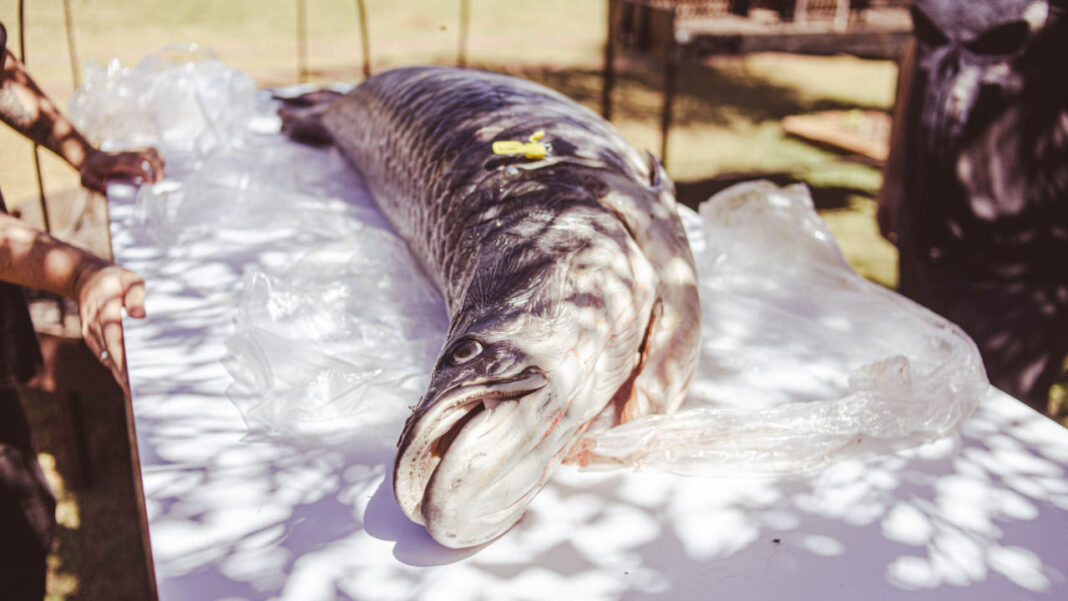

Lake sturgeon swimming in the Great Lakes today may be older than we ever imagined. Some could have been alive when the Declaration of Independence was signed in 1776. That is the striking finding from a new study by the Michigan Department of Natural Resources and Michigan State University. Researchers now believe we have badly underestimated how long these fish can live.
Lake sturgeon are already known as one of North America‘s longest-living freshwater fish. But this new research suggests their true lifespan goes far beyond earlier estimates. Scott Colborne, an assistant professor at Michigan State University’s Department of Fisheries and Wildlife, helped lead the study. He says the numbers are surprising even to experts who already knew that sturgeon live a long time.
The study looked at five sturgeon populations across the Great Lakes. Scientists used long-term capture and recapture records collected over many decades. Their findings suggest that in some of these populations, many sturgeon regularly live past 200 years. A few individuals may even approach 300 years old.
For a long time, scientists judged a sturgeon’s age by counting rings inside its fin spine, much like counting rings in a tree trunk. This method worked well for younger fish. But as sturgeon grow older, those rings become harder to read clearly. Researchers began to suspect the method was causing them to underestimate the true age of the oldest fish.
To dig deeper, Colborne’s team turned to one of the biggest long-term sturgeon datasets ever collected. It included records from tagged fish that had been measured again and again over the years.
This allowed researchers to track how slowly sturgeon continue to grow throughout their entire lives. They used statistical modeling techniques similar to those once used to estimate the age of Greenland sharks, another famously long-lived species.
These new findings matter for conservation efforts. Lake sturgeon grow slowly, take many years to reach maturity, and reproduce only occasionally. Because of these factors, their populations can take decades to recover after a decline. Knowing a more accurate lifespan helps scientists better understand survival rates, population growth, and how harvesting or habitat restoration affects sturgeon numbers over time.
None of these findings would have been possible without decades of patient fieldwork. University scientists, tribal nations, and state agencies worked together for years, tagging and tracking sturgeon across the Great Lakes region. Colborne says this long-term commitment was the real key to the discovery. Without decades of careful data collection, he says, questions like these could never be answered.
Colborne personally recalled a significant moment from the research. While speaking with a member of a tribal community, he learned something remarkable. Some Indigenous communities have long believed lake sturgeon can live up to 400 years. Colborne called it a goosebump moment. Modern scientific modeling was now pointing toward something Indigenous knowledge had recognized long before.
Even with these new estimates, many questions remain. Scientists still do not fully understand the biology that allows sturgeon to live so long. The study may also encourage researchers to reconsider how they estimate the age of other long-lived fish species around the world.
Despite the uncertainty, Colborne sees a hopeful message in the findings. He explains that sturgeon are naturally resilient and adaptable animals because of how they live and grow. Given the chance to survive, he believes they will continue to thrive. After all, these ancient fish have already survived for millions of years on Earth.
The research was funded through a State Wildlife Grant provided by the Michigan Department of Natural Resources, continuing a long tradition of state-supported conservation science.