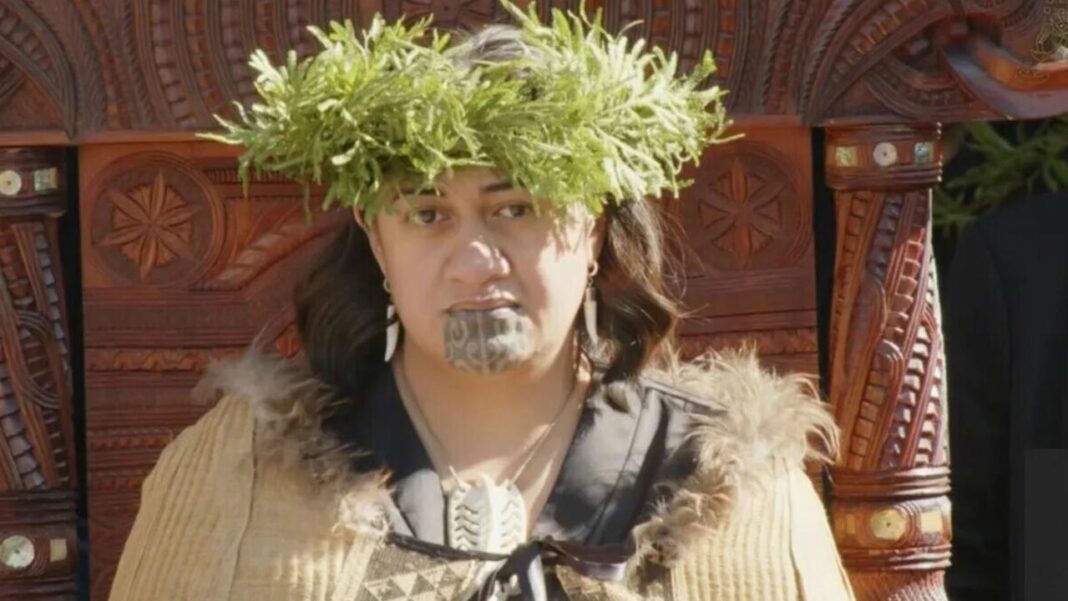

World (Commonwealth Union) _ Ngā Wai hono i te pō has been crowned as the eighth Māori monarch in New Zealand, succeeding her late father, Kiingi Tuheitia Pōtatau Te Wherowhero VII, who passed away at the age of 69. The 27-year-old was chosen as “kuini”—the Māori word for queen—by a council of Māori chiefs in an elaborate ceremony held on New Zealand’s North Island.
The new queen is only the second Māori queen, following in the footsteps of her grandmother, Te Arikinui Dame Te Atairangikaahu. She is the youngest child of Kiingi Tuheitia, who died last Friday after suffering from heart complications post-surgery, just days after celebrating the 18th anniversary of his coronation.
The coronation ceremony took place at Tūrangawaewae Marae, the seat of the Kiingitanga or Māori King Movement. The new queen was announced while sitting on a carved wooden throne and blessed with the same Bible that was used to anoint the first Māori king in 1858. She wore a wreath and a traditional cloak as prayers and chants were performed ahead of her father’s burial.
A flotilla of waka (war canoes) then transported the late king to his final resting place on Mount Taupiri, a sacred site for the Māori people. King Tuheitia had lain in state for six days before his burial, and his coffin was accompanied by a haka dance, a traditional Māori performance, during parts of the emotional funeral ceremony.
The naming of Ngā Wai hono i te pō as queen marks a generational shift in the Māori monarchy and is viewed by many as a gesture of renewal and a positive influence on younger Māori members. The new queen holds a master’s degree in Māori cultural studies and teaches kapa haka, the Māori term for performing arts, underscoring her deep connection to Māori culture and heritage.
King Tuheitia, born Tūheitia Paki in 1955, was crowned in 2006 following the death of his mother, Te Arikinui Dame Te Atairangikaahu. He was regarded as a unifying figure who recently called on Māori to stand together in the face of policies perceived as targeting them. His passing is seen as a significant loss for followers of Te Kiingitanga, Māori communities, and the entire nation.
Rahui Papa, spokesperson for the Kiingitanga movement, described the king’s death as “a moment of great sadness.” Chris Hipkins, leader of New Zealand’s opposition Labour Party, praised King Tuheitia as “a fantastic king with a wicked sense of humor,” while Prime Minister Christopher Luxon lauded him as a leader “whose commitment to Māori and all New Zealanders has been felt right across the country.”
The Māori monarchy dates back to the 19th century when various Māori tribes decided to create a unifying figure akin to a European monarch to prevent the widespread loss of land to British colonizers and preserve Māori culture. Although largely ceremonial, the role has been significant in promoting unity and solidarity among Māori communities.
The official period of mourning for Kiingi Tuheitia was extended from the usual three days to seven, reflecting the magnitude of his influence and to accommodate the numerous delegations that came to pay their respects.
Mereana Hond, a Māori journalist, reflected on the profound impact of King Tuheitia’s death, noting, “We have lost a king who was rising in prominence, leading all tribes of Aotearoa/New Zealand at a time when we’re under a lot of political and social pressure under this coalition government.”
The ceremony and coronation occur amid heightened political tensions in New Zealand regarding Indigenous rights. Last year, protests erupted against government plans to reverse policies supporting Māori rights, including plans to close the Māori Health Authority, Te Aka Whai Ora. Critics have accused Prime Minister Luxon’s government of being anti-Māori, highlighting the importance of leadership figures like King Tuheitia and now Queen Ngā Wai hono i te pō in advocating for Indigenous rights and unity.
The coronation of Ngā Wai hono i te pō as the new Māori queen marks both a new chapter for the Māori monarchy and a symbol of hope and renewal for the Māori community. As the Māori monarchy continues to evolve, it remains a powerful symbol of unity, resistance, and the preservation of Māori culture and heritage in New Zealand.