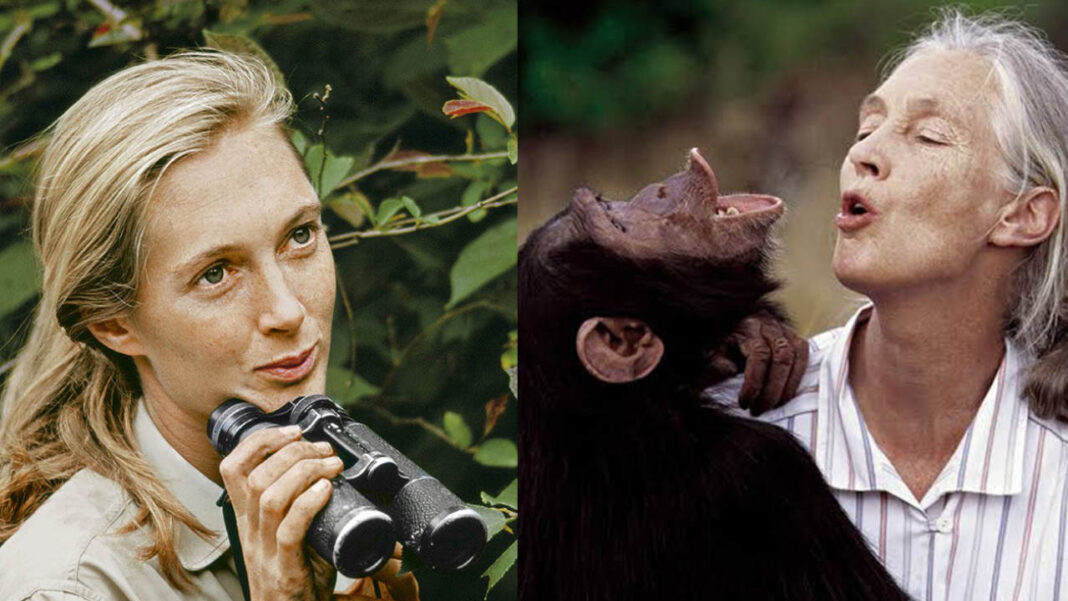

Jane Goodall‘s life began with a childhood fascination that gradually led her from England to the forests of Tanzania, both Commonwealth countries, where she revolutionized the study of chimpanzees and emerged as a prominent advocate for conservation.
Born Valerie Jane Morris-Goodall on April 3, back in the year of 1934, in London, she was the daughter of Mortimer Herbert Morris-Goodall, who was a businessman and writer, and Margaret Myfanwe Joseph. Her mother from young days encouraged her interest in animals. A stuffed chimpanzee who was named Jubilee became one of her favorite childhood companions, while her curiosity once led her to hide in a henhouse for hours because she was keen to discover how a chicken laid an egg. During the Second World War, her family moved to Bournemouth, where she ended up spending most of her childhood. She grew up surrounded by books about animals and became captivated by stories such as Tarzan and Dr. Dolittle. As a young girl, Goodall developed an early dream of travelling to Africa and living among wildlife, similar to the characters she admired in her books.
Goodall did not follow the conventional academic route into science. After leaving school, she worked as a waitress and secretary while saving money for her ambition, which she dreamed of for almost her entire life. In 1957, at the age of 23, she packed her bags and landed in Kenya, a very prominent Commonwealth country, after accepting an invitation to visit a school friend’s family farm. There she met the paleoanthropologist, Louis Leakey. Impressed by her patience and determination to understand animals, Leakey eventually asked her to undertake a study of wild chimpanzees.
3 years later, in 1960, when she became 26, Goodall arrived at what was then the Gombe Stream Chimpanzee Reserve in Tanganyika, now Tanzania. Her research began on July 14, and her mother accompanied her during the early period. Without a university degree or formal scientific training, Goodall spent months patiently observing and analysing chimpanzees. With her tireless effort, she ended up gradually earning their trust. Instead of just identifying them only by numbers, she gave individual animals names, developing a strong bond that allowed her to document their distinct behaviors and relationships.
Her observations produced findings that challenged conventional scientific understandings. In 1960, she saw a chimpanzee who was named David Greybeard, making and using tools by modifying twigs to obtain termites from their nests. At the time, toolmaking was more commonly understood as a unique human ability. Goodall also documented chimpanzees hunting and eating meat, which ended up challenging the idea that their diets were primarily vegetarian. Her work ended up helping the scientific understanding of animal behavior and the similarities between humans and other species broaden.
Goodall later earned a PhD in ethology from the University of Cambridge in 1966, even though she entered the program without an undergraduate degree. In 1977, she founded the Jane Goodall Institute. The institute is very well known for its continuous research, conservation, and animal-welfare initiatives. In 1991, she created Roots & Shoots, which is a youth program that helps in encouraging young people to take action for communities, animals, and the environment.
Her career went far beyond research. After becoming increasingly concerned about threats to chimpanzees and their habitats, she devoted much of her life to conservation and advocacy. She became a United Nations Messenger of Peace and kept successfully motivating audiences worldwide.
Goodall, unfortunately, passed away back in October 2025 at age 91. However, the work connected to her vision continues to grow and inspire so many people even as few years have gone by. Her story continues to be an example of how curiosity nurtured in childhood can end up developing into a lifetime of scientific discovery, conservation, and action.