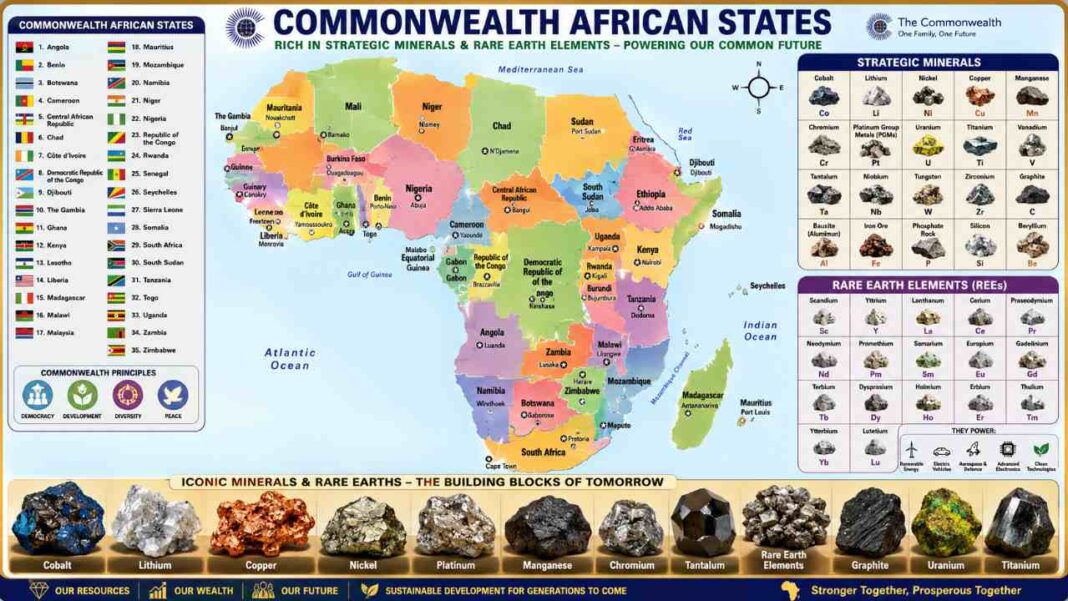

The Compendium of Africa’s Strategic Minerals reframes the continent’s mineral endowment. This information is from a catalogue of resources for a system-level economic proposition. It reflects that Africa’s mineral challenge is one of conservation. It turns resources into infrastructure, industrial capacity, & regional value chains. It links minerals to power, transport, industrial zones, demand fundamentals, & global supply-chain dynamics. The compendium identifies where coordination may materially improve project economics and where beneficiation is commercially viable. Also, Africa may anchor durable positions in both the regional & global value chains. As such, its key message is clear. Africa’s mineral wealth becomes transformative only when embedded in infrastructure. Also, in aggregate demand, besides in integrated industrial systems.
Key findings
Africa could become more intentional in deepening its Geological Data Ecosystem
Africa hosts one of the world’s most diverse and strategically significant mineral endowments. The estimated mine site value in Africa is USD 29.5 trillion. That’s approximately 20% of the global total (I). Of this, USD 8.6 trillion remains underdeveloped. That’s equivalent to approximately 2.5 times the continent’s annual GDP.
Ø Africa’s estimated USD 8.6 trillion in underdeveloped mineral assets remain largely latent. This is because the continent is structurally underexplored. As such, improving data availability & quality is imperative to address elevated risk perceptions, besides derisking investments across the value chain.
Ø Building on this foundation, the African Finance Corporation (AFC) invites governments, regional institutions & private-sector partners to partner with them in deepening Africa’s geological data ecosystems. Furthermore, improving data quality is a key tool to de-risk investments in the sector.
(I) Mine-site values are derived from the MinEx Global Deposits Database. It refers to the estimated gross in-situ value of mineral resources at the mine gate. This is before processing, transportation, royalties, taxes, or operating costs.
Benefaction works where demand may be anchored regionally
Across Africa, mineral beneficiation remains uneven. Also, it is underscaled or disconnected from downstream demand, which limits the potential for economic growth and industrial development in the region. A more durable approach needs to reframe African minerals as anchors for regional industrial demand clusters that reflect the continent’s long-term growth fundamentals.
Africa represents the world’s largest upside in future demand for power, construction materials, food inputs, manufactured goods, & digital infrastructure. All of them are mineral-intensive. This demand directly leads to the creation of essential development clusters.
ü Infrastructure to expand railways, build ports, or factories needs steel & ferro. Also, alloys along with construction materials involving inputs made of aluminium, mineral sands or fluorspar
ü Clean technologies & electrification (batteries, renewables, besides energy-transition materials) to bridge Africa’s energy deficit, requiring copper, aluminium, cobalt, rare earths, graphite, silver or uranium
ü Fertilisers to grow agricultural yields & achieve food self-sufficiency include a large share of phosphate besides potash rocks.
ü Portable devices & electronics to equip
ü The workforce of the future is anchored in tin, titanium, tungsten & battery minerals.
ü Automotive & machinery need lead & PGMs for traditional internal combustion engines. Alternatively, lithium, nickel, rare earths, manganese, cobalt, or graphite could be used for EV batteries.
Infrastructure is more than an Enabler
Africa’s ambition to localise mineral supply chains only becomes economically meaningful when minerals are embedded in functional infrastructure ecosystems. Power cost & reliability, logistics availability, access to industrial land, & trade capacity ultimately set the ceiling on beneficiation, besides value capture.
For this purpose, the Compendium introduces a continent-wide minerals & infrastructure map which identifies all operating mines besides underdeveloped deposits. It links them to railroads, ports, and major power generation hubs.
Trade & geo-economic realignment is elevating the strategic relevance of African minerals
Global mineral supply chains are under growing pressure from trade tensions. Additionally, there are export controls, shifts in industrial policy, and concerted efforts to reduce concentration risk. Africa’s scale of mineral endowment & its broadly non-aligned positioning constitute genuine strategic advantages, although only if applied selectively & pragmatically.